
Where Have All the Christians Gone?
By Sam Redding
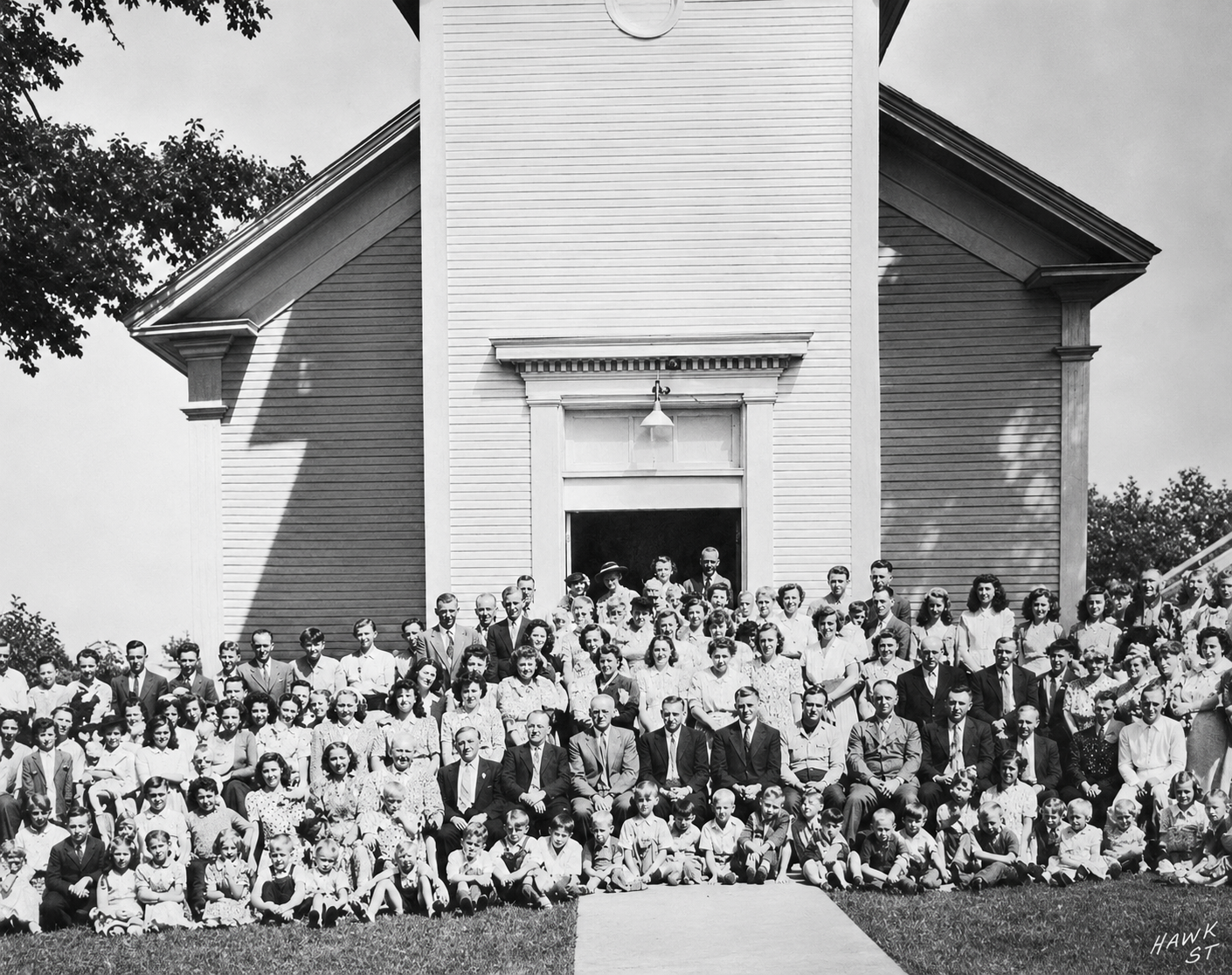
Towanda Baptist Church (now First Baptist Church of Towanda) about 1953.
This Star Hitchers story is about one church in a small town that may reflect national trends. Tell your story at StarHitchers.com. Subscribe FREE at starhitchers.substack.com.
The Story
The village of Towanda in central Illinois has maintained essentially the same population—450—that it had at the end of World War II. In 1945, Towanda boasted three churches—Methodist, Presbyterian, and Baptist—a familiar trio of Protestant denominations in small-town America.
Two subdivisions, Lamplighter and Indian Creek, sprang up just beyond the village limits in the 1970s, roughly doubling the population of the surrounding community. But only one of the three churches remains: First Baptist Church. Its Sunday attendance has dwindled to a dozen or so, yet a small congregation continues to hope for renewal.
Knowing this town and this church as I do, I wondered whether their experience reflects national trends for small towns and their churches. First, a look at those trends. Then, a walk through the history of the churches in one small town. Then the reflections of church members.
Looking at the Trendlines
The decline of the small-town church is part of a much larger change in American religious life. In 1944, a Gallup survey found that 75 percent of Americans belonged to a church or other house of worship. As recently as 1999, the figure was still 70 percent. By 2023, it had fallen to 45 percent. Traditional mainline Protestant denominations have been particularly hard hit. Pew Research Center found that the share of American adults identifying as mainline Protestants declined from 18 percent in 2007 to about 11 percent in 2023–24.
Small-town America has also changed. In 1940, 43.5 percent of Americans lived in areas classified by the Census Bureau as rural. By 2010, that proportion had fallen to 19.3 percent. The definitions of urban and rural have changed over the years, but the figures illustrate the nation's movement toward urban and suburban living. These numbers, however, tell us little about the fortunes of individual towns. Some lost population. Others remained stable, while still others grew into larger communities.
Towanda is one of the towns that remained remarkably stable, even growing with the development of homes on its outskirts. Its churches did not.
Three Churches on Money Creek
The Baptist, Methodist, and Presbyterian churches began as small clusters of settlers around Smith's Grove on Money Creek in the 1850s. They met in homes and later in a schoolhouse.
According to early church records reported in a 1976 history of Towanda, at one point the “sprinkling professors,” by which they meant people who professed sprinkling infants as a form of baptism, locked the door to the Baptists. The fledgling congregation moved to town, constructing first a log building and later a frame church.
By 1870, all three congregations had constructed church buildings in Towanda.
My family moved from Kansas to Illinois in 1955 when my father accepted a job as business manager for a construction company formed by the minister of our Methodist church. The company had moved to Illinois to build highways.
That minister, Amos Barton, was, in fact, a Baptist. Years later, he became president of Judson College, affiliated with the American Baptist Convention.
We intended to be Methodists in Towanda, as we had been in Kansas. But ten years earlier, in 1945, the Methodists and Presbyterians had combined. The big, brick Presbyterian church was abandoned, and both congregations met as one in the Methodist Church, now reorganized as a Community Church.
The Community Church seemed familiar to us, much like the Methodist church we had attended in Kansas, the one my dad had grown up in.
We sang the old hymns: Softly and Tenderly, Just as I Am, Amazing Grace, Blessed Assurance. Solid Protestant fare. Piano accompaniment, no organ.
To earn my God and Country award from the Boy Scouts, I helped Cassie Livingston clean the church on Saturdays and rang the bell on Sunday mornings. I remember the scent of furniture oil rising from the freshly polished pews and the bell rope tugging me upward as the bell swung back and forth.
The church was sometimes led by a Presbyterian pastor, sometimes by a Methodist one.
In my eighth-grade year, the Methodist pastor left, and the church brought in a graduate of Bob Jones University, an evangelical institution with a theology quite different from the Methodist and Presbyterian traditions.
The new preacher at the Community Church was a fire-and-brimstone orator. He soon attracted strong advocates, including a group of older high school students. During Bible School the summer after eighth grade, I "went forward," as the Baptists would say, and was "saved" by the new preacher. He later baptized me by immersion in Money Creek.
None of this seemed very Methodist or Presbyterian. The Community Church had taken on a more evangelical, Southern Baptist flavor in a town where the only other church was Northern Baptist.
When the preacher began railing against the teenage dances held at the Community Building on Saturday nights, my parents finally decided to leave. We became Methodists again, driving each Sunday morning to Normal to attend the church on the perimeter of the university campus.
My parents were happy as Methodists in Normal; I wasn't. I wanted to be back with the Towanda kids, in a small church, in our own town. I'm not sure my complaints persuaded my parents to change churches again, but after a year at First Methodist in Normal, we tried Towanda Baptist.
Towanda Baptist was affiliated with the American Baptist Convention, the Northern Baptist tradition. Today, American Baptist Churches USA is considered part of mainstream Protestantism. My Methodist parents were comfortable there, in a branch of the Baptist tradition that, except for baptism by immersion, seemed almost Methodist.
We liked it. Before I knew it, my dad and brothers, previously baptized by sprinkling as Methodists, were being immersed in the baptistry. My dad became an elder, and my mother taught Sunday School. I horsed around in Sunday School, happy to be with buddies and schoolmates, some of whom had made the same migration from Towanda Community Church to Normal Methodist to Towanda Baptist.
A Church Full of Memories
Those days at the Baptist church remain vivid to me. Lyle Merritt greeted the congregation, made announcements, and directed us to turn to number 243 for the opening hymn. He often called on my dad, Brother Roy, to offer the opening prayer.
I can hear Armeda Anderson's voice, distinct and robust, rising above the others and hitting the high notes in Love Lifted Me. I hear my dad's happy, melodic intonations. My mother, whose dream was to sing sweetly like my dad, tried her best to stay on key in her flat Kansas twang. My three brothers and I squirmed in the hard wooden pews.
At home, my brothers complained that Mary Ellen, a girl their age, was allowed to color in a coloring book during church. We were not. Unfair.
I can name a succession of preachers and the nicknames the kids gave them. Spider Man and The Griper come to mind. The teacher of our high school Sunday School class we called Ace, for no reason I can recall.
While in college, I filled in with a sermon when a preacher was absent. My younger brother Rod, at sixteen, was elected a deacon. My youngest brother, Gary Mel, grew up to become a Southern Baptist minister. I didn't stick with it.
My parents remained mainstays of Towanda Baptist. I married a Lutheran and joined her church. My wife and I moved away from Towanda but returned to the church often; my parents were still there. My kids spent summers with their grandparents and attended Bible School at Towanda Baptist. My daughter and her husband eventually built a home in Towanda, and my grandchildren attended Sunday School and Bible School for a time.
I remember Barney Moore, our preacher, and his wife Velma and sister-in-law Maxine Sewell, who favored us with musical specials. Barney was like the men I remembered from our early days at the church, Perry McKay, Mallard Miller, and John Richards. They had been through hard times, some of them having experienced the war and all of them the Depression. They were steeped in Bible stories and told them in a way that made you think they were there at the time. The Bible characters were like people down the street that the storytellers knew.
Barney was with us in a dark hospital room the night my brother Kent died. The funerals for my brother and my mother were held at Towanda Baptist, the pews were filled and people stood along the walls. My cousin Beth Anne from Tennessee read the eulogies my brothers and I had prepared.
Over the Fourth of July celebration, which was a huge event in the village, my brother Gary, by then a Baptist preacher with a doctorate in theology, often came home and preached a sermon at the church. His daughters Briana and Emily provided special music.
On my visits over the decades, the tiny church with the tall white steeple remained a happy, inviting place for me, full of memories from the few years I regularly occupied its pews.
In 2006, the church celebrated its 150th anniversary with an impressive slate of church officers and members. All seemed well.
My mother's funeral was in 2009. Rev. Gowen presided; his Virginia accent betrayed a deep Baptist heritage. He knew my mother and spoke of her personally. Like every family funeral, In the Garden brought us to tears.
Fifty years after leaving Towanda, my wife and I returned. My dad was 100 by then, but no longer attending church. Towanda Baptist was down to a handful of members. We opted to attend a small Methodist church in the country not far from us.
Then Dad died, at 103. His funeral was held at Towanda Baptist, and once again the pews were full of family and friends. This time cousin Eric from Wisconsin read the eulogy we had prepared. Pastor Jack Moody, a Navy veteran like my dad, told what he knew of my father. It seemed like the church of my youth. A few of the same faces, but mostly different ones.
From afar, I hadn't realized how steeply the Baptist church had declined. But something had happened over the years. The record of new baptisms had slowed after 2000 and came to a near stop by 2009, the year of my mother's funeral. Only three baptisms have been recorded since—and this is a Baptist church.
Something had let the air out of the Baptist Church's tires. We had noticed, not long after my mother died, that Dad was no longer attending.
At that time, just a few years ago, in the only church remaining in Towanda, a dozen or so people gathered on Sunday for the message. No one played the piano. A retired preacher, in town only on Sunday, did his best.
To honor my father and reconnect with memories of days gone by, I began attending Bible Study on Tuesday nights at the church. Vaughn, a man I had known since grade school, led the group. Typically, six or eight of us gathered to read a chapter from the Bible.
Before long, the preacher, a retired businessman who had served the church for a few years, left. Our Bible Study group shrank by one.
In time, the church persuaded a very able retired minister, Pastor Mike Talbert, to take on the challenge of serving as pastor of the only church in town. His wife, Sally, plays the piano. His son, Daniel, has read the Bible ten times. They all attend Bible Study and enrich the discussion.
Things may be rebounding for the Baptists in Towanda. They have a capable pastor and a small core of dedicated congregants. But much has changed since Towanda Baptist became First Baptist Church somewhere along the way. Also along the way, the congregation went independent, severing its ties with the American Baptist Convention.
What can we make of the history of the three churches in Towanda and of the only remaining church? Decline has been the order of the day in recent decades, according to the statistics. Can we learn why by looking close at one small church in a small town?
What Happened, and Where Does the Church Go From Here?
A picture on the wall in the church’s entryway shows a couple hundred people posing in front of the church in the 1950s. Where have all the Christians gone?
I asked this question of the Bible Study group one Tuesday night. Their answers varied.
Some thought the COVID epidemic was to blame. But others thought the church was in decline before that and COVID only accelerated the drop.
One member noted that twice in his memory the church had been split by controversy. Doctrinal, I asked? Somewhat, he conjectured, but also personalities.
One controversy was over the congregation’s decision to leave the American Baptist Convention. Some were opposed and left the church. What precipitated the move away from the Convention, I asked.
It was when churches in Chicago started hiring gay preachers, one responded. Coming from a Lutheran church and attending a Methodist church, that sounded familiar. But still, where did these people go, if anywhere? There was no other church in town.
Perhaps people were drawn to the big churches in Bloomington and Normal, including a megachurch just three miles from Towanda. “They just want to be entertained,” added one. Perhaps. But they couldn’t name names.
More likely, folks went nowhere. Stay home. Grow old.
The preacher’s wife reminded me that I had told them that when I was a boy, I wanted to change churches from the big Methodist church in Normal to the little Baptist church in Towanda because my friends from school went there. When we tried the church, my parents liked it too. “You were drawn there for social reasons,” she observed.
She was right. No big doctrinal concerns in my fourteen-year-old mind at the time. But then, my family left the Community Church when doctrine and practice had taken an abrupt turn. Hard to put your finger on just why people change churches and leave altogether. But lots of people do.
Where does the church go from here? The coming Sunday, Pastor Mike is scheduled to baptize a 29-year-old woman who has been attending church. That is a big step forward, and this remnant of churchgoers in the town is hopeful.
Threads to Follow
Threads to Follow are questions to prompt further discovery, conversation, and discussion.
What do you think contributed to the disappearance of the Methodist and Presbyterian congregations? Does the time period in which they combined tell us anything about the reasons?
How much do you think denominational disagreements and church controversies contributed to the decline of First Baptist? Does this explain any of the national trends?
What does the future look like for small-town churches when the population remains stable but the congregation grows older?
What do you think small-town churches can do to reverse decline and thrive?
Sources and Further Reading
National Church Membership
Gallup, How Religious Are Americans? Historical data on U.S. church membership, including the 1944, 1999, and 2023 figures. Gallup
Religious Identification
Pew Research Center, 2023–24 Religious Landscape Study, February 2025. Data on changes in American religious identification and the decline of mainline Protestantism. Pew Research Center
Rural and Urban Population
U.S. Census Bureau, Measuring America: Our Changing Landscape, December 2016. Historical rural and urban population figures. U.S. Census Bureau
Towanda Church History
Mildred Hirst Roberts and Elizabeth Jones Winter (1976): Towanda, McLean County, Illinois, 1826-1976
Historical records of First Baptist Church of Towanda, including baptism records and church membership information.