
Story 01: Endurance
The Dogged Tenacity of Thomas Jefferson Gillihan (1828/32-1909)
By Sam Redding
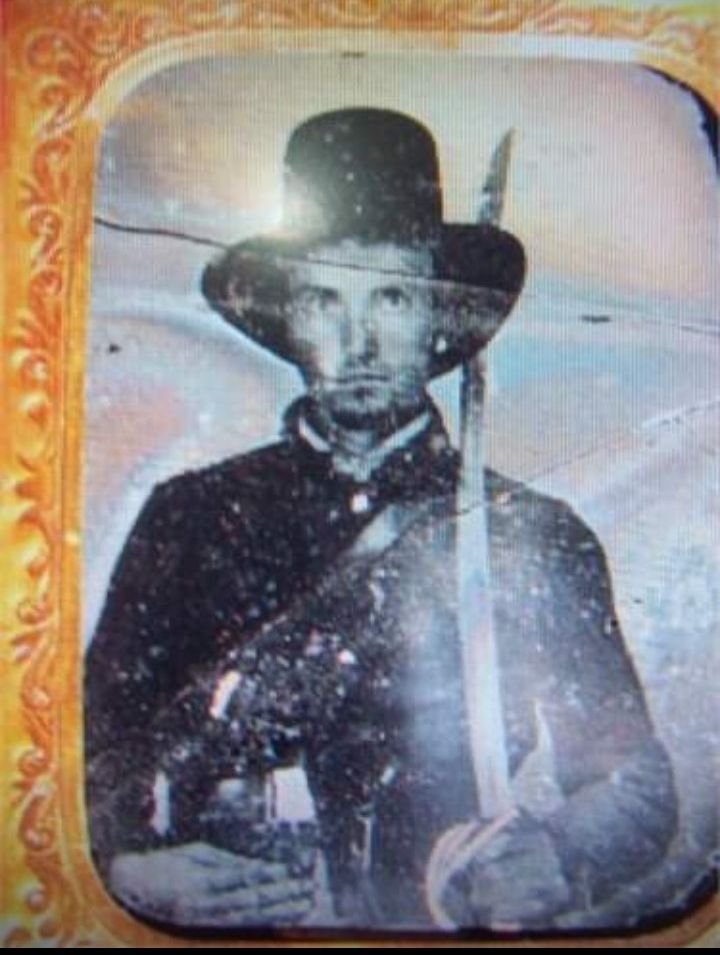
Thomas Jefferson Gillihan, about 1860.
This essay is adapted from the more detailed account, Article 04: Endurance.
The Story
By the end of the Civil War, Thomas Jefferson Gillihan had been shot twice, nearly blinded, and assigned to bury the dead.
He would carry a bullet in his leg for the rest of his life. Years later, his injured eye would, in his own words, “burst plumb out.” And yet he endured—long enough to raise a large family that spread across Missouri and Kansas, and to leave behind a story that nearly vanished from memory.
I went looking for him because I had to.
Thomas Jefferson Gillihan was my great-great grandfather, though I never knew a single member of that side of the family. My grandmother died before I was born, and with her went whatever stories might have been told. That absence left a question hanging—who were these people?
Years ago, before online databases made such searches routine, I began digging. Letters went out. Replies came back slowly. A distant cousin in Kansas sent records. A genealogy group filled in fragments. Eventually, military and pension files arrived in the mail from another distant cousin—pages that began to sketch the outline of a life marked less by triumph than by endurance.
A life begun in uncertainty
Even Thomas Jefferson Gillihan did not know exactly when or where he was born.
He entered the world around 1828, the child of a young, unmarried mother, Elizabeth, at a time when their extended family was moving west from Illinois into Missouri. His father disappeared from the story entirely—whether by death or departure, no one ever knew. Thomas never met him.
Thomas was raised by his grandparents, Thomas and Lucy Gillihan, who were part of a larger migration of families from East Tennessee into the Mississippi River valley. When both grandparents died, eight-year-old Thomas returned to his mother’s household, now expanded by marriage and more children.
At seventeen, he married sixteen-year-old Susan Ruth (or Routh), an orphan whose path to Missouri is still uncertain. Susan’s father, Jacob Ruth (or Routh), a widower, died in Tennessee in 1835. His seven children were taken in by his brothers.
Family stories claim that two of Susan’s brothers, one 10 years old and the other 12, once set out on foot from Tennessee, walking hundreds of miles in search of relatives in Missouri. Whether Susan made that journey with them, followed later, or arrived by some other route remains a mystery. Like much in their lives, the details are blurred—but the movement westward is unmistakable.
War and injury
By 1860, Thomas and Susan were in northwest Arkansas, farming a small plot of land. Thomas also was a shoemaker.
Then came the war.
In October 1862, Thomas enlisted in the Union Army at Elkhorn Tavern, not far from where Union and Confederate forces had clashed earlier that year at Pea Ridge. Within months, he was wounded—first a bullet to the leg, then another through his hand at the Battle of Prairie Grove.
He recovered, returned to service, and then fell ill.
He recovered again.
Then came the accident that would define the rest of his life.
In February 1864, while standing in line at a hospital to receive liniment, a steward opened a bottle of ammonia beside him. The bottle exploded into his face. Thomas was blinded in one eye and left with impaired vision in the other.
After that, he was assigned to burial duty.
It is difficult to imagine that work—the steady, necessary labor of interring the dead after battle—but he carried it out until the end of the war, when he was discharged in August 1865.
After the war
Thomas returned to civilian life carrying his injuries with him.
The bullet remained in his leg. His vision never recovered. And yet he farmed, moved with his growing family, and followed the familiar American path westward—from Missouri into Kansas.
By 1900, the results of that persistence were visible. Thirty-nine members of the extended Gillihan family were living in Olathe, Kansas—children, grandchildren, and their families, clustered together.
Thomas was 72. Susan was 65. They had been married nearly fifty years. Of their thirteen children, seven were still living.
He could read and write. She could read, but not write.
They had endured.
Thomas Jefferson Gillihan died in 1909. He was buried in Olathe, in a circle of Civil War graves surrounding a monument. Susan followed two years later.
What remains
It is easy to lose knowledge of a life like his.
He left no famous words, held no office, led no great movement. His story survives in fragments—records, letters, family recollections, and a few unresolved questions.
And yet, his life traces something essential about American history: movement, hardship, war, family, and persistence in the face of uncertainty.
Because he endured, his family endured.
And because they endured, I am here—along with descendants scattered across the country, most of whom have never heard his name.
Threads to follow
1. The Gillihans identified as Irish in early Virginia and Tennessee (pre-Revolutionary War). What might that identity have meant in their everyday lives—and how might others have seen them?
2. When the family moved to Illinois around 1830, they went together as extended kin. Why do you think families made that choice—and what would have made the journey worth the risk?
3. Susan’s path from Tennessee to Missouri isn’t fully clear. Based on the clues we have, what do you think is the most likely story?
4. After the war, T.J. lived with blindness and a meager pension, attempting to farm with the help of family. Do you think that would have been enough to sustain a farming family—or were they likely always struggling?
Author
Name: Sam Redding
Place of Residence: Towanda, McLean County, Illinois
Primary Sources: Family correspondence; Ancestry.com; Military and pension documents
Photographs of Main Character(s): Yes
Photographs of Artifacts: No
Maps: No
Subject
Name of Subject at Birth: Thomas Jefferson Gillihan
Birth Date: 1832
Birthplace: Illinois or Missouri
Name of Subject at Death: Thomas Jefferson Gillihan
Death Date: 1909
Place of Death: Olathe, Kansas
Spouse(s): Susan T. Routh/Ruth
Other Key Locations: Greene, Polk County, Missouri; Washington County, Arkansas; Johnson County, Kansas
Most admirable qualities: Resilience, Devotion to Family, Service