
Article 05: Diamonds in the Rough
Growing Up in a Small Town
By Jeff Collins
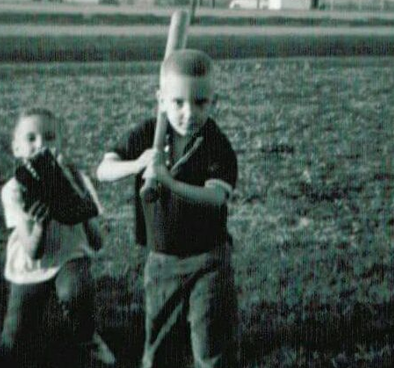
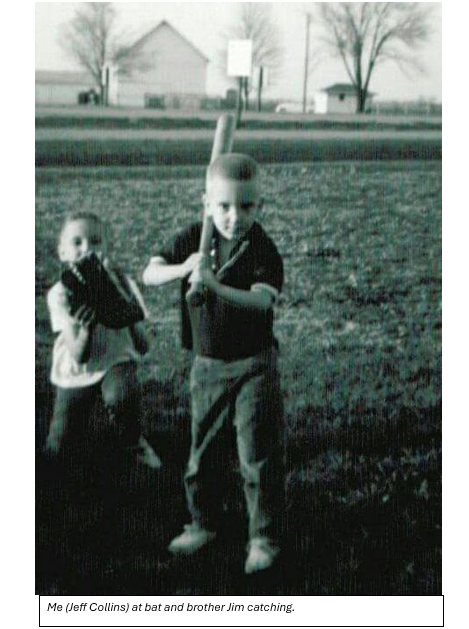
Jeff Collins at bat, brother Jim catching.
Story
Background
· Author’s interest in the place, why it is “special” to the author
· Brief description of geographic location, surroundings, context
· Brief scan of history of the place
· Sources of information
I lived in Towanda, Illinois, the whole time I was growing up, with my mother and father, sisters and brother. I live near there now. I have many memories of Towanda, and some days remain clear in my mind, like it was only last week. There were Halloween costumes and fall pranks. Slogging through the snow on my way to school in the wintertime. Half the town gathered for an event in the Community Building. Our huge 4th of July celebration, with thousands of people flooding the town for the flea market, games at the school, and fireworks. But of all the memories, playing on Towanda’s many ball diamonds is the best. Kids being kids. Kids having fun while learning the skills they would use down the road.
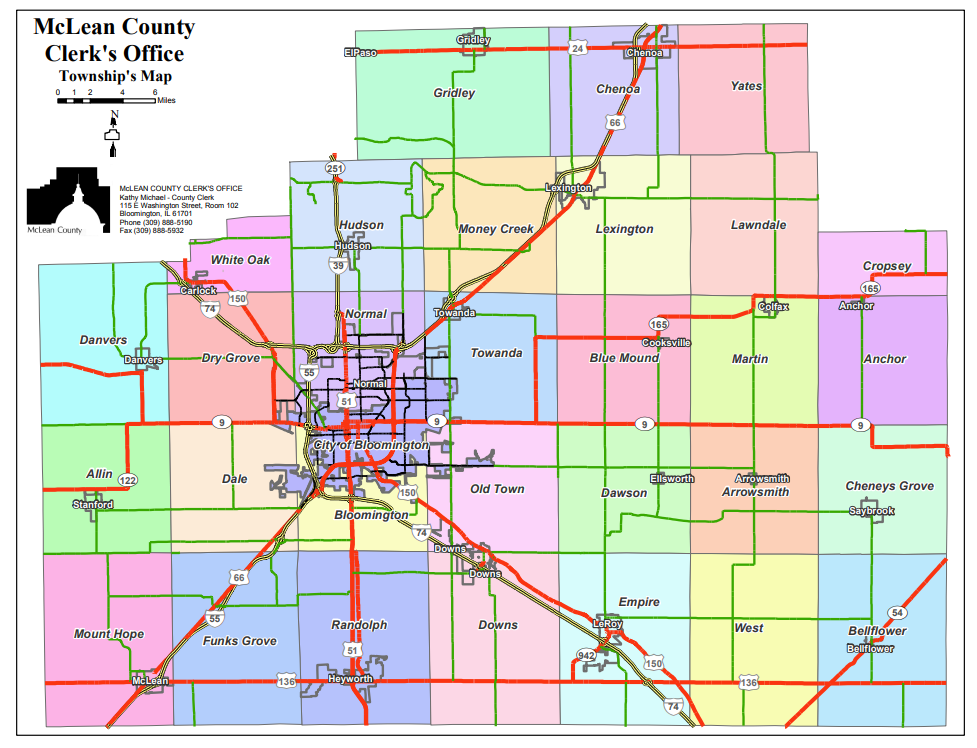
Towanda, Illinois, in my days growing up and yet today, is home to about 430 people, less than ten miles northeast of Bloomington-Normal, right up the Route 66 (now Interstate 55) corridor. Towanda is in McLean County, a large, agriculturally rich county in the middle of the state and at the heart of the Grand Prairie.
Towanda was founded in 1854 by land speculators planting towns where the railroad was being built from Chicago to St. Louis. Before that, it was the territory of the Kickapoo Tribe and various early settlers. The town has changed much over the years, but in some ways has changed little. Fewer shops downtown. No high school or junior high since consolidation with a large district decades ago. The first-class softball field at the school, used in the 1960’s by championship teams, is gone. But the people seem much the same. I like to think I was lucky to grow up when I did, when backyards were full of kids playing wiffle ball.
My sources for this story include my own memories, chats with friends, old Daily Pantagraph articles, and a great Facebook site called “When We Were Hornets,” which I founded, and which continues to curate wonderful pictures and stories from years gone by.
Focus of the Story
· Tell the Story of Your Focus: The aspect of the place, tradition, or special characteristic
· Sources of information
My focus for this story is on one day and one event among hundreds of summer days on backyard wiffle ball fields in Towanda. Now for the story.
___________________________
It’s an early summer morning. Sometime in June, July or maybe early August. Early to mid-1970s.
Awakened by the sound of semi-tractor trailers pulling in or out of the Delco. Also known as the Greasy Spoon. The aging truck stop sits across Route 66 – just a couple hundred yards away from my brother and my bedroom window. Even with a box fan humming like it had all night, the trucks or a blaring horn still would awaken us. Or just the soaked sweat cooling off from the night’s sleep. No silly alarms needed.
The agenda for the morning is much like most mornings in the warmth of the summer. Get up, change into some “play” clothes and, after a quick breakfast of cinnamon toast and Captain Crunch cereal, we would decide what time and on which diamond of dreams we would take the field today for wiffle ball.
It could be our backyard. It could be across North Street, next to the Jim and Luella Richard residence. The lot which was a diamond in the summer, and a football field in the fall and winter—we just called McCurdie’s lot.
Games could also be scheduled down North Street to the east where Bob and Mardell McLeese lived with their houseful of kids. The McLeese family had a big backyard and nice-sized side lot. Wiffle ball games could be played directly behind the house. The side lot was used for fast-pitch “tennis ball” games. For a few years, a homemade backstop stood there, just like the ones on the real diamonds.
The vacant McCurdie lot and the McLeese backyard were the primary spots, but other yards and lots were never completely out of the question. If there was a game to be played, a prime or convenient location could be found.
Games usually started while the dew was still drying. But in an open yard or lot, thirst still would need to be quenched at some point. A green garden hose with lukewarm water would suffice. But if we were at a location with no water supply, we carried an old thermos. We could also run or ride our bikes to Ike’s Grocery on Main Street and pick up a cold soft drink. Ike Hirst, the store’s owner, lived between our house and the McLeeses. My mother, Lois Collins, worked at Ike’s Grocery most days as the cashier. Ike and his wife Betty Ann’s garden grew about 10 feet over our short right-field fence. More than once, one of us was scolded for chasing a homerun ball into Hirsts’ pristine garden. Stopping a game was not an option; the ball was found no matter where it strayed.
Sometimes we might bike to Texaco or Fat Brown’s gas station to grab a cold soda out of the pop machines. Fat (real name Feron) had a great soda machine loaded with orange and grape Nehi. Root beer or Pepsi were our other choices. Staying hydrated was a must on hot summer days. We always found a way to keep replacing our sweat with fluids.
Ideally we would have six or eight kids playing a game. Three or four kids to a side. But sometimes, we went one-on-one and determined between ourselves what were hits and what were not when there were no players in the field. In fact, mano a mano was best played with a game of home run derby. This helped avoid any heated discussion about what was a hit and what was an out. Since many times we were swinging for the fences, strikeouts came in bunches too. Yes, you might say we were ahead of our time as today’s Major League games are much the same.
In wiffle ball, we rarely used a catcher. We might use a lawn chair or an old Radio Flyer wagon for the backstop. If we could find a big piece of plywood – even better. These were the days before step tracking, but I bet we put in thousands of steps just retrieving un-hit or unhittable balls each day. We emulated our heroes. Names like Collins, McLeese, Adams, Messer, Phelps, Miller, Hargis, Risen, Kocar, Broom and Merritt would become Tiant, Gibson, Stargell, Aaron, Williams, Banks, Marichal, Jackson, Seaver, Brock or Mays.
Television shows in later years poked fun at organized games and parents bringing snacks. Snacks for us consisted of apples, rhubarb, cherries, grapes, peaches and even long green onions. All natural from the local trees, patches, and vines closest to the field on that particular day.
Heat never stopped a game. Rain never stopped a game and was often a welcome addition to the contest. Not only cooling things off but making it easier to slide into the bases. And let’s face it – we slid if needed to or not. Grass stains, dirt and mud were badges of honor.
There was one thing that could stop a game.
One mid-August day in 1970, the morning game was interrupted by a car coming off Route 66 and flying through the ditch and directly crossing into the backyard diamond at our house. There were four of us playing that day. We all scattered to get out of the way of the wayward vehicle. It narrowly missed bushes, an apple tree, and a very solid clothesline metal pole before gently bumping into our house. The occupants, all from Indiana, were on their way to California. Although they were sore and hurt from the wild ride off the highway and through the ditches, by the grace of God, tragedy was averted.
Fifty-six years later, that story of the car crashing into our yard has been rehashed on more than a few occasions. The ball payers that day were my brother Jim, Tom McLeese, Brian Risen, and myself. The incident scared us all. Jim and Luella Richard told of seeing four boys run from the back of the house to the front, “faster than any boys they had ever seen run.” Tom, six years old at the time, ran home and hid under a bed. For an instant, we were panicked, thinking he was under the car. Thankfully he was just freaked out to the core. Who wouldn’t be?
Mom was working at Ike’s, heard the commotion, and ran home. She ran with the urgency of a fireman called to the station by an alarm. A neighbor might have said she ran like a girl. That’s a term not used much today. In fact, she ran like a very fast and frightened girl.
Most games didn’t end in such drastic and scary ways. Some games would end in arguments about a call. Those arguments may even sometimes end in a scuffle. Never anything too harsh. Just enough to call off action for the day. Or maybe just a few hours. Until we went home and cooled off. When the next game started, all was forgiven, and we were back living the dream.
Years later, a walk through the backyards in Towanda would reveal lines of thin grass that were once baselines, worn down by our running feet, and patches where we slid into the bases. The lines in the grass brought back memories of the days we played wiffle ball in backyards.
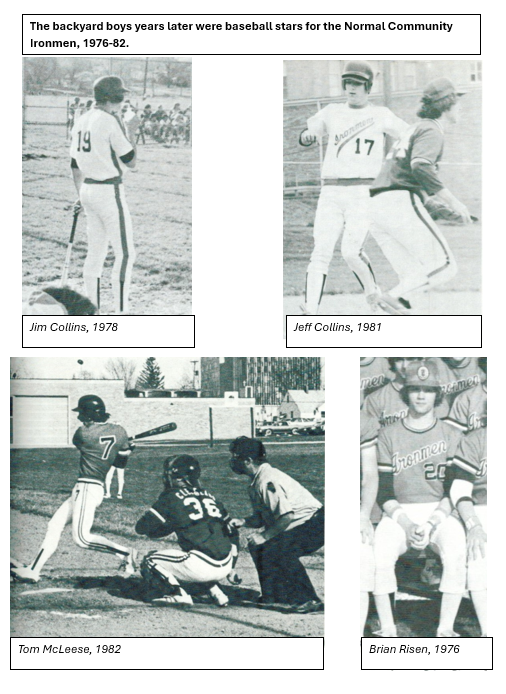
That hot August day when a car interrupted the game? There were four future Normal Community High School baseball stars playing ball and running from that car on that day. Brian Risen (Class of 76), Jim Collins (Class of 78), Jeff Collins (Class of 81). and Tom McLeese (Class of 82) were not just having fun – they were preparing for some future diamond success.
Reflections on the Place and Your Focus on It
· Author’s impressions, memories (if applicable)
· The special character of the place
Growing up in a small town like Towanda was the best – everyone knew everyone. Playing ball was where we got to know each other best. Wiffle ball, tennis ball (baseball with a tennis ball), softball or baseball. We would find enough players and go at it all day long. Building friendships and skills for a lifetime.
Towanda was nurturing, in a gentle, hands-off way, giving its kids a chance to learn the rules of life with no umpires, no rule books, no score boards. We just played ball.
Author
Author’s Name: Jeff Collins
Author’s Place of Residence: Normal, McLean County, Illinois
Primary Sources of Information: Personal memories, discussions with friends, Daily Pantagraph articles, Facebook site: When We Were Hornets
Place
Area reported: Village of Towanda, Illinois
Timespan: 1960-2026
Most Descriptive Characteristics: (select up to three):
__ Scenic __ Prosperous _x_ Historical _x_ Agricultural __ Industrial __ Medical __ Educational _x_ Other: Nurturing