
Story 10: A Bowl of Chili at the Merna Tap
Memories and a Few Facts About a Tiny Town
By Sam Redding
We ask Star Hitchers writers to explain why their subject interests them and how they came to know it. Usually that explanation is brief. Not this time. To submit your story, see Story Submission at StarHitchers.com.
The Story
My interest in the tiny community of Merna, Illinois, began when I was nine years old.
The story begins when our family moved from Kansas to Towanda before my fourth-grade year.
A new school meant figuring out where I fit in. The routine of school was familiar enough. Every morning we stood, hand over heart, and recited the Pledge of Allegiance. Before lunch, one student took a turn offering a table grace.
That was where I began sorting out my new classmates.
The Catholic kids crossed themselves and said, “Bless us, O Lord, for these Thy gifts . . .”
The Lutheran kids recited, “Come Lord Jesus, be our guest . . .”
The rest of us improvised. My family's prayer was, “Thank you for the world so sweet, thank you for the food we eat . . .” A friend without a prayer from home borrowed mine.
Soon I discovered there were other categories for my classmates.
Some kids walked to school. Others rode buses from farms. The farm kids themselves came in two varieties: the farmer's children and the children of the hired man who worked for him. The hired man usually lived in a smaller house down the road and had more children than the farmer.
One Saturday, my classmate David Kinsella invited me to spend the day with his family.
David belonged to two groups that fascinated me. He was Catholic, and he lived on a farm.
At lunchtime, seated among a table full of Kinsellas, who chatted comfortably among themselves, I tried my best to sound like I belonged there. Mr. Kinsella asked what was happening at our house.
I replied, “My dad is diggin' 'taters.”
Mr. Kinsella grinned.
At that moment, I realized that the way I remembered farmers talking back in Kansas was apparently not how farmers talked in central Illinois. I’m sure I blushed.
The Kinsella farm introduced me to something else.
The farmhouse sat on a street in a tiny town, with the barns and cropland stretching behind it.
That surprised me. In my imagination, farms were over a hill somewhere, miles from civilization.
Instead, David's farm occupied the edge of a place called Merna.
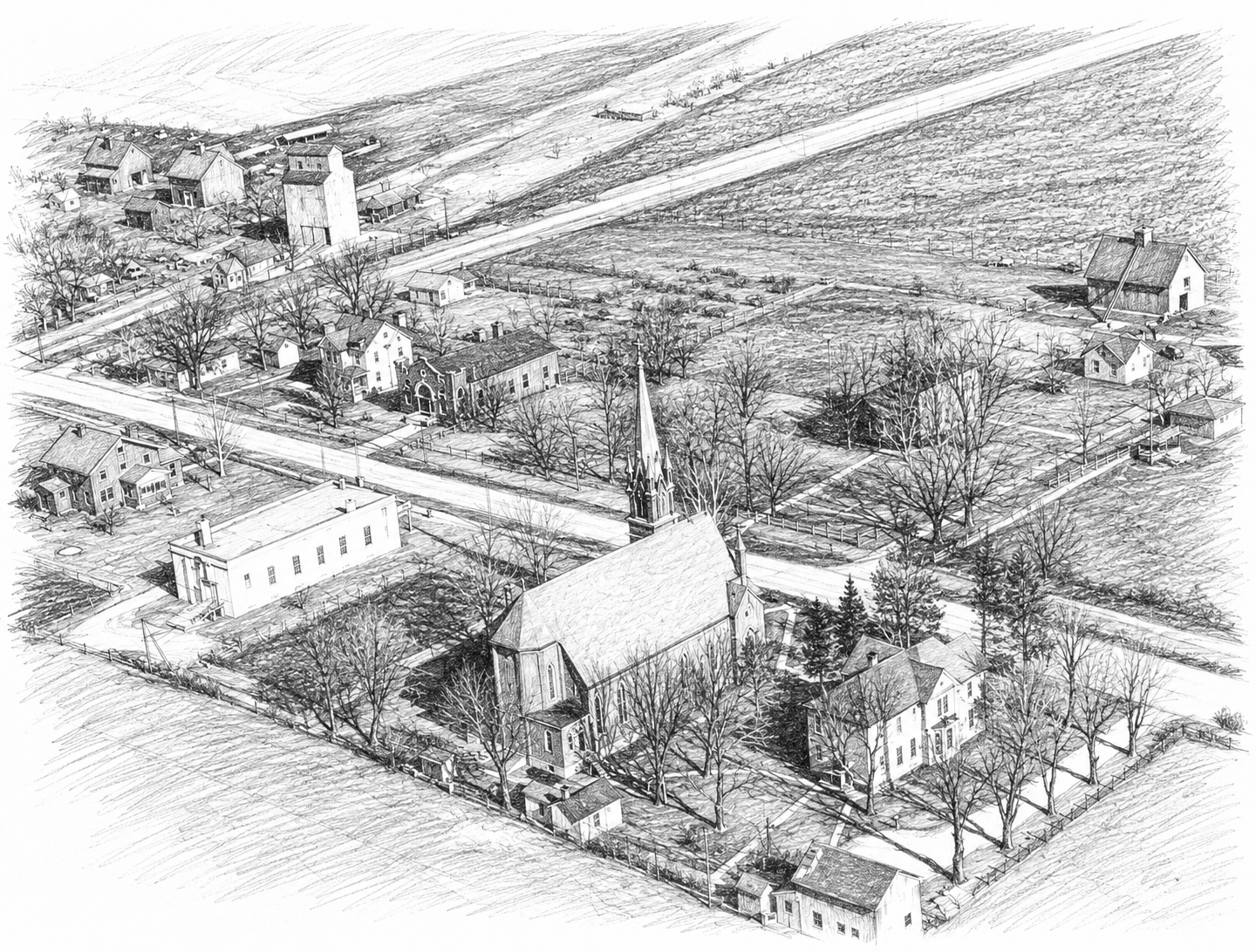
Merna was little more than a half-dozen houses strung along a road. There was a grain elevator, a general store and post office, a community hall, a Catholic church, and the Merna Tap.
As I got to know more kids from the Merna area, I noticed names that repeated themselves: Kinsella, Kelly, Killian, Larkin, Carmody.
There was a pattern that I learned.
The people around Merna were largely Irish and Catholic.
The place intrigued me.
In sixth grade, our class attended the Passion Play at the Consistory in Bloomington. Before the performance, students from a nearby Catholic elementary school presented Irish dances. They were about our age. They smiled constantly while tapping their toes and snapping their heels.
I was mesmerized.
A few years later, some classmates invited me to a square dance at the Merna Community Hall.
The place was packed.
Young people, old people, farmers, children—everyone seemed to know everyone else. The caller sang out instructions:
“Circle left! Do Si Do! Swing your partner! Allemande right!”
Hands clapped. Faces grinned. Couples spun.
I remember wondering whether “allemande” was an Irish word.
From that evening, I formed an early impression of what a community ought to be.
The people of Merna appeared connected to one another in a way that seemed both natural and enviable.
I attended midnight Mass at the Merna church once with a friend. The church was overflowing. I sat surrounded by families who clearly considered this place the center of their lives.
Another time, on opening day of pheasant season, my father and our neighbor brought me along to serve as the dog. My assignment was to walk through the tall grass and flush birds.
At lunchtime we stopped at the Merna Tap.
I ordered a bowl of chili.
The chili was good.
The memory stayed with me.
Then came high school.
My mother worried that I was not developing into a normal teenager. Heck, I was barely thirteen. But Homecoming approached. It was apparently time to ask a girl for a date.
Who would be the ideal Homecoming date?
Patty Larkin, of course.
Patty was pretty, Irish, Catholic, and from a farm near Merna. In my mind, she embodied everything I admired about that community. But she had changed her name to Tricia and now attended a Catholic high school. I had not seen her since grade school graduation in the spring.
And, unfortunately, I was very shy of girls.
One evening I fortified myself with a chocolate malt at the Delco truck stop. Then I walked to the pay phone in the hallway. Two buddies followed close behind to witness either my triumph or humiliation.
I plunked in a coin and dialed the Larkin home. A woman answered.
“Is Patty—uh, I mean Tricia—there?” I squeaked.
When Patty came to the phone, I somehow managed to ask her to Homecoming.
My friends demanded an immediate report.
“Well?”
“She said yes.”
I probably bought Patty a mum, as was the tradition. My memory has lost the details.
The evening of Homecoming, my Uncle Babe drove Patty and me to Casella's for pizza while he waited in the car. Then he drove us to the dance. I watched some kids dance. Later Uncle Babe drove us home.
As instructed by my mother, I opened the car door for Patty and walked her to the house.
“Thank you,” I said. “I had a nice time.”
Then I turned around and hurried back to the car.
It was not the beginning of a great romance. I did not see Patty again for decades.
But it was a pleasant evening, and my mother considered it a step toward adulthood.
Years passed.
One day I attended my nephew's confirmation at a Lutheran church and ran into Patty.
She had married David Kinsella.
The same David Kinsella who had first invited me to spend a Saturday in Merna.
They lived on the Kinsella farm.
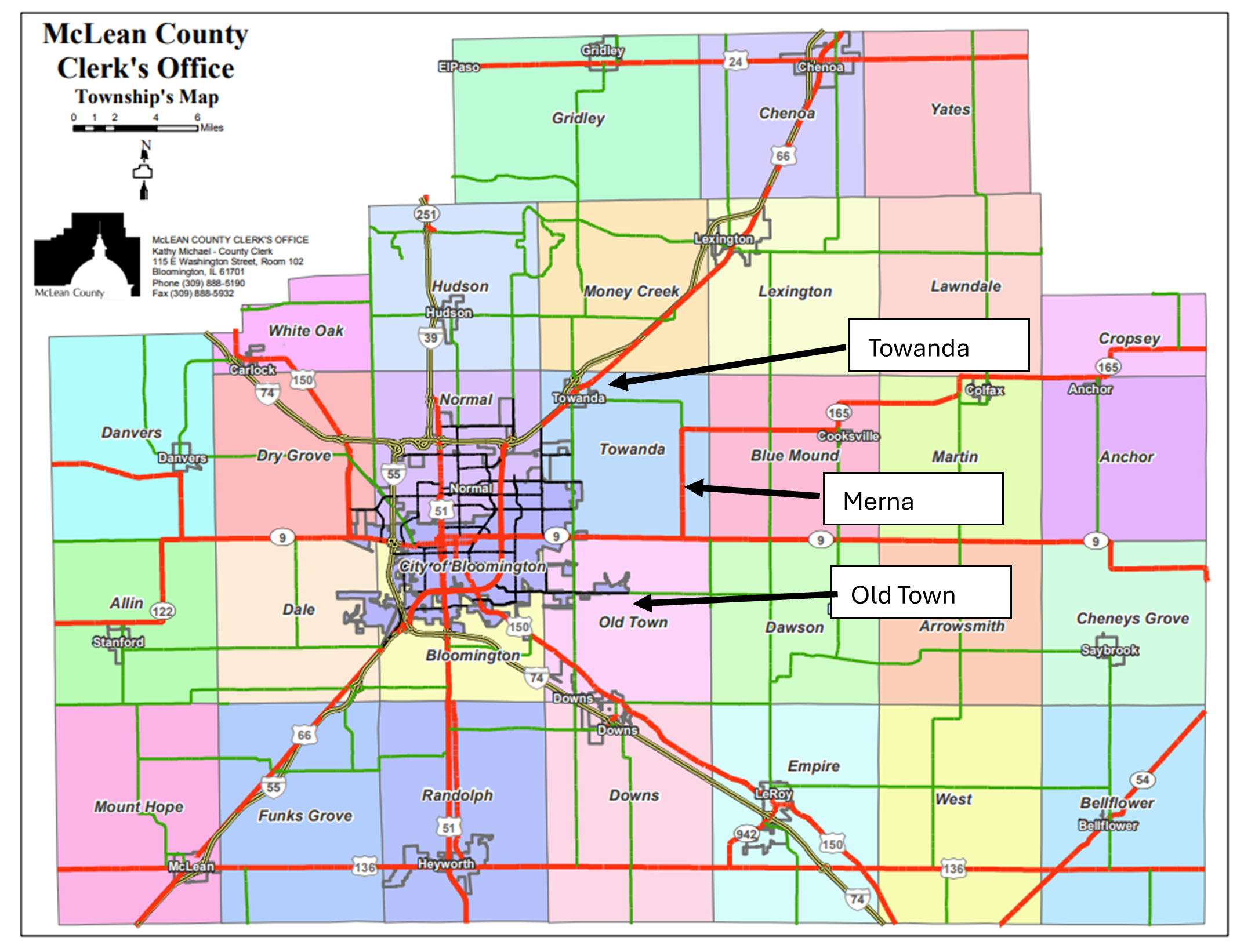
I had married a German Lutheran girl from a farm neighborhood called Old Town, just south of Merna. We moved away, raised four children, and eventually returned to Towanda. That is another story.
My personal story of Merna seemed true of communities and neighborhoods at the time. Life consists of circles, starts and endings that sometimes connect.
Merna itself has its own story, a story with a beginning, a disruption, and a return.
Merna’s story begin in 1883 when brothers Patrick and James Merna laid out a small settlement along an Illinois Central Railroad branch line. Like many communities on the prairie, Merna owed its existence to the railroad and the rich farmland surrounding it.
Irish and German families settled the area, and the Irish held tight to Merna.
By 1890, local Catholics had replaced their original frame church with a handsome brick and stone St. Patrick's Church whose steeple dominated the landscape.
Merna never became large. It didn't need to.
The church, grain elevator, general store, community hall, tavern, and a scattering of homes were enough to anchor a community.
One of Merna's most notable sons was George J. Mecherle, the German-American farmer who founded State Farm Insurance by selling policies to his neighbors. The company he founded became State Farm, today one of the largest insurers in the nation and one of central Illinois' largest employers.
Then, on August 24, 1982, disruption arrived to Merna all at once.
A tornado swept through the town and destroyed St. Patrick's Church.
Much of the community had gathered at the Merna Tap after a farm sale and escaped injury. The church, however, was beyond repair.
Eventually, a new St. Patrick's Church was built near Bloomington, but the original village lost the landmark that had stood at its center for generations.
Yet Merna endures.
Many of the same Irish surnames that appeared there a century ago remain in the area today, and a scattering of German names among them. The farms are larger. Fewer people make their living from the land. The world has changed.
But some places retain their identity.
Merna is one of them.
Whenever I stop at the Merna Tap for a bowl of chili, I am reminded not only of a tiny town but of a lesson I learned there long ago.
Communities are built from churches, schools, businesses, and farms. More important, they are built from relationships that endure across generations.
Merna taught me that.
A bowl of chili simply helps me remember.
Threads to Follow
Many small Midwestern towns grew around railroad stops. How did the arrival—and later decline—of rail service shape communities such as Merna?
What role did churches play in defining the identity of rural communities? How do you think the loss of St. Patrick's Church in the 1982 tornado affected the people of Merna?
George J. Mecherle grew up in the Merna area before founding State Farm. How did the values and relationships of rural farm communities influence the business he created?
If a visitor stopped in your town for a bowl of chili, a cup of coffee, or a slice of pie, what story would you tell them about the place before they left?
An Invitation
You have stories to tell. Only you can tell them. StarHitchers.com gives you guidance and a place to submit your stories. Sometimes your memories are enough, but usually an internet search, conversations with friends, and a newspaper archive will give you more to write about. Give it a try.
My Sources of Information
My sources of information were my memories (not always reliable), the McLean County Museum of History, and Pantagraph articles by Nancy Steele Brokaw (March 8, 1999) and Bill Kemp (March 14, 2021).
Author
Name: Sam Redding
Place of Residence: Towanda, McLean, Illinois
Primary Sources: McLean County History Museum library; Pantagraph articles by Nancy Steele Brokaw (March 8, 1999) and Bill Kemp (March 14, 2021); memories (not always reliable).
Subject
Place reported: Merna, McLean County, Illinois
Timespan: 1850-2026
Most descriptive characteristics: Historical, Agricultural, Nurturing