
Article 06: Caroline Vergie Smith Dobbins, Midwife
The Whole Story of the Author’s Discovery
By Mallard W. Benton
This version of the author’s story provides detail about his route to discovery. Tell your story at StarHitchers.com
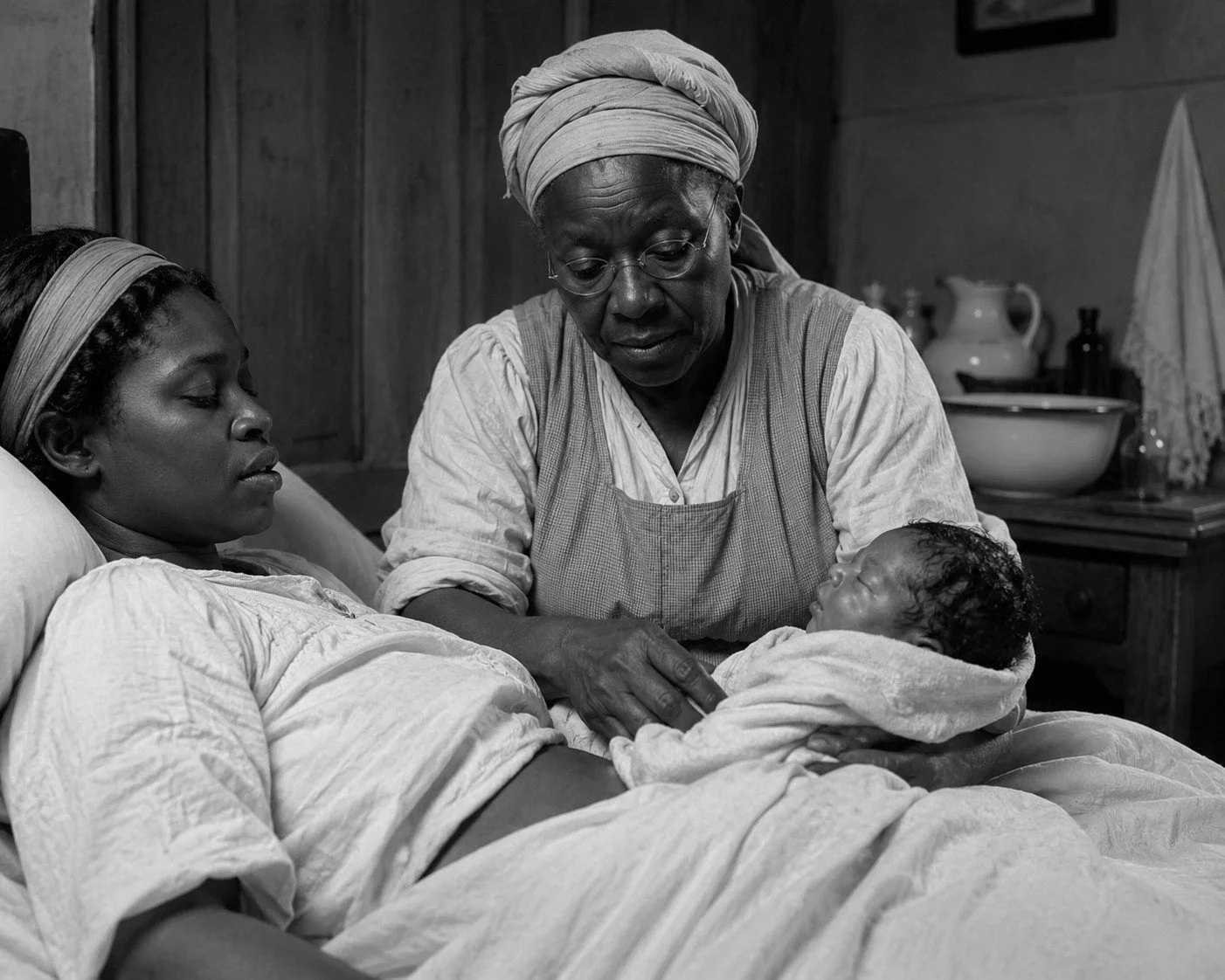
[This image is a representation of nurses like Caroline V. Smith Dobbins.]
The Story
My great grandmother Caroline Vergie Smith Dobbins was the second of Anderson and Eliza Jane Smith’s 14 children. Caroline married a farmer, James M. Dobbins in 1866 and they went on to give birth to 16 children, with 11 of them surviving into their late teens and adulthood . Caroline and James lived in the town of Hamlet, the county of Richmond in North Carolina; Hamlet’s population grew from 2,173 people in 1910 to 3,808 in 1920. My father was born in Hamlet in 1912, and I’ve been researching his father’s and his mother’s families. Caroline was his maternal grandmother.
My interest level rose dramatically when I found Caroline’s name on the 1910 federal census and noticed under the occupation category her trade or profession was shown as “trained” and the general nature of industry as “nurse”[1]. This was a surprise to me after seeing housekeeper next to her name on the 1880 census and the category left blank next to her name in the 1900 census.
By 1920, now a widow and with her name misspelled, Caroline’s occupation is again listed as “nurse” as is the “trade, profession or particular kind of work” of her adult daughter, Hattie[2].

[1] "United States, Census, 1910", , FamilySearch (https://www.familysearch.org/ark:/61903/1:1:ML38-ZS8 : Sun Jul 14 13:55:24 UTC 2024), Entry for James M Dobbins and Caroline Dobbins, 1910.

[1] "United States, Census, 1920", , FamilySearch (https://www.familysearch.org/ark:/61903/1:1:MZVQ-HZ9 : Mon Jan 13 12:34:32 UTC 2025), Entry for Karline Dobbins and Hattie Dobbins, 1920.
Sometime later, researching my father’s immediate family, I found the name Caroline Dobbins listed on the birth certificate for one of his siblings, Maurice Benton, born in 1914. As Maurice’s mother was Hannah Jane Dobbins Benton, this meant that Caroline delivered at least one of her grandsons.
North Carolina first began issuing birth certificates in 1913. Investigating further I found Caroline’s name or mark or her name and her mark on 49 birth certificates, and I’m convinced that there are many more, and that perhaps she attended some births prior to 1913 which were not recorded on certificates, or some later that have not yet been archived. Among other research questions, I’m interested in the circumstances of her becoming a midwife.
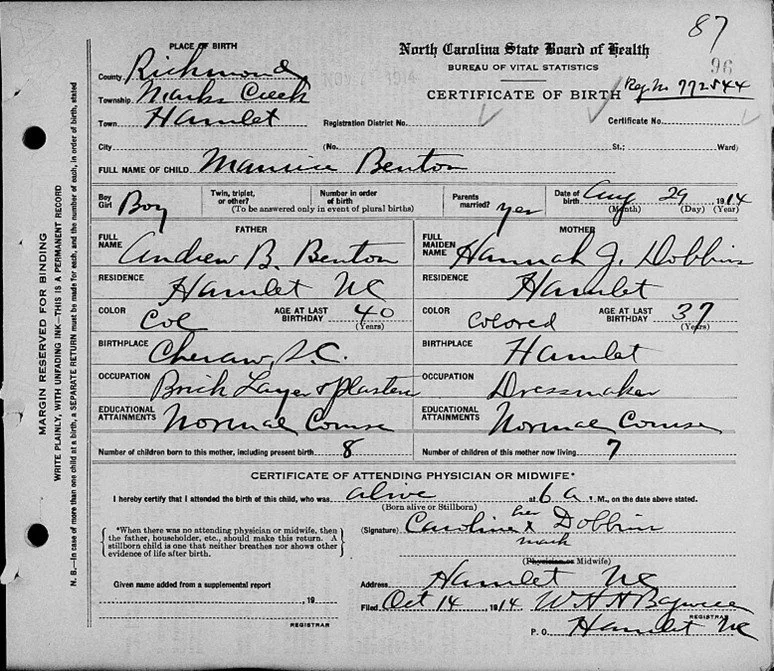
Figure 1 Maurice Benton birth certificate
In her book Delivered by Midwives: African American Midwifery in the Twentieth Century South, Jenny M. Luke writes “…the almost total neglect of the health needs of the African American population in the Jim Crow South created an indescribable level of chronic ill health…[1]” Midwives had served this population throughout slavery and continued through Reconstruction. My great grandmother who may have been a slave and lived all her life in Richmond County, North Carolina was likely familiar with Black women regularly attending to the health and other needs of Black women and their families. And as a mother so many times over, it’s almost certain she would have taken an active interest in the health of other mothers.
[1] Luke, J., Delivered by Midwives: African American Midwifery in the Twentieth-Century South, 2018, University of Mississippi Press
According to Sarah Mobley, midwives were first licensed in North Carolina in 1917 and there were 9,000 of them.[1] I don’t know if Caroline or any other African American midwives were numbered among them.
Hamlet Hospital was started in 1915 by William Daniel James, MD and his wife Lillian Duer James, and RN. Ms. James was also responsible for the Hamlet School of Nursing, also started in 1915. The school was not integrated and I wonder how my great grandmother might have benefited from a formal nursing education.
Among the 49 birth certificates I’ve located so far, several of the births were to couples in the community, that is within 10 pages of the Dobbins family in the 1910 or 1920 census. On a couple of the certificates, only a mother’s name is shown and “illegitimate” has been written in where the father’s name would normally be. Two of the certificates indicated that the baby was stillborn. Five of the birth certificates I found were for white citizens.
As part of researching my father’s family in Hamlet I’ve been interested in learning their occupations. Men on the Benton side of my father’s family were carpenters and bricklayers, and a couple worked at the main hotel near the train depot. On the Dobbins side, most of the men were farmers. The birth certificates I examined indicated fathers who were cooks, farmers, laborers, ministers, carpenters, draymen and a couple who worked the railroad as firemen and brakemen. One was a butcher and another a merchant. Most of the women were listed as domestic or housewife. Of the five white fathers, two were farmers, one a carpenter and the remaining two worked the railroad one as a conductor and the other as brakeman. Four of the white wives who reported work listed domestic and housekeeping.
Beyond crucial birth, marriage, death genealogical markers, I’ve enjoyed exploring how people lived, what work the did, in what “circles” they moved.
My great grandmother, Caroline Vergie Smith Dobbins died in 1924.
[1] Mobley, Sarah. "Midwives." NCpedia, 2006. Encyclopedia of North Carolina, University of North Carolina Press.
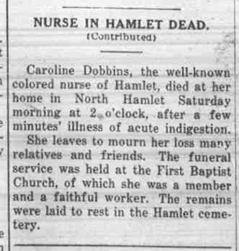
Figure 2. Obituary notice from the Rockingham Post-Dispatch, May 29, 1924.
Threads to Follow
How does one person become important to a community without becoming famous?
Caroline Dobbins appears in few historical records, yet she helped bring dozens of children into the world. What other people perform essential work but leave little trace in history?
How much can we learn about a person's life from official records?
Census records and birth certificates reveal facts, but they leave many questions unanswered. What can historians and genealogists infer from such records, and what remains unknowable?
Who provided health care when doctors and hospitals were unavailable?
Before modern hospitals became common, midwives played a critical role in many communities. How did people receive medical care in rural America a century ago?
What opportunities were available to African American women in the post-Civil War South?
Caroline was identified as a trained nurse and midwife during a period of segregation and limited educational opportunities. How did Black women acquire skills, earn respect, and serve their communities despite these barriers?
What stories are hidden in your own family tree?
The discovery of Caroline's work began with a simple census entry. What surprising stories might be uncovered through old documents, photographs, newspapers, or conversations with relatives?
More Threads to Follow (for richer discussion)
How many lives can one person influence?
Caroline Dobbins delivered at least forty-nine babies whose births were recorded on official certificates. Many more may have been born with her assistance before birth registration began or in records that have not survived. How many descendants might those children have today? How can the actions of one person continue to shape a community long after that person is gone?
What makes someone historically important?
Many history books focus on political leaders, business owners, and famous figures. Caroline Dobbins was none of these. Should people who quietly serve their communities be considered just as important to history? Why or why not?
What roles did women play in their communities that often went unrecognized?
How did midwives, teachers, caregivers, and church workers contribute to community life in the early twentieth century? Why are their contributions often overlooked?
What can family history teach us about American history?
Researching one person's life led to questions about race, health care, education, work, and community in the Jim Crow South. How can a family story help us better understand larger historical events?
An Invitation
While researching his family history, Mallard Benton discovered that his great-grandmother, Caroline Dobbins, served as a midwife who helped bring dozens of children into the world. What began as a search for names and dates became a deeper understanding of his family, his community, and himself.
You have stories like this to tell.
Every family has stories. Every place has stories. The people who came before us shaped our lives in ways we often do not recognize until we begin to look.
Star Hitchers invites you to explore those stories and share them with others. Tell us about a person who influenced your family. Tell us about a place that matters to you. Tell us about a discovery that changed the way you understand your past.
As America celebrates its 250th birthday, Star Hitchers is building a library of original stories about Americans and the places where they lived. These stories will help students learn about their country through the experiences of ordinary people whose lives helped shape it.
Visit StarHitchers.com for guidance, resources, and instructions for developing and submitting your story. We would be honored to include it in the collection.
Author
Name: Mallard W. Benton
Place of Residence: Woodstock, Cherokee, Georgia
Primary Sources: birth certificate, newspaper article, North Carolina Genealogical Society
Subject
Name of Subject at Birth: Caroline Smith
Birth Date: 1855
Birthplace: Wadesboro, North Carolina
Name of Subject at Death: Caroline Dobbins
Death Date: 1924
Place of Death: Hamlet, NC
Spouse(s): James Madison Dobbins
Other Key Locations: Wadesboro and Hamlet, NC
Most admirable qualities: Hard Work, Service, Occupational/Professional Accomplishment