
Article 01: The Long Search for Susan
A Southern Woman in the Civil War
By Sam Redding
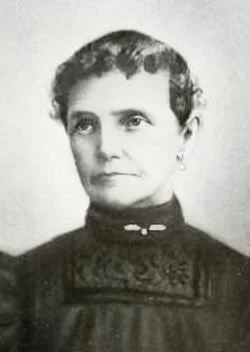
Saluda Keylon Loyd Granade
In this article, the author tells of his search for his ancestor, Susan Green Loyd Granade.
The Story
Background
Author’s Relationship to Subject
Author’s Interest in Family History
Author’s Reason for Focusing on this Subject
Susan Green Lloyd was my great-great grandmother. She has always intrigued me, mainly because I knew so little about her. I have researched many family lines and authored a few books about the Redding and Allen families, as well as one on my wife’s family, the Bittners. But in all that, Susan remained a mystery. I knew that she had married my great-great grandfather, Hervey W. Granade. Over time, I learned more from a few scraps of information about the Granade family, gathered from the correspondence of my great-aunt and great-grandmother with a distant relative, Ada (Mrs. H.L.) Peoples of Dallas, Texas. The letters from 1930s must have been returned by Mrs. Peoples to my great-aunt at some time.
My great-aunt (grandmother’s sister), Clyde Ethel Anderson Walker (1886-1965), was postmistress for many years in Mountain View, Missouri, near where she was born. Aunt Clyde had no children, but was an enthusiast for family history, especially that of her grandfather’s Granade family. The Granade family gave Aunt Clyde hope of acceptance into the Daughters of American Revolution (DAR), for which she accumulated a great store of documents and letters. Aunt Clyde shared some of this information with my mother (Margie Jean Allen Redding) as she was acquiring it. In 1955, Aunt Clyde’s documentation was approved, and her enrollment in DAR was granted. She died in 1965.
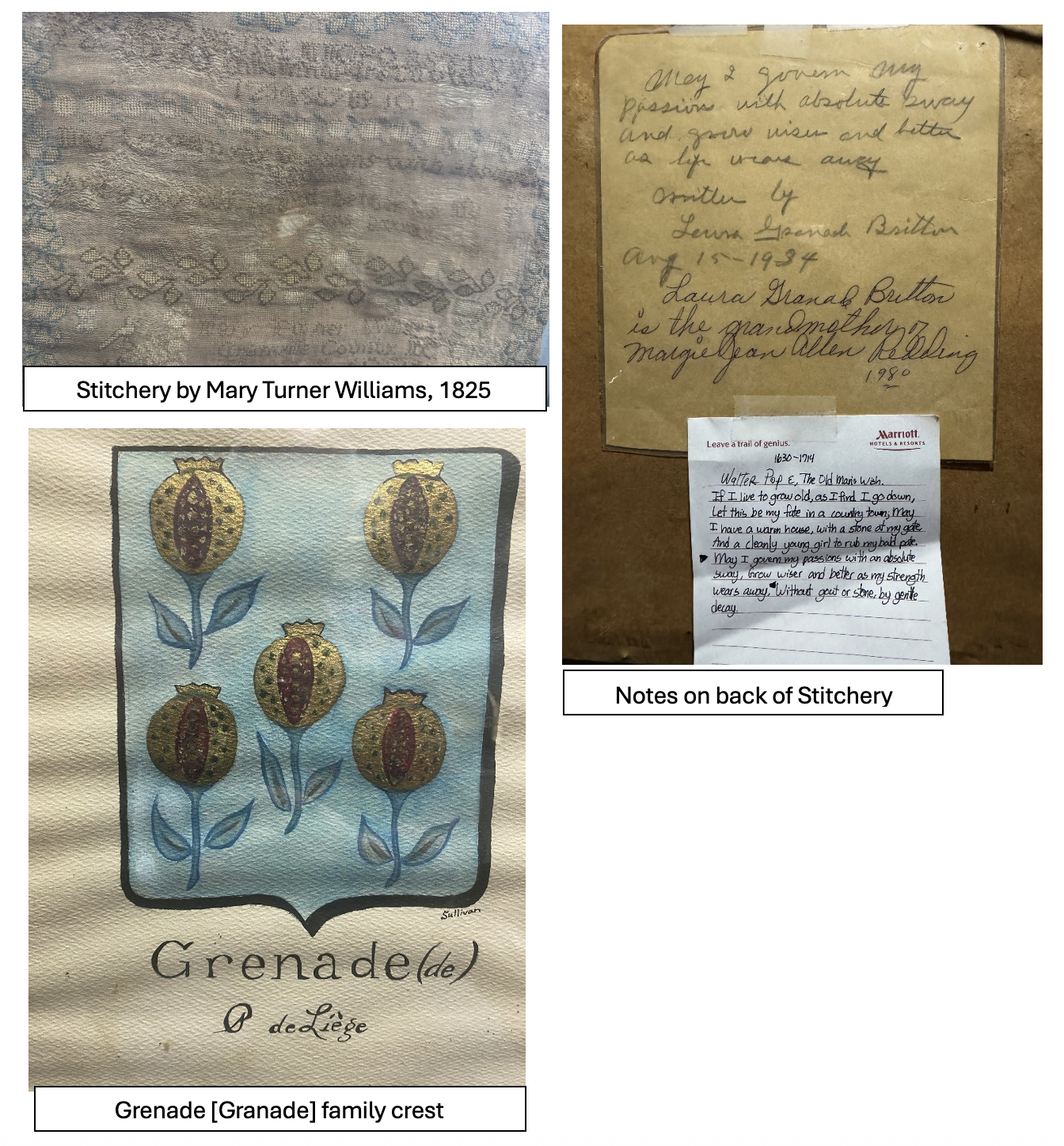
When I was about 10 years old, my mother showed me a Granade (or de Grenade) family crest that Aunt Clyde had given her. At the same time, Aunt Clyde gave my mother a letter that touted our (supposed) French heritage, leading all the way back to King Louis XIV who died in 1715. The family crest reads: Grenade (de) P de Liege. This indicates that the family was from the little principality of Liege, which was sometimes part of Belgium, sometimes in France, but also near Germany. Liege was Roman Catholic, and its Protestants (Huguenots and Walloons) emigrated to other countries, including America, in the 18th century. It is possible this is the place of origin for John Granade (or Johann Granad), our known ancestor.
Aunt Clyde paid genealogists to give her the information she favored, and she favored French nobility. However, later, more reliable, research suggested that the Granade family was more likely Palatinate German or Swiss, arriving in North Carolina in 1710.
I credit Aunt Clyde and my great-grandmother Laura Ellen, with instilling in me a love for family history. They had focused on the Granades, and my knowledge of Susan and the Loyds was sketchy at best. From Aunt Clyde’s old letters, I knew simply that Susan was born in North Carolina in 1832 and married my great-great grandfather, Hervey Wynn Granade, a 51-year-old widower, in Arkansas in1859 (December 18) when she was 27. With that as a backdrop, my search began in 2024 and carried deep into the following year. I was, to borrow a movie title, desperately seeking Susan.
Stitched into the fabric of a sampler passed down from Great-Grandmother Laura Ellen, who died about the time I was born, is the maxim (or prayer): May I govern my passions with absolute sway and grow wiser and better as life wears away. The identity of its creator is sewed into the sampler: Mary Turner Williams, Granville County, North Carolina, 1825. A note attached to the back of the stitchery, written by Laura Ellen, explains that Mary Turner Williams was her “mother’s mother’s mother.” That would be the grandmother of Susan Green Loyd. The note from my great-grandmother also gives Susan Loyd Granade’s birth and death dates as August 10,1832 and March 24, 1883. That was my starting point in my search for Susan Green Loyd.
Subject’s Life
Summary of Subject’s Life
Sources of Information
Family Roots
Only recently did I learn that in Susan’s lifetime (1832-1883), the family spelled the name “Loyd,” even though the family correspondence in Susan’s daughter’s hand spelled it Lloyd, as did more recent generations of the family.
In 2004, Harold A. Lloyd, now an attorney in North Carolina, published a book titled The Lloyds of Granville and the “Harricanes.” With Harold Lloyd’s book in one hand, and information I had accumulated about the Granade family in the other, I sought to confirm Susan Green Loyd’s ancestry and trace her life from her birth in North Carolina in 1832 to her death in Arkansas in 1883. In doing so, I unearthed the complicated lives of people who surrounded Susan. From Granville County records, I found that Susan’s mother, Mary Williams, married William Loyd there in 1829. The newlyweds were entered into the Granville County census of 1830.
Harold Lloyd’s book confirms that at the time of its writing (2004), ancestry for the Lloyds prior to the 19th century was not well established. The book explains that most of the Lloyds (and Loyds) came into Granville County from Virginia, especially Mecklenburg (previously Lunenburg) and Essex Counties. The “Harricanes” referenced in the book’s title refers to an area of about 15 miles radius where Franklin, Granville, and Wake Counties meet, an area once devasted by a hurricane.
The name “Lloyd” is derived from “Llwyd,” a Welsh name meaning “gray” or “gray-haired,” a reference to the wisdom of a person of mature age. The Loyd variation in early Granville County was common across the South. In later years, many of these branches of the family adopted the Lloyd spelling. Interestingly, my great-grandmother wrote that her mother, Susan Green Loyd Granade, thought “her people were Scotch-Irish.”
Relying on family histories posted on Ancestry.com and other sites, including sites devoted to specific families, is necessary and helpful, but must also be done with caution, confirming and double-checking their work whenever possible. Harold Lloyd’s book is the result of a huge amount of research by a careful family historian, and Harold is candid in noting when he is operating on an educated assumption. The thrill in genealogical research comes in finding the hard evidence for something you suspect or even something that jolts you from your preconceptions.
Deloris Williams, County Coordinator for the USGenWeb Project in Granville County, was very helpful to me as I navigated records on her website. Erin Bradford, Reference Librarian at State Library of North Carolina, also led me to useful resources. But despite great effort and good help, I have not been able to connect Susan’s parents to any specific Loyd or Williams family. That is disappointing. Therefore, I know little of the family history prior to the marriage of William Loyd to Mary Williams in 1829. I do know that Granville County, in the early decades of the nineteenth century, grew prosperous for families that held slaves and large acreages of land, but provided diminishing opportunity for others. By the 1840s, the families of limited means were moving on, to the south and west, seeking better lives.
Subject’s Early Years
Parents, Location
Include Sources of Information
Searching on Ancestry for William and Mary Loyd in the 1850 census, the first census that recorded the names of each family member, I found in Newton County, Georgia, a William and Mary Loyd, both born in North Carolina. But of the seven children in their household, none was named Susan. Wrong William and Mary Loyd? I pulled a file from my cabinet and skimmed through old correspondence about the Granade family accumulated by Aunt Clyde. What was the connection between Loyds in North Carolina and Loyds in Georgia? And if this was the right William and Mary Loyd in Georgia in 1850, where was Susan?
Subject’s Adult Life
Locations Where Subject Lived and Died
Marriages and Children
Major Events
Sources of Information
Among the handwritten letters and notes left by my great-grandmother and great-aunt, I found one reference in a note from Laura Ellen in which she stated that her father, Hervey W. Granade, had married Susan Green Lloyd Barnett. That was the first I had seen the name Barnett attached to Susan. This clue at last gave me traction with Susan’s history beyond Granville County. In 1849, the year before the census, seventeen-year-old Susan had married James Barnett in Newton County, Georgia, and was with him in the census of 1850. That confirmed that I had the right William and Mary Loyd in the same census, living near James and Susan. Working from the ages of the children in the census, I calculated that the family had left North Carolina about 1846.
Apparently, soon after the 1844 birth of Lucy in North Carolina, the Loyds moved to Georgia, where Saluda was born in 1847. From Granville County, North Carolina, to Newton County, Georgia is a trek of 400 miles. In 1846, that journey was probably by drawn wagon to accommodate both the family and essential belongings. With a family of nine, some members must have walked or ridden horseback. A short stretch of railroad ran from Raleigh to Charlotte about that time and could possibly have provided easier transit for one leg of the trip. Regardless of method, this would have been a long, arduous slog of three or four weeks.
I pushed forward in Georgia records, attempting to track William, Mary, their children, and James and Susan Barnett. Much later in my year of research, I turned back to the stack of letters from Laura Ellen and notes from Aunt Clyde to try to figure out what happened to James Barnett and how Susan, 10 years after her marriage to Barnett in Georgia, had arrived in Arkansas, married to Hervey Granade. It was a lost decade. Then I found a phrase in one of Laura Ellen’s letters that explained that Hervey, widowed for eight years from his first wife, Nancy Swan, on a trip to Mississippi to visit an old friend, Col. Maxwell, met a widow, Susan. They married on December 18, 1859.
My father (Roy Lee Redding), a Navy veteran of D-Day, died in August of 2024; he was 103 and living at home, just a mile from me. That was about the time I began seriously working on this study of Susan Green Loyd and her family. While removing the last of my parents’ belongings from the house where I grew up, I found a small box of old documents. It was obviously my mother’s box; she had died in 2009. Thumbing through the documents, I realized most were more papers assembled by Aunt Clyde in her appeal for DAR membership. In fact, one document of several pages was her application for membership, approved with the signatures of DAR officials in 1955. More pieces of the Susan puzzle begin to fall into place.
James Barnett’s brother Charles, who was near James and Susan in Georgia in the 1850 census, was in Concordia, Bolivar County, Mississippi, in 1860. Bolivar County is a delta county on the Mississippi River in west-central Mississippi. James W. [or M.] Barnett, Susan’s first husband and brother of Charles, has not been found in the 1860 census. My assumption is that James and Susan had moved to Mississippi at the same time as Charles and his wife (also named Susan) and James had died before Susan and Hervey somehow connected and went to Arkansas. I located Susan’s siblings in Georgia in the 1860 census, but not her parents, who must have died. In fact, in 1860, two of Susan’s younger sisters were living with their brother John, and Susan was caring for her sister Saluda in Hervey’s household in Arkansas.
Susan married Hervey Wynn Granade in 1859, presumably in Greene County, Arkansas, although I have not found record of the marriage. Susan and Hervey became my great-great grandparents. Hervey was a Tennessee-born son of a Methodist minister, John Adam Granade, known as the “wild man of Goose Creek,” and Polly Wynne Granade. Hervey’s father died just before Hervey was born in 1808, and Hervey and his brother, John Adam Granade, Jr., were raised by their uncle, Devereaux Wynne. Uncle Devereaux saw to it that Hervey was educated in the Methodist ministry in New Orleans, but Hervey never preached. He was a farmer throughout his life. He did, however, see to it that his son Hervey Milton Granade was also educated in the Methodist ministry, and Hervey Milton, after his service in the Confederate Army in the Civil War, became a practicing pastor in Fort Smith, Arkansas. His obituary described him as “outspoken in denunciation of what he thought was wrong and . . . a true friend to the poor and needy.”
To Susan and Hervey were born in 1863, a daughter named Laura Ellen, and in 1864 a son named Homer Wynne. Laura Ellen married Thomas Mitchell Anderson, a doctor in Mountain View, Missouri, in 1882, a year before her mother, Susan, died. Thomas Mitchell Anderson was born in Franklin County, Missouri in 1850 and reared in Pulaski County where his father, also named Thomas, was the county’s first schoolteacher and later a judge. Thomas Anderson graduated from medical school in Keokuk, Iowa, in 1881, the year before he and Laura Ellen married.
Thomas and Laura Ellen had two daughters. One daughter, Myrtle Blaine Anderson Allen (1884-1949), was my maternal grandmother. The name Blaine was not a family name; it was the name of James G. Blaine, Republican reformer and aspirant for the presidency from the state of Maine. My Aunt Beth Allen (not blood kin of Laura Ellen) taught us that James G. Blaine (1830-1893), prominent in politics for decades, was chided in his campaigns with the chant, “James G. Blaine, continental liar from the state of Maine.” Despite that, Doc Anderson and Laura Ellen must have admired him.
In my mother’s memory box, on one folded, yellowed paper, with the heading United States Post Office, were three lines typed by Aunt Clyde and nothing more. The typed lines read: “My Mother Mrs. Laura Ellen Granade [Anderson] Britton was born Jan. 8, 1863, died May 21, 1946. My husband John Linn Walker was born Aug. 24, 1875, died Sept. 8, 1948. My Grandmother’s name at death Susan Granade Gatlin died at Bakersfield, Mo.”
Wow. Susan had married again, after Hervey Granade died in 1870. A quick search with Ancestry produced nothing new. Then I found an entry in Find-A-Grave: Susan Grande [sic] Gatlin in County Line Cemetery, Baxter County, Arkansas. The entry included a picture of her small tombstone.
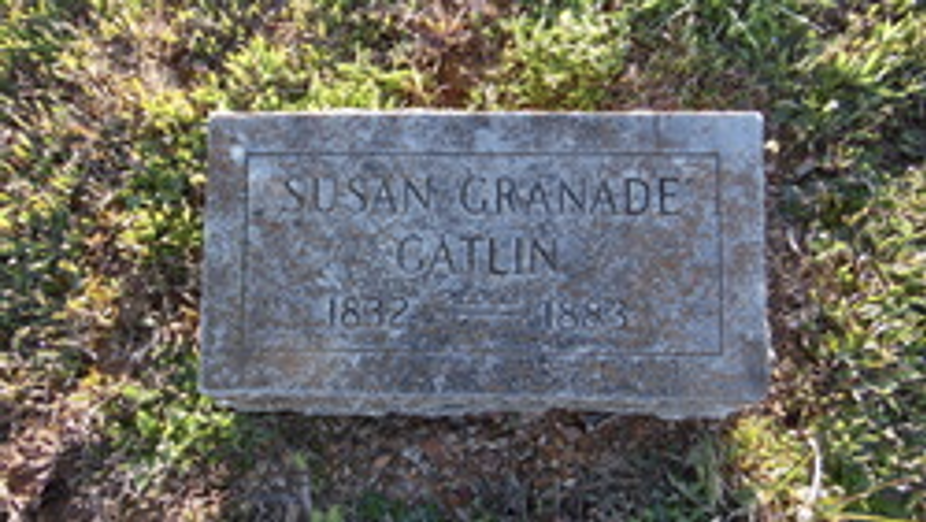
In the 1880 census, in Bennetts Bayou, Fulton, Arkansas, I found J.R. Gatlin, 30, farmer, born in Tennessee and his wife S.T. Gatlin, 45, born in North Carolina, with L.E. Gatlin, 18, daughter, H.W. Gatlin, 15, son, and R.C.H. Gatlin, 6, son. Laura (L.E.) and Homer (H.W.) lived with their mother and stepfather at some point after their father’s death. A new child, R.C.H., 6 years old, father born in Tennessee and mother in North Carolina, was in the picture; Susan’s? Susan reported to the census-taker that her father was born in North Carolina and her mother in Virginia. That was the first I learned of a possible Virginia connection for the Williams family, which I kept in mind even though Susan’s mother, Mary, reported in the 1850 census that her birthplace was North Carolina.
Susan died on March 23, 1883, at the age of fifty. My great-grandmother’s notes state that she died in Bakersfield, Missouri, but she was last known to have been living in Fulton County, Arkansas, and was buried at the Countyline Cemetery, on the border of Fulton and Baxter County, and just south of the Missouri line.
Writing in 1934 in a letter from Canton, Kansas, Susan’s daughter Laura Ellen said, “When she [Susan] died, I was days away by horse and buggy and no R.R. at that time between us. My stepfather did not write me till after she was buried, only sick two days. I never saw her grave, never felt I could look upon it until in recent years. Now I long to do so.”
Four months after her death, Susan’s third husband, the much younger James Gatlin, married to a much younger Delila Joice, in Mountain View, Howell County, Missouri, where Susan’s son-in-law, Thomas Anderson, was soon to establish his medical practice, where my grandmother Myrtle grew up and married, and where Aunt Clyde spent all of her adult life.
Reflections on the Subject’s Life
Scan of Major Events
Author’s Impressions
Subject’s Character
Scanning back over the lifetime of this ancestor about whom I previously knew nothing, I marvel at the rivulets and eddies that formed the stream of Susan’s short life. A North Carolinian by birth, at seventeen she married in Georgia. Ten years later, a widow (I assume), her parents dead, her siblings scattered and a younger sister in her care, she met a man in Mississippi who became my great-great grandfather, a man who was himself widowed with nine children. They married and set up home on the Arkansas frontier where, over the first five years of her marriage, while tending to four of her husband’s children as well as a younger sister, she gave birth to a daughter and a son. This was in the midst of the Civil War, with Union and Confederate troops skirmishing within miles of her home in northeast Arkansas. The war took the lives of one of her brothers (John) and one of her stepsons (William), crippled another brother (James), and imprisoned a stepson (John A.) who came home to marry her sister, Saluda (the sister Susan had raised).
Ten years after her marriage to Hervey Granade, the Civil War now ended and the South embroiled in its turbulent aftermath, Hervey died. Within a few years, Susan remarried to a young fellow who had previously boarded with her, bore his son, and moved to a bayou in northcentral Arkansas, where her daughter married a doctor and within months, Susan died at 50 years of age. What a story!
In 1934, in the depth of the Great Depression, Laura Ellen, then 70, was living in Canton, Kansas, with her daughter Myrtle Allen’s family. In a letter to Ada Peoples, Laura Ellen commented: “One thing I must mention, I had the dearest mother on earth. She was far above the average women of her time.”
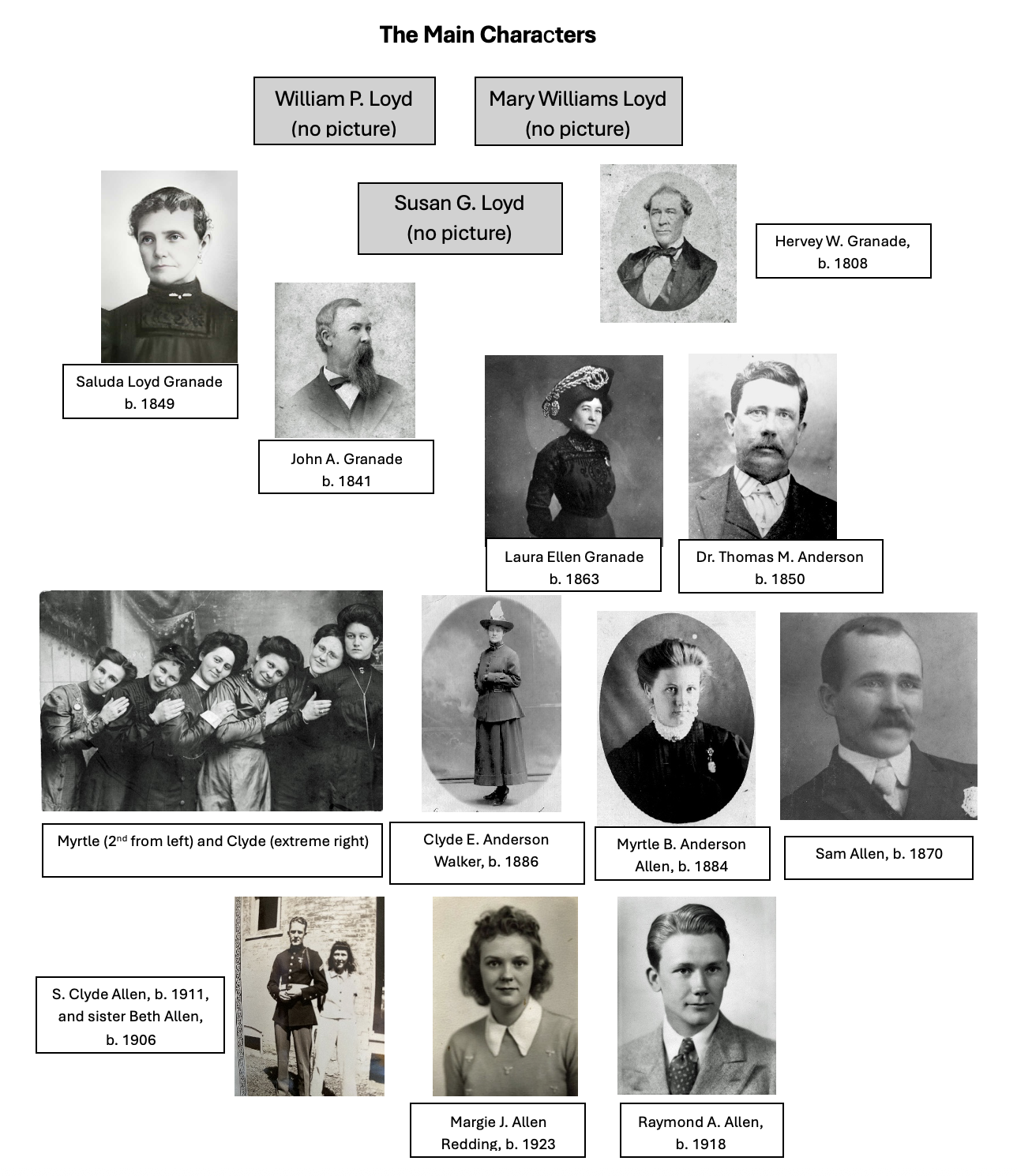
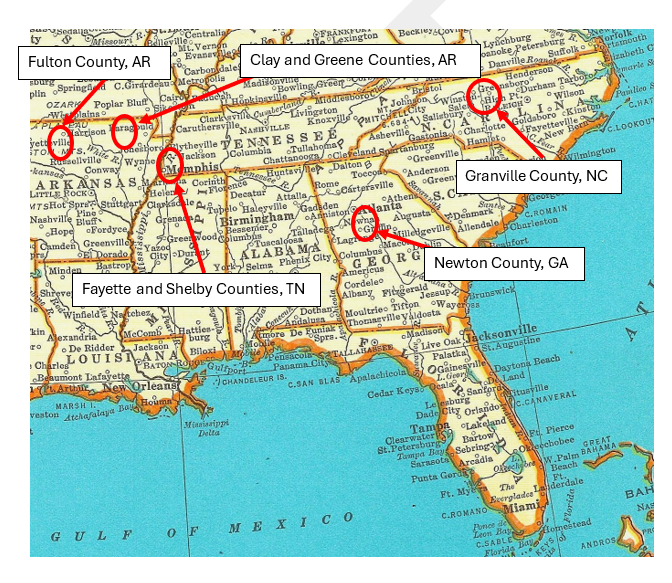
Map of Key Locations
The Author
Author’s Name: Sam Redding
Author’s Place of Residence (county and state): McLean County, Illinois
Primary Sources of Information:
Family: Letters and documents between great-grandmother, great-aunt, grandmother, mother
Publications: The Lloyds of Granville and the “Harricanes.” (2004) Harold A. Lloyd; web-based docs--cite
Websites: Ancestry.com, familysearch.org, ncgenweb.us/ncgranville/; findagrave.com
Artifacts: Stitchery by Great-great-great grandmother; family crest/coat of arms
Genealogists: Diane L. Richard (mosaicrpm.com); Deloris Williams, County Coordinator for the USGenWeb Project in Granville County; Erin Bradford, Reference Librarian at State Library of North Carolina
The Subject
Name of Subject at Birth: Susan Green Loyd
Birth Date: August 10, 1832
Birthplace: Granville County, North Carolina
Name of Subject at Death: Susan Granade Gatlin
Death Date: March 24, 1883
Death Place: Fulton County, Arkansas
Spouse(s): James Barnett, Hervey W. Granade, James Gatlin
Other Key Locations: Newton County, Georgia; Mississippi; Greene/Clay County, Arkansas; Fulton County, Arkansas
Most Admirable Qualities: Resilience, Hard Work, Devotion to Family