
Article 02: Two in One Day
A History of Towanda, Illinois
By Sam Redding
The Story
Author’s Interest in the Place
· Why the place is “special” to the author
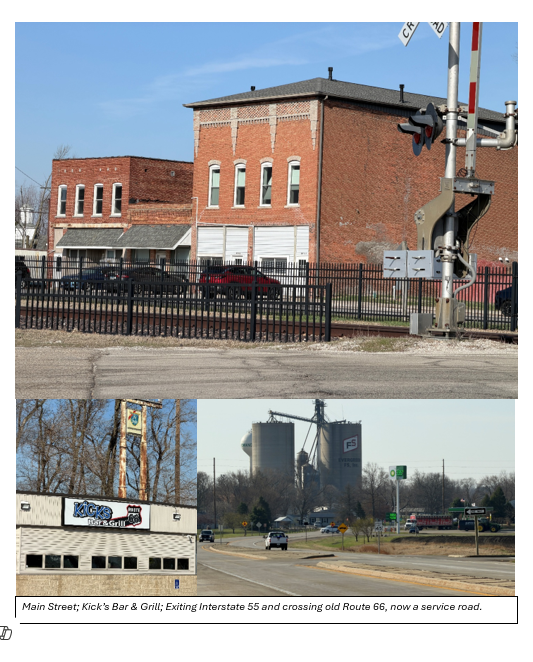
Who wouldn’t be interested in Towanda? It’s the place where you get your kicks, remember? On Route 66. In fact, today the town’s only bar and grill, called Kick’s, serves a mean sloppy Joe and cold beer on the northeast corner of town next to the old highway, now a service road that runs north to Lexington and south to Normal. The new interstate, built in the 1970s, was thoughtful enough to give the town some elbow room, slicing through farmland half a mile north of Towanda’s outskirts.
Towanda rose from the prairie in 1854 when tracks for the Chicago & Alton Railroad were being laid down from Bloomington to Joliet, completing a route from Chicago to Alton, across the river from St. Louis. The tracks and trains run right down Towanda’s Main Street yet today, even though the depot is gone, as are the stores that once lined the two-block strip.
In 1955, when I was a third grader in Tonganoxie, Kansas, our Methodist minister, a Baptist preacher from Arkansas named Amos Barton, offered my dad a job as the business manager with his company. Reverend Barton, raising five kids with his wife Sadie, supplemented his meager preacher’s wages by contracting for summer work curing concrete. His small crew, including men he collected from Tonganoxie, hopped from state to state in the Midwest each summer, taking on the specialty niche of concrete curing--moving the I-beam forms, laying down the heavy paper to slow the cement’s hardening, sawing expansion joints with diamond-blade saws.
Mr. Barton decided to put preaching aside and move to Illinois with a small construction company to land bigger contracts turning the Mother Road into a four-lane highway and expanding O’Hare Airport. Mr. Barton chose a tiny shop on Towanda’s Main Street for his headquarters, and my dad found us a house six blocks from there. On the last day of school in May, Dad fetched me from the schoolhouse, and we rambled from Kansas to Illinois in our ’37 Chevy, our dog, Ginger, content to doze in the back seat. A couple weeks later, Mom and my two younger brothers arrived by train. On the Fourth of July, my youngest brother was born, the first Illinois native in our family.
I attended Towanda Grade School in grades three through eight, rode the school bus to nearby Normal for high school, graduated from Illinois State University, and married Jane, a farm girl who, before college, raised angus about seven miles south of Towanda. Our first child, Becky, was born in 1970, and a year later, we left Towanda to live in nearby communities—LeRoy and Lincoln—for 50 years. We were never more than 45 miles away from Towanda, so we got back often to see our parents and a few old friends.
As chance would have it, Becky married a man who worked for State Farm in Bloomington, the twin-city of Normal, both just 6 to 12 miles from Towanda. My parents, eager to have their great-grandkids nearby, gave my daughter and her husband a corner of their pasture, where Becky and Doug built a home and raised four kids.
My mother passed away in 2009. In 2021, my father, then 101-years old, lived alone in the homeplace. Becky and her family gave Dad enough help to enable him to live in the house he had occupied since 1956. Our grandson Aidan lived with Dad while Aidan was in college. On November 1, 2021, Jane and I moved back to Towanda, a mile from my homeplace. Dad died in 2024, a much-honored D-Day veteran and former three-term mayor of Towanda.
Thus, my interest in Towanda, the place I call home, despite an absence of 50 years. The place, also, where I got my kicks.
For our nation’s Bicentennial in 1976, local residents Mildred Hirst Roberts and Elizabeth Jones Winter, produced a wonderful history of Towanda. It was a key source for my research. While visiting the Towanda District Library, the librarian, Rachel Ballinger, pointed me to the great collection of Towanda materials online at the Illinois Archival Library.
Physical Context
· Geographic location and surroundings
· Natural features (e.g., coastline, mountains, lakes, rivers, grasslands)
· Climate
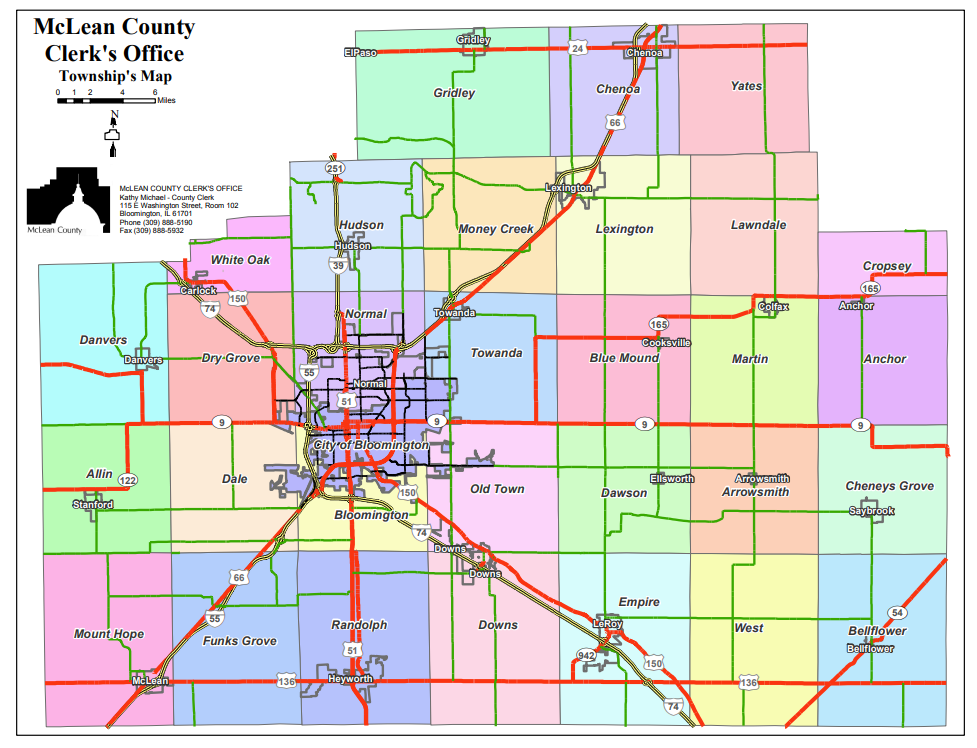
The Grand Prairie extends across a broad swath of central Illinois. Towanda is in Towanda Township in McLean County, near the center of the state. McLean County is the largest county by land area in the state and the state’s greatest agricultural producer with crops primarily of corn and soybeans. Money Creek runs through McLean County from the southeast to the northwest and within a mile of Towanda, draining into Lake Bloomington. A drainage ditch from fields south of Towanda forms what is unofficially designated the “Little Jordan” as it cuts through the village and on to Money Creek a mile northwest of town. Towanda is 125 miles south of Chicago, 175 north of St. Louis, 42 miles east of Peoria, and 54 miles northwest of Champaign-Urbana.
The most prominent natural feature is the prairie, now tilled as crop ground, with a few timbered woods along the creeks. The soil, also the state soil of Illinois, is predominantly Drummer silty clay loam, referred to locally as “black gold,” one of the richest soils in the world. As mentioned above, Towanda is dissected by the Little Jordan and is near Money Creek. It is within a dozen miles of Lake Bloomington, Lake Evergreen, and the Mackinaw River.
Towanda’s climate consists of warm to hot summers, cold winters, with about 40 inches of rain and 40 inches of snow annually, making it generally humid. Not for the faint of heart.
The Place Over the Years
· First inhabitants and founding
· Evolution of economy
· Changes in demographics
· Major Events
· Notable People
· Author’s Memories (if applicable)
According to legend, a Kickapoo chief’s wife gave birth to twins, and the chief joyfully exclaimed, “Two in one day!” The spot where the tribe then camped became known as Two-One-Day, or Towanda. In fact, the village of Towanda took the name of a town of the same name in Pennsylvania, probably from the Delaware tribe meaning “burial place.” Towanda, Pennsylvania, was settled in the 1780s and incorporated in 1828. My Towanda, in Illinois, was settled in the 1840s and founded in 1854 by Jesse Fell, a Pennsylvanian, and Charles W. Holder, an Easterner, both real estate developers who established several towns in central Illinois as the railroads were opening up settlement here. Peter A. Bedeau donated property for the original town on February 18, 1853, and assisted Jesse Fell in mapping out the town. Towanda was born a creature of the railroad, along the corridor from St. Louis to Chicago.
The Prairie Band of the Kickapoo Tribe was dominant in McLean County prior to their removal to Missouri in 1832. Later the Kickapoo were moved to Kansas, where some remained, and then to Oklahoma. A group of Kickapoo went on to settle in Texas and Mexico. When a group of German-background, United Brethren churchgoers from Pennsylvania began meeting in a log cabin home on Money Creek, two miles north of Towanda, about 1827, a remnant of Kickapoo occasionally attended their services. The Grand Village of the Kickapoo, fifteen miles south of Towanda, held a large Indian population from 1725 until it was burned by General Zachary Taylor in 1813. The Tribe scattered into smaller bands until its removal under President Andrew Jackson’s Indian removal policy in 1832. In 2022, the McLean County Historical Society co-deeded a small piece of land near the original village site to the Kickapoo Tribe in Kansas. Tribal members return to the site to hold pow-wows.
Many of the towns established across the Midwest in the mid-nineteenth century were organized around a town square which, in county seats, held the courthouse. Towanda, however, was a creature of the railroad, and its Main Street runs for two long blocks along the tracks. When I was a boy in Towanda, the depot stood by the tracks across Main Street from the brick buildings that formed the business district. Each day the mail train snagged the mail bag from a pole extending from the depot and dropped Towanda’s mail for the post office. At one time, Main Street’s brick buildings held two grocery stores, a cafe, drug store, bank, and a pool hall. No more.
Towanda’s demographics have changed little over the decades. The original settlers of English, Scots, Irish, and German background, were replaced by people much like them for many years. Located in the center of Illinois, Towanda received migrants from the south, especially Kentucky, as well as from the states north of the Ohio River all the way to the east coast. In the early twentieth century, handfuls of Italians and Poles arrived, directly or through marriage into the native stock. McLean County, with its universities and corporate headquarters, attracted a more diverse population than Towanda itself, and it grew rapidly after World War II, even as Towanda stood still. In 2023, the census reported the population of the county at 170,882. For as long as I have known Towanda, its population has hovered around 450.
Beginning around 1970, two country subdivisions sprang up—Lamplighter, where I live, a mile south of town and Indian Creek two miles north of town. Indian Creek runs along the stream where I camped, hunted, and fished as a boy. The residents of Towanda, not the subdivisions, are known as “villagers.” About six miles west of Towanda, the outskirts of Normal and its twin city Bloomington begin. Normal inches closer to Towanda every year, and Normal Community High School, which was deep in the heart of Normal when I was a student there, now gathers its students in a handsome new building just two miles southwest of Towanda.
The hamlet of Merna, a settlement of Irish farmers, sits in the prairie seven miles southwest of Towanda. When I was in grade school, the Merna kids schooled with us in Towanda. Most of them went to Catholic high school in Bloomington when the rest of us moved on to public high school in Normal. In grade school, when our class bowed our heads for grace before going to the lunchroom, we each took a turn. The Catholic kids had their prayer (Bless us, O Lord, for these Thy gifts . . . ) and the Lutheran kids had their prayer (“Come Lord Jesus be our guest . . .), but we Baptists and Methodists had to fend for ourselves. We latched onto something simple, “Thank you for the world so sweet; thank you for the food we eat.”
Hudson, with a population of 1,700, is seven miles to the northwest of Towanda, near Lake Bloomington. Hudson and Towanda, since 1948, have been part of the Unit 5 school district, along with Normal and Carlock. Lexington, eight miles up old Route 66 (or Interstate 55 if you prefer the modern route), boasts a population over 2,000 and maintains its own school system. Lake Bloomington and Lake Evergreen, both about 10 miles northwest of Towanda, near Hudson, provide water for Towanda, Hudson, and Bloomington and are lovely centers of recreation.
Major Events
A fire of unknown origin devastated the town’s business district in 1905, just as the village was taking off. Towanda virtually started over. The village passed a fire ordinance setting a code for new construction. Over the next decade, fire engines were purchased and a fire bell was installed on top the Hirst building on Main Street. Later, a 1936 Chevy truck (“Old Whitey) was acquired and converted to a fire engine. In 1951, a fire leveled the warehouse of the Towanda Grain Company, and in 1966, the Town Hall burned to the ground.
By 1930, Route 66, a national artery, cut through Towanda as the two-lane Mother Road of lore. After World War II, the expansion of the highway to four lanes took out a few homes and made a wider swath through town. In the 1970s, Interstate 55 replaced the old highway, moving farther north and stranding businesses that had built up along Highway 66. With each change in the highway, Towanda changed.
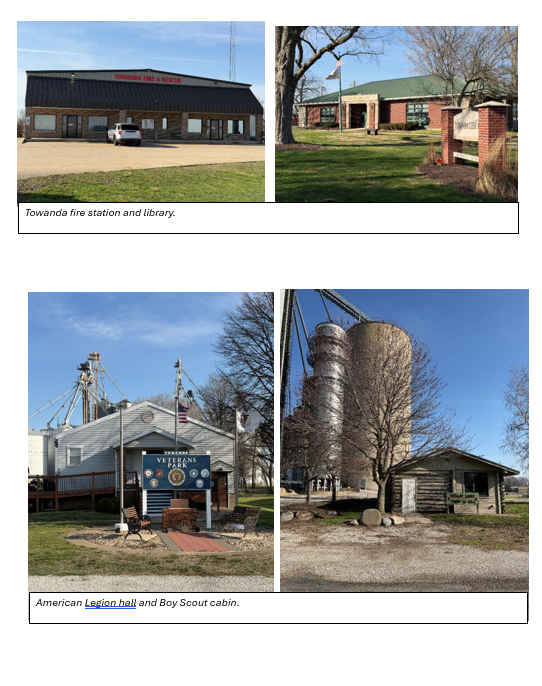
The Boy Scout Pancake and Sausage Day, held each February at the school cafeteria, was a major event for 60 years. My dad was a Scout leader, and my three brothers and I spent a good amount of our growing up in Scouting. That included our work at the Pancake and Sausage Day, raising money for trips to Canada, and Idaho, and New Mexico, and other far-away destinations. We camped along Money Creek and canoed down the Sangamon River from Springfield to Beardstown. Each summer we spent a week at Camp Heffernan at Lake Bloomington, where each year some of us were “tapped out” to join the elite Order of the Arrow. Sadly, in recent years Scouting has died in Towanda, and with it the Pancake and Sausage Day.
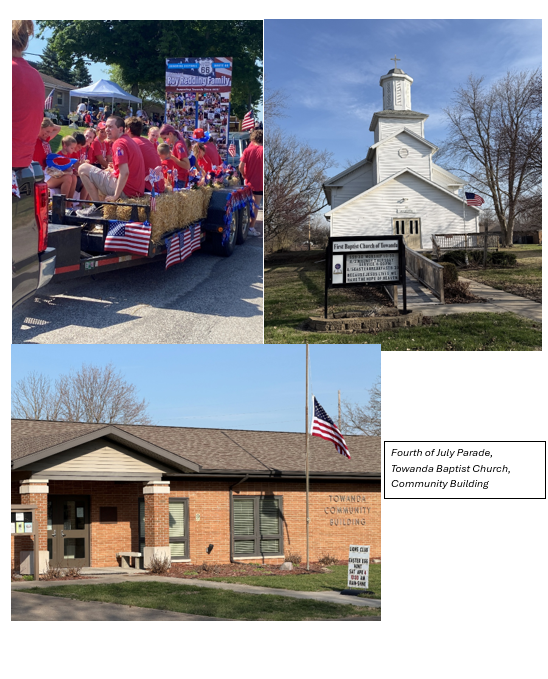
The annual Fourth of July celebration, which began in 1969, is a huge event in Towanda. The village swells to accommodate 15,000 people. The parade stretches for blocks as it winds through town for more than an hour. The south park is converted to a flea market, the Home Extension sponsors a spaghetti supper at the community building, the Lions Club sells snow cones in the park, there is a street dance and fireworks in the evening.
The American Legion is always a staple of the Independence Day parade. Its ranks swelled after World War II, and it remains a vital organization in Towanda. At the Legion’s meeting house on the southeast corner of Towanda, the Legionnaires sponsor monthly meals, and the building is used for many community and family events.
The McLean County Fair each summer was the year’s culminating event for the local 4-H clubs. Some clubs were for boys, some for girls, and some for both. We visited each other’s homes to inspect their projects. I showed rabbits and chickens at the fair. Once I took a lighted picture frame for an electricity project. I envied the farm kids who showed cows and pigs and sheep.
Institutional Context
· Schools and Colleges
· Places of Worship
· Organizations
· Major Industries
· Parks and Recreational Opportunities
· Government Structure
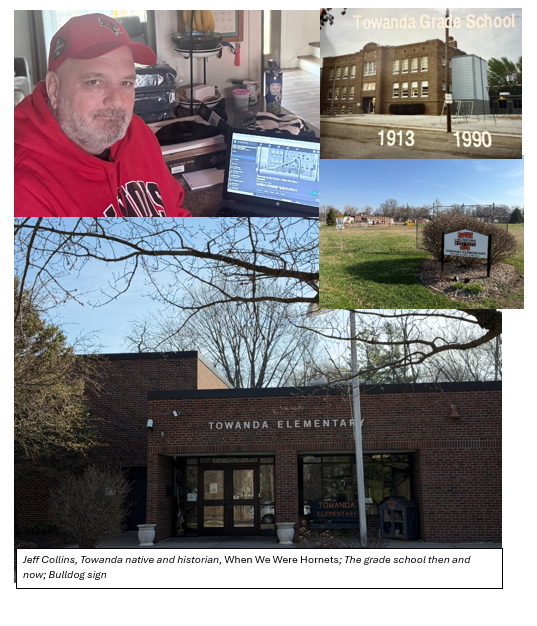
Towanda’s first school, a wood-framed structure, was built in 1866 on the same site that a brick building was constructed in 1913. In 1990 the three-story building was reduced to two stories and remodeled. All grades attended that school until the high school closed in 1948 when Towanda joined Unit 5 in Normal.
In 1960 I graduated from Towanda Grade School (later redubbed as Towanda Elementary School) and began, the next fall, to ride the school bus to high school in Normal. That was the last eighth-grade class in Towanda. The school was reduced to six grades (plus kindergarten) and later to five grades, as middle schools sprang up in Normal. No more inter-school sports for Towanda.
Towanda Grade School was the home of the Hornets when I was there. From fifth grade through eighth grade, the boys played school sports—basketball, baseball, track, and touch football. The girls cheered. No, that wasn’t fair.
About 1991, when the school building was dramatically renovated, the Hornets became Bulldogs. That mascot switch is a bone of contention for old-timers and the source of fun for Jeff Collins, a Towanda native who manages a Facebook site called “When We Were Hornets.” The school now enrolls 200 students today, drawn primarily from Towanda and Money Creek Townships. The school remains the beating heart of the village, on the same site since 1866. It boasts a reputation for excellent academic excellence.
Towanda was once a town of Protestants, with Baptist, Methodist, and Presbyterian Churches. The Presbyterians dedicated their first church in Towanda in 1863, on the corner of Adams and Taylor Streets, where the public library now stands. The Methodists built a church near the railroad track in the center of town in 1867, and the Baptists erected their church in 1869. In 1945, the Presbyterians and Methodists merged to form a Community Church that met in the building formerly occupied by the Methodists. The old brick Presbyterian Church stood empty until it was razed to create a site for the new public library in 1989. (The library district includes Towanda, Money Creek, and Blue Mound Townships). Today, only the Baptist Church remains.
Barton Corporation, formed when Mr. Barton’s construction company began to manufacture concrete saws and other equipment for the concrete industry, was the main industry in Towanda in the eyes of our family. Our friends were children of Barton’s foremen and shop hands. Many of us worked for the Bartons in the summers. I mowed yards at first, later drove a truck to deliver equipment across the country, and in college labored on construction crews in Chicago. Barton Corporation dissolved about 1968, just as I was graduating college. Mr. Barton became president of Judson College near Chicago, and my dad became an accountant for State Farm Insurance in Bloomington. The Barton building has, for many years, housed Alexander Manufacturing, producers of mechanical pencils.
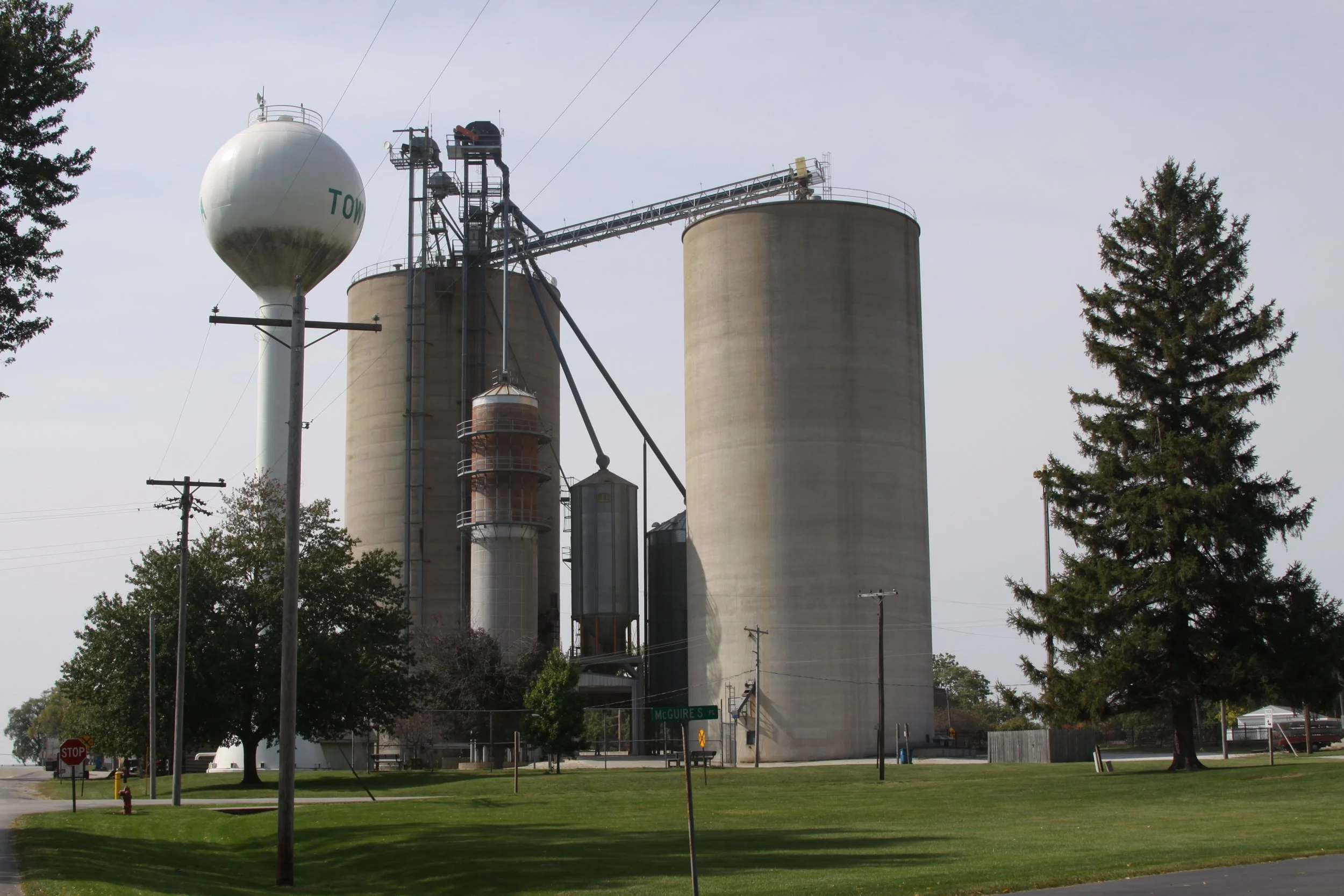
At one time, an Allis-Chalmers tractor dealer operated in Towanda. Near that site now, Legacy Solar delivers solar, electrical, and utility interconnection services across Illinois. Towanda Grain Company, a cooperative of local farmers, stood tall along the railroad tracks, with its elevators reaching to the sky. There are even more tall elevators today, and the enterprise is now part of Evergreen Farm Services.
For decades, Fern’s Texaco, a gas station and café operated by my friend’s family on Old 66, served hot coffee to gossipy farmers in the winter and hamburgers to travelers all year long. Many of us pumped gas at Fern’s at one time or another. In fifth and sixth grade, I biked past Fern’s each day after school, crossed the four lanes of Route 66, and gathered a stack of Chicago Daily News newspapers that the bus had dropped at Jerry Henderson’s farm garage. I delivered them around town. My brother Rod delivered the morning Daily Pantagraph.
The Delco truck stop was also on Old 66, on the side opposite Fern’s and down the road a half mile. Delco was larger than Fern’s, with a second floor to bunk truck drivers and a restaurant where teenagers assembled for milk shakes and French fries. From time to time, a gas station or café or both popped up where Kick’s now stands, and a café rose and fell at intervals on Main Street. Fern’s is now gone. On the Delco site, a much smaller BP gas station and convenient mart called Rapid Rocky’s sells beer, milk, and ice. Rapid Rocky’s is building an addition to include gambling machines, now permitted in the state and by the Village.
The Village of Towanda is governed by an elected Village Board and Mayor who meet monthly in the community building, built in 1965 and expanded in 2013. The community building serves as a meeting place for other organizations, and families book it for reunions, receptions, and funeral dinners. The old community building, originally called the Town Hall, burned in 1966, and on its site now stands a post office, built in 1971. The Towanda Fire Department is housed in a handsome, modern fire station on the north side of town. Its volunteer fire fighters are backed up, when necessary, by the fire fighters from Normal. Towanda and Hudson typically share a policeman.
Thinking About Tomorrow
· Opportunities
· Concerns
· Visions of the future
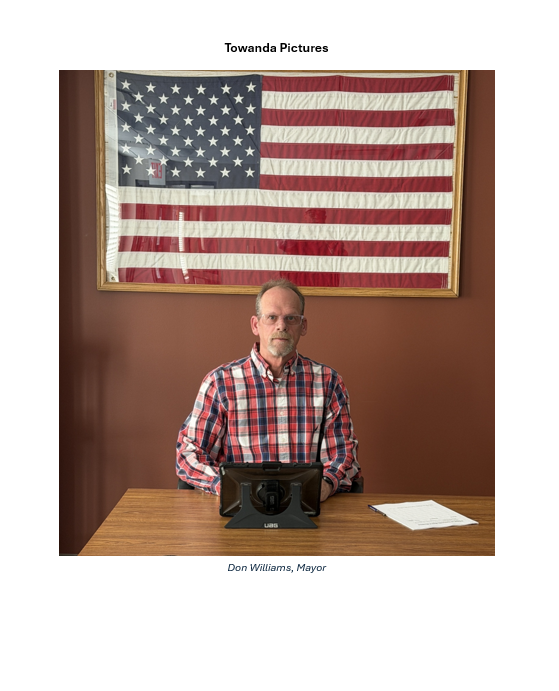
To capture a sense of where Towanda is headed and how it might get there, I interviewed three people. Jeff Collins grew up in Towanda in the 1960s and ‘70s, now lives in Normal just a few miles from his hometown, and manages a Facebook site called When We Were Hornets, dedicated to those of us who attended Towanda Grade School before its mascot, the Hornets, was changed to Bulldogs in 1991. Don Williams grew up in a military family that moved frequently. He ended up in Normal for high school, became familiar with Towanda then, and years later moved to Towanda and ultimately became its mayor. Don has a sharp eye for Towanda’s potential and a commitment to the work required to achieve it. Randi Howell is Towanda’s post office clerk. She and her husband Dave are owners of Duncan Manor, their home and business, a destination site that attracts people from far and near for its events in and around a nineteenth-century mansion about a mile south of Towanda.
Although Jeff is a good 15 years my junior (he retired early from State Farm in 2022), the Towanda childhood of his memory is very similar to my own. Sometime in the 1980s things changed. But during the ‘50s, 60’s, and 70’s, Towanda was full of families with kids. More than now, Jeff recalls, those families spanned two or more generations of grandparents and parents, aunts and uncles, cousins. In the summertime, Jeff remembers, as do I, we lit out in the morning on our bikes, played pickup baseball at the school’s diamond or whiffle ball in someone’s backyard, sometimes pedaled out to Money Creek to fish, got home by suppertime, played hide-and-seek and “ghost appearing” in our yards well into the dark. As we got a little older, we might have been “riding around” in someone’s car, or playing cards at a friend’s house, or huddled over a lantern in a shack we built in the woods by the railroad track. But we were always home before the town’s curfew sounded at 10:00.
Jeff laments the loss of the grocery store on Main Street where his mother worked for Ike Hirst when Jeff was a boy. “It was a place where people met, ran into each other, chatted, caught up on the local scuttlebutt. These days most people in Towanda live here but shop in Bloomington-Normal and go there for activities.” Please see Jeff’s story “Diamonds in the Rough” about baseball in Towanda over the years.
Don Williams is a mayor with vision in every direction, including the past where he sees aspects of Towanda that he thinks should return. The Fourth of July Festival, he notes, was once a two-day event with games in the schoolground (watermelon eating contest, egg tosses, for example) and a dance in the park for kids.” “It is still a major event, but in some ways it has shrunk,” Don observes. “We can do more. We need to bring back the Pancake and Sausage Day as a mid-winter event. It brought people together and was something everyone looked forward to.”
Looking forward, Don believes in collaboration with other communities and advocates for the Red Carpet Corridor, a collaboration of 15 communities that celebrate their link with Old Route 66. Towanda preserves a section of the old road, with historical markers, a walking trail, and an officially designated arboretum. During the Red Carpet Corridor days in May, the section of old highway is filled with antique cars in a show that draws crowds. This year, 2026, marks the 100th anniversary of Route 66.
Don explains that Towanda is locked in by the interstate highway and service road on its north side, the blacktop road and farms on the south side, and the railroad through the middle. “We are challenged to grow geographically,” Don says, “but we can grow socially by connecting with other communities.”
Another barrier to growth is Towanda’s lack of a sewage system. Each home has its own septic tank. The town is also dependent upon Bloomington and its lakes for water, which means it is also subject to increases in rates. “We would benefit from growth in business,” Don says, “because currently most of the businesses like FS (the grain company) and Alexander’s (pencil manufacturers) are not retail and don’t pay sales tax.” Two successful businesses, the Old Rugged Barn and Duncan Manor, both attract tourists and customers for events and vendor fairs, Don notes. But both businesses lie just outside the village’s limits.
Don is active with county organizations and concerned that the Airport Authority may impact Towanda’s taxes. He is an active mayor who is able to see challenges and possibilities in every direction.
Randi Howell clerks Towanda’s post office, which means she is usually the only one there, and always she is fully in charge. This year at Christmastime, when mail delivery is heaviest, Towanda’s rural mail quit her job in exasperation after her jeep broke down. Those of us in rural Towanda went to the post office to get our mail for several days. Then mail carriers from surrounding towns picked up parts of Towanda’s route each day after they delivered the mail on their own routes. Finally, we got a new rural mail carrier. But during the peak pre-Christmas mail week, Towanda’s little post office was jammed full of packages and letters waiting for rural folks to pick them up. Through all this, Randi maintained her usual cool, greeted us with a smile, and made us happy that we had a reason to visit the post office.
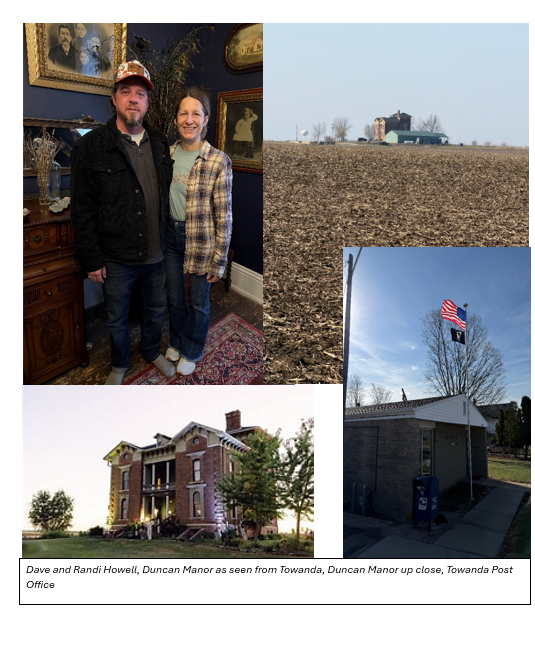
In 2014, Randi and Dave Howell were restless in Colorado, looking for a challenge, and finding it in an old, rundown mansion for sale just south of Towanda. Duncan Manor was constructed on a rise in the flat prairie in the 1870s by businessman and shorthorn cattle breeder, William R. Duncan. It is near the railroad and seen by passengers on every train between Chicago and St. Louis since that time. It was visible from Route 66 and now from Interstate 55. People who now nothing else about Towanda know about the mansion on its outskirts.
Randi and Dave arranged to purchase Duncan Manor and Randi, an Air Force veteran who served in the Kuwait and Iraq, landed a job with the post office in Normal. When they moved into the mansion, it was “like camping out,” Randi explains. Fortunately, Dave brought with him the skills of a carpenter and general handyman. He went to work on the manor house. It is now a home for Dave, Randi, and their two children. It is their business and a focal point for Towanda.
This year, Dave and Randi announced the completion of a large metal building on the manor grounds, a venue that can accommodate 150 people for music, sound baths, and morning coffee. This new addition will add to the many events held at the mansion.
Dave and Randi express a strong connection to Towanda, even though they lie just outside its limits. “The Fourth of July events and Route 66 activities are good for Towanda and good for us to be discovered by more people,” Dave says. He and Randi both suggest that planning and conducting major events like the Route 66 Centennial and Fourth of July Festival are best accomplished by enlisting the help of residents beyond the town’s limits. “Indian Creek, Lamplighter, and the farms around Towanda include many people who care about Towanda and work for it,” Randi notes. “We could be better organized for that kind of Towanda-area cooperation.”
Author’s Reflections
Memories (if applicable)
Summary thoughts
Ike Hirst’s grocery store occupied one of the two-story, brick buildings on Main Street when I was a boy. Helen Oldfield’s grocery store (later Hal Miller’s) was also on Main Street, a block west of Ike’s. On the second floor above Ike’s store, the telephone operator managed our calls. We called her “Central,” or more often by her name. She responded to our ring on the old crank telephones, connecting us with our neighbors. Our number was “two longs on 65,” a party line. On the alley side of the business buildings, was the north park, complete with a bandstand and swing sets, perfect for picnics and Memorial Day speeches. On Memorial Day when I was 12 years old, the band teacher charged me with standing behind a tree in the park with my trumpet, playing an echo to the bugler. Phillip Woodrum, an accomplished trumpeter one year my senior, sounded Taps from the bandstand. I froze, chickened out and slipped away through the backside of the park and ran home. Not my finest moment. Phillip carried on.
Feron “Fat” Brown changed oil in the open air outside his tiny gas station on the west end of Main Street. He also repaired kids’ bike tires for free.
Recently my dentist, Dr. Baker, seeing me stretched out on his dental chair, trying to calm my nerves with conversation, said, “You’re a tall guy. Did you play basketball?”
“Not after grade school,” I answered, “except in a church league. My only athletic accomplishment was as a mediocre member of the college swim team at ISU.”
Doc was surprised. Not that I was not really an athlete, but that I was a swimmer. “Did Towanda have a swimming pool in those days?” he asked.
“No,” I said.
“Well how did you learn to swim well enough to compete on a team in college?”
“We swam in Sucker Hole at Money Creek,” I said. It was great when the creek was high, except for pulling the leaches off our skin.”
Times have changed. My grandson Andrew swam on the high school team in the high school’s own pool.
Moms were everywhere when I was a kid. They drove us to our ball games in Bloomington. They were our Cub Scout leaders and taught the girls to sew in 4-H. My mom sold subscriptions to Reader’s Digest and Avon products, always trying to scrape up a few dollars for the extras. In 1960, she used the money she had squirreled away to buy my dad a set of nickel- plated Colt revolvers, a gift from her and his boys. My mom took a job as the high school cook after I graduated. We had just one car, and my dad took it to work. Mom rode the school bus to the high school each day until someone complained that she was freeloading. The school district kindly transferred her to Towanda, at the grade school a block from our house, where she prepared kids’ meals until she retired.
I suspect mothers still manage to wrangle the kids even while working outside the home. The kids are less free than when I was growing up, more bound to their houses and gadgets, more organized into structured activities in Bloomington-Normal. I don’t see them free ranging on bikes in town or choosing sides for baseball at the schoolground.
I remember the dances at the Community Building next to the railroad tracks, and the floor shuddering as a train rattled by. That old Community Building is gone. Not sure where young folks dance now.
There was the night a snowstorm closed Route 66 and weary travelers slept on the Grade School gym floor and in downtown businesses that opened their doors. I know my neighbors would do the same today.
Things have changed. But I love the place. Towanda is still where I get my kicks.
Author
Author’s Name: Sam Redding
Author’s Place of Residence (county and state): McLean County, Illinois
Primary Sources of Information
Interviews: Jeff Collins, local historian; Randi and Dave Howell, proprietors of the Duncan Manor; Don Williams, mayor
Publications: Towanda, McLean County, Illinois 1826-1976, by Elizabeth Jones Winter and Mildred Hirst Roberts (1976)
Websites: Illinois Digital Archives - Illinois Digital Archives; https://villageoftowanda.org/; Duncan Manor House & Gardens – Duncan Manor House & Gardens; Towanda District Library | Visit, Discover, Enjoy
Other: Rachel Ballinger, director of Towanda Public Library; the McLean County History Museum’s library.
Place
Area reported: Village of Towanda, Illinois, and its surroundings
Timespan: 1800-2026
Most Descriptive Characteristics: (select up to three):
__ Scenic __ Prosperous _x_ Historical _x_ Agricultural __ Industrial __ Medical __ Educational __ Other _______