
Story 12: The Town I Never Knew
How Family Stories Shaped My View of Canton, Kansas
By Sam Redding
This week’s story is a “place” story, a place I have never seen. But I have plenty of thoughts about it. Submit your story at StarHitchers.com.
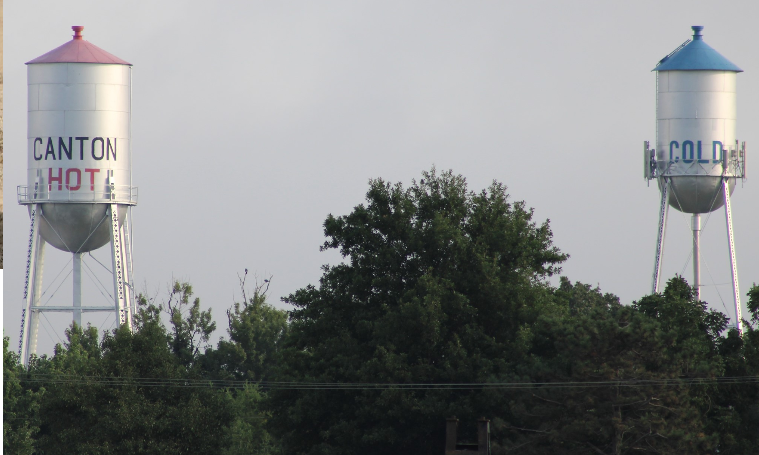
Canton, Kansas, today: My thoughts about Canton have run hot and cold.
The Story
Canton, Kansas, rose from the prairie in 1879 to accommodate the railroad, just north of the old Santa Fe trail. Canton changed the course of my life, even though I never wanted to go there.
My mother’s family lived there in the 1930s. Based solely on my elders’ descriptions of life in Canton, I have always pictured it as a dusty town in a bleak, brown flatland where the wind blew unceasingly.
Like many people of my generation, I grew up hearing stories about the Great Depression. My mother and Aunt Beth told theirs with humor rather than bitterness. They remembered hard times with a twinkle in their eyes, proud of how the family had pulled together and made do.
Still, taken as a whole, the Depression stories left me thinking that Canton was not a place I wanted to be.
“When we lived in Canton,” Aunt Beth explained, “Mama gave me a quarter, and told me to buy groceries for the seven of us. Margie Jean [my mother] and I walked to the store and bought a couple cans of beans and some bread.”
“If we saw a cigarette butt lying in a curb, Margie Jean would pick it up. My brother Clyde and I kept a snipe jar in which we saved the butts so we could shake the tobacco out and roll our own.”
“I saved pennies from the grocery money until I had enough to buy Margie Jean an ice cream cone. We shared the cone once we were around the corner from Main Street.”
“One winter the temperature dropped below zero and the wind howled,” Mom recalled. “Pop ran out of coal and couldn’t afford more, so he tore boards from the horse stalls and burned them. We huddled around the stove to stay warm.”
“I had one sock doll and no other toys,” Mom said, “The doll’s name was Betsy, and I loved her. I loved her until the stuffing came out.”
“The boys each had one pair of bib overalls that they wore to school. They ran around the house in their underwear when Mama did the wash.” So said Aunt Beth, who was a stickler for the truth. That did not, however, keep her from embellishing a good story.
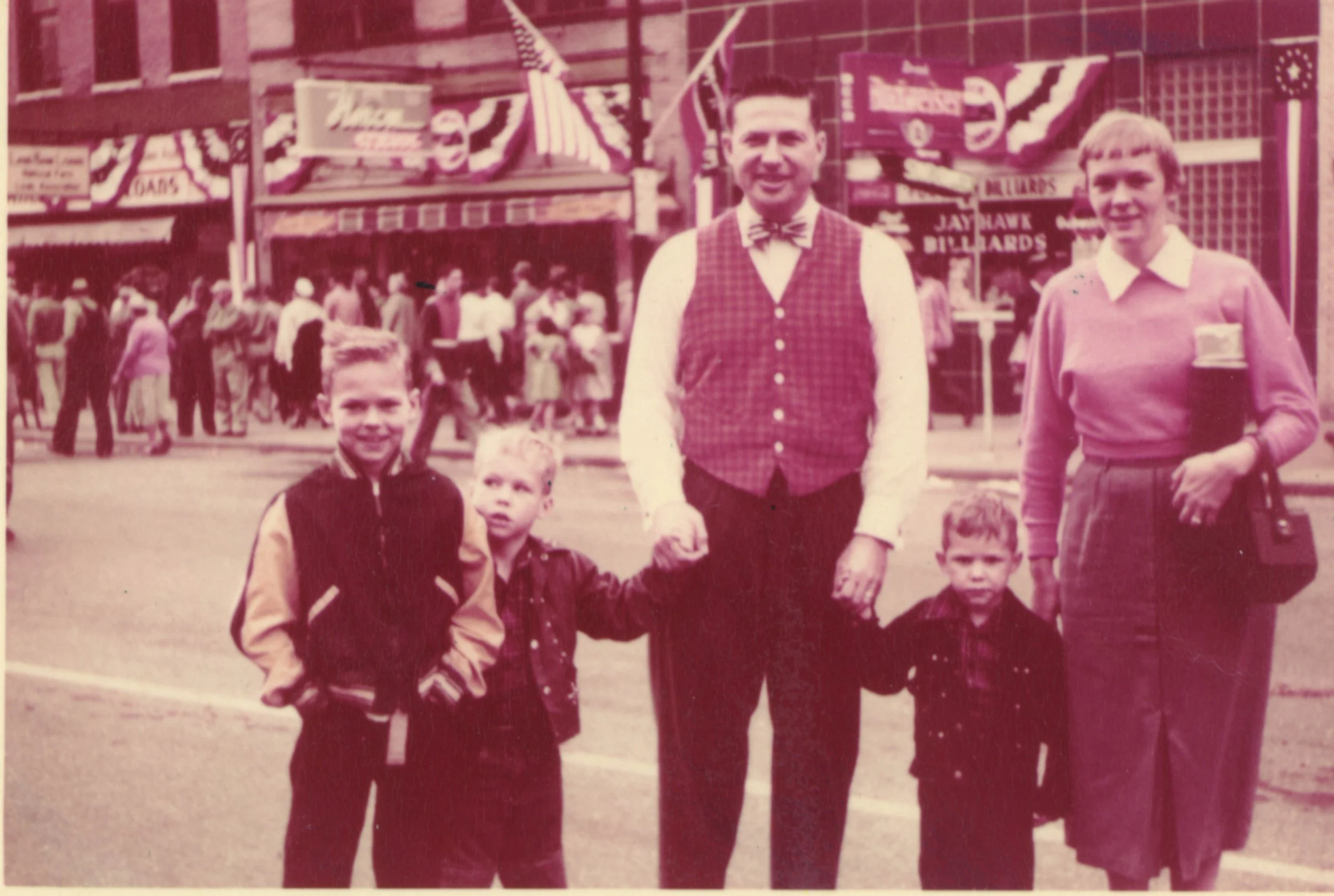
1954 in Lawrence, not long before we decided to leave Kansas. Me (Sam), Rodney, Dad (Roy Lee), Kent, and Mom (Margie Jean)
The Decision Was Ours, Supposedly
I was only nine years old when I first realized that I had an emotional aversion to Canton.
One day after the dinner meal, Dad asked us to stay at the table. Mom cleared the dishes and Dad spread out a big map. My two younger brothers and I sat attentively.
“I have been offered two jobs,” Dad said, “and whichever one I take, we will move far from here. I want your opinions on which job to take.” I am sure Mom had the inside track to the decision, but we three boys took seriously Dad’s desire to include us.
Dad went on: “One job is in Bird City, Kansas, and the other is in Towanda, Illinois.” He pointed to Bird City, way out in the far northwest corner of the state. His finger slid across the map, through Missouri, over the Mississippi River, into the middle of Illinois.
“Illinois!” I shouted, and my little brothers nodded their heads in agreement.
We knew almost nothing about Illinois. We had, however, visited relatives in Missouri and remembered hills, trees, and clear, rock-bottomed streams. Bird City, by contrast, brought Canton immediately to mind. To me, Bird City meant Western Kansas.
Only years later did I realize that Canton was nowhere near Bird City. Geography had little to do with it. In my mind, every hard-luck Depression story belonged to "Western Kansas."
Thanks to our negative impressions of Western Kansas, and our error in placing Canton there, we rejected Bird City. Thus, I was reared in Illinois.
My Mom’s Family Moves West
Mom’s family hailed from Valley Falls, Kansas, in that part of the state where woods crown low ridges and Holstein and Guernsey cows graze the pastures. Her dad, Sam Allen, a blacksmith born in a sod dugout in northeastern Kansas, was 53 when my mother was born in 1923. Mom was the last of his five children from two wives.
Sam Allen had prospered in Valley Falls, his hometown since he was a small boy. Sam owned a large home near the Delaware River and a blacksmith shop in the village.
In 1927, the economy in Eastern Kansas was collapsing and the Ku Klux Klan pressured men in rural communities to join. Threatened with a boycott if he refused to join, Sam Allen decided to pick up stakes and take a job in Hillsboro, Kansas, 140 miles southwest of Valley Falls.
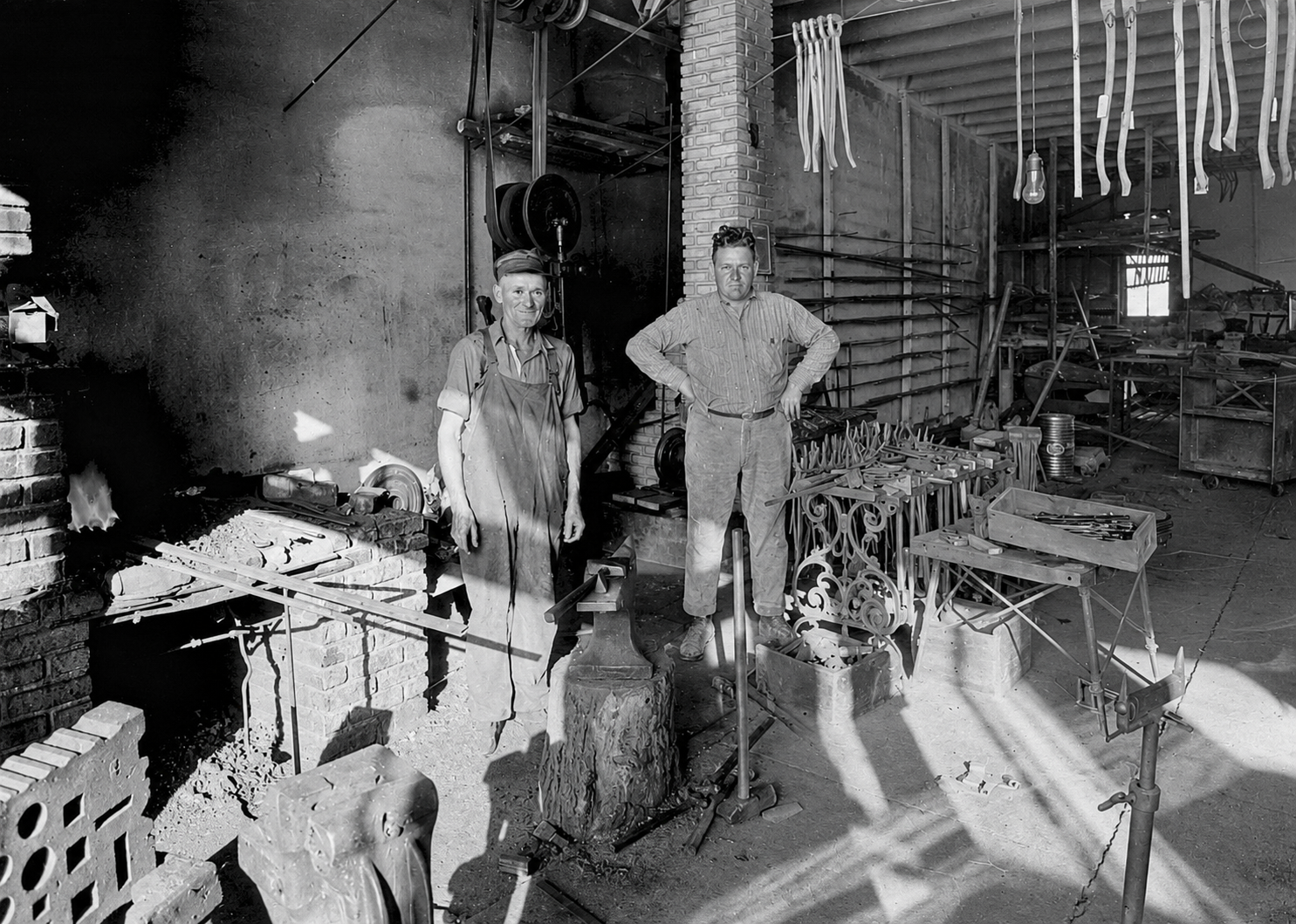
Sam Allen (left) and Pete Jost in the early 1930s in Hillsboro or Canton shop. Sam was in his 60s. Pete was born on a farm near Hillsboro in 1894, homesteaded in Canada, and returned home to buy a blacksmith shop in 1919. The Jost family operates the Jost Welding, Inc. in Hillsboro yet today.
Life in Canton
In Hillsboro, Sam applied his blacksmithing skills in a machine shop owned by a Mennonite man named Peter Jost. My mother and aunt referred to Mr. Jost as the “kind German.”
After a brief stay in Hillsboro working for Pete, Sam moved his family to Canton to run the blacksmith shop that Pete owned there. For eight years through the depth of the Depression, Sam Allen plied his blacksmithing trade for Pete Jost.
Sam’s family lived in a four-room house, where the rent was $10 per month. Unable to pay the rent during the winter months, Sam caught up during the summer when plow season brought more work.
In 1930, Sam and Myrtle (my grandmother) shared the four-room house with Myrtle’s mother, Laura, and their youngest children, Samuel Clyde, Raymond, and Margie. Beth, who lost her job to the Depression in Los Angeles, was also home.
In Canton, Beth did housework and babysat for a family. She worked from sunup to sundown for $2.50 per week, seven days a week.
My Mom’s Family Moves East
In 1935, Sam Allen bought a blacksmith shop in Tonganoxie, Kansas, thirty-five miles from Valley Falls, back in Eastern Kansas. The family moved there that summer.
In an article in the Valley Falls Vindicator, Sam Allen explained his move to Tonganoxie and the difference between McPherson County (Canton) and his homeland in Eastern Kansas:
“Out in McPherson County all the work was crowded into four months and then nothing to do—and as for horse-shoeing, I don’t know of a shod team in the country.”
In 1941, Sam Allen died of a heart attack at his anvil in the shop in Tonganoxie. I lived in Tongie until I was nine. That was when my family chose Illinois over Bird City.
Canton altered the course of my life, even though I never lived there. Remarkably, I have never even visited. My mother and aunt were remembering hard years, not condemning a place, but as a boy I couldn't separate the two.
Perhaps every family leaves us an imaginary map as well as a real one. Mine led me away from Canton before I ever had the chance to know it.
Threads to Follow
1. What place have you formed an opinion about without ever having lived there? How did family stories, books, or popular culture shape that impression?
2. How do hard times become attached to a place? When people recall difficult years, are they remembering the place itself or the circumstances they endured there?
3. What "imaginary maps" has your family passed down? Were there places to seek out—or places to avoid? Have your own experiences confirmed or challenged those inherited beliefs?
4. How did the Great Depression change the course of your family's history? Did economic hardship lead to a move, a new occupation, or a different path for later generations?
5. If you could revisit one place from your family's stories, where would you go? What would you hope to discover that your parents or grandparents never told you?
Author
Name: Sam Redding
Place of Residence: Towanda, McLean, Illinois
Primary Sources: Memories, interviews with family members, internet search, articles about Peter G. Jost
Subject
Place reported: Canton, Kansas
Timespan: 1927-1955
Most descriptive characteristics: Agricultural