
Story 17: In Common
What Stories Tell Us About Ourselves
By Sam Redding
This Star Hitcher story is about the common humanity revealed through stories, with the author’s memories and a life sketch of Abraham Lincoln. Submit your story at StarHitchers.com.
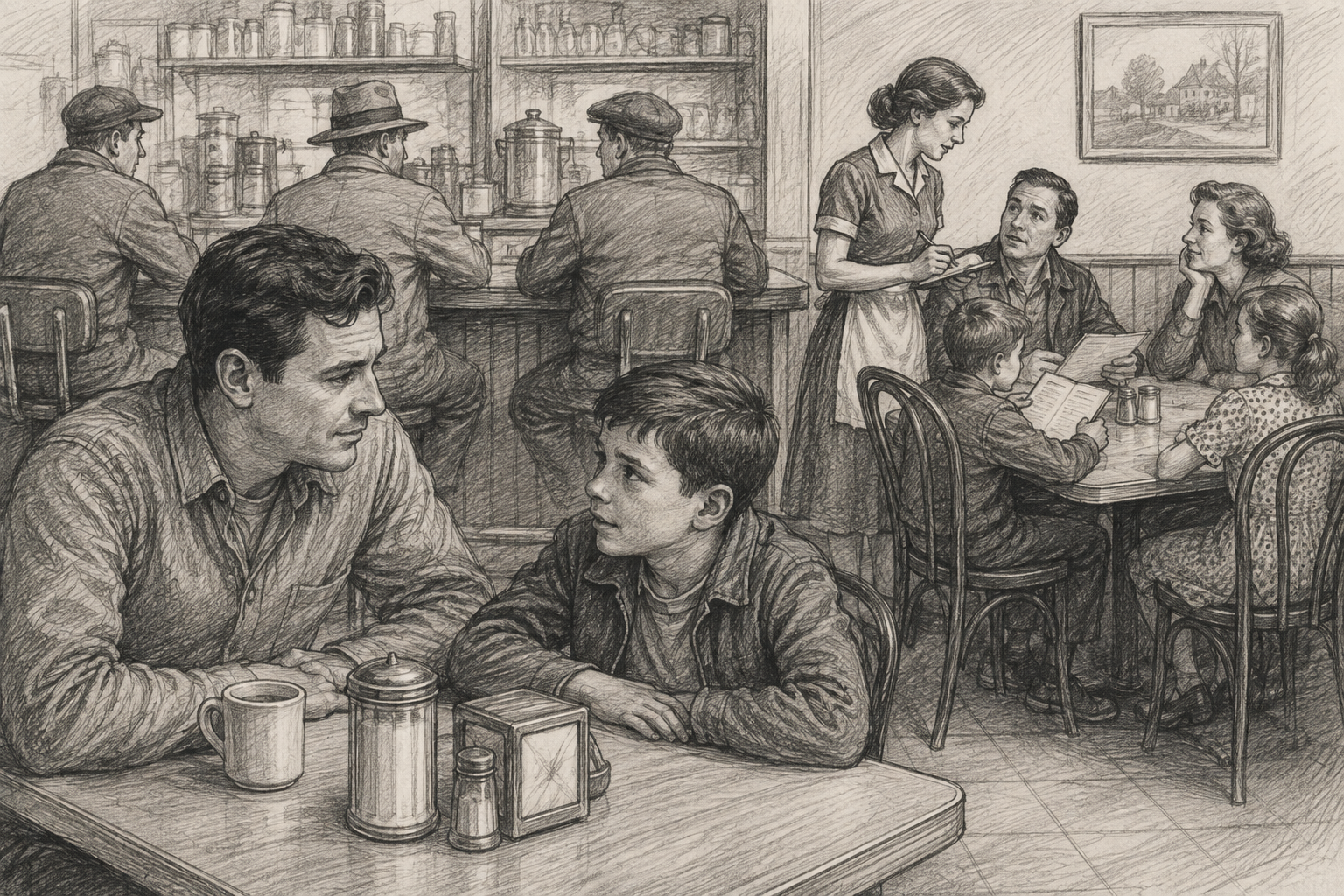
Wherever you go, people are people.
The Story
I was nine, and my dad, dog, and I were tooling our way from Kansas to our new home in Illinois. Our windows were down in the blue, ’37 Chevy, and Ginger was panting in the back seat. Mom and brothers would arrive later by train.
We passed through Kansas City late in the afternoon. School was letting out, and kids filled the streets. I saw, for the first time, a black boy with red hair. He was about my age. Black kids sat in class with me at home. But I had never seen a black person with red hair. I pointed it out to my dad. He nodded but said nothing.
By the time twilight was dimming that May evening, we were near Chillicothe, the home of sliced bread. That is a fact I discovered years later: Loafs of bread were first sliced and sold in Chillicothe, Missouri, in 1928. Go figure.
Dad pulled into a roadside café and told me to crank my window to leave a gap so Ginger could lounge in the car while we dined. We sat in a small, square table in the middle of a softly lit room. Three old fellows at the counter spiked their forks into their meatloaf and turned to each other between bites to mumble. At a table alongside the wall, a mom, dad, and boy and girl about my age, had the attention of a waitress, order book in hand, pencil in ear.
I was gawking around the café room. We were midway on a journey from one place to another place. My thoughts were drifting away.
I thought of the kid in Kansas City. I was curious about the old men at the counter and the family near the wall. I imagined what kind of people we might find in the town where we were moving.
I said nothing to Dad.
Dad was well attuned to my curious nature and, no doubt, sensed my unease. As I recall, he only said, “Remember, wherever you go, people are people.” He said it to reassure me.
_______________
My dad didn’t mean people are all the same. No two of us are alike, and that’s a good thing.
My dad’s simple statement meant that a common strain of humanity runs through us. The way he lived taught me to seek that strain in people and expect to find it.
Some of us have more in common than others. We share similar upbringings, life experiences, interests, beliefs. We are drawn to people with whom we have much in common. We are also drawn to people whose differences from us engage our curiosity.
When we launched the Star Hitchers project, our idea was to collect stories of common people at different times and places in American history.
One Star Hitchers goal is for teachers to use stories to help their students understand life “on the ground” throughout our history. Students might also write about the people and places of greatest interest to them.
It is essential that students learn about the people who have risen to greatness, of course. Their curiosity, however, will inevitably lead them to wonder about the “common” folks.
This curiosity extends from the student’s more immediate concern: “What was going on with my own family back then, or people like them?”
Curiosity is a great motivator for discovery.
Recently, we posted a story by Kathleen Hawkinson, telling of the places and people in her life when she was a child. Kathleen and her husband, Dave, gathered twenty friends and family members to listen to the story together. They discussed the Threads to Follow that we include with every story.
Of course, Kathleen and Dave were both teachers at one time, so placing a learning experience at the heart of a social event came naturally for them. I am hopeful that this idea catches on.
We now know what distinguishes a Star Hitchers story—its focus on an ordinary person or place, its grounding in historical evidence, and its ability to illuminate a larger truth about American history.
__________
That brings me to Abraham Lincoln. No ordinary life, to be sure. But somehow the humanity we share with him is vivid in his life’s every chapter.
Abe’s mother, Nancy, was born out of wedlock in Virginia and raised by her grandparents. Her grandfather struggled to make ends meet and moved the family from Virginia to Kentucky, and died not long after.
Nancy then lived for three years with her mother who had remarried. At age 12, she left her mother to live with her aunt and uncle and called them “mother” and “father.” She became a seamstress.
When she was 22, Nancy married a young farmer, Tom Lincoln. Over the next six years, Nancy gave birth to two sons, Thomas, Jr. and Abraham, and a daughter, Sarah. Thomas, Jr. died in infancy.
Having little success with farming in Kentucky, Tom moved the family to Indiana where the family first lived in a crude shelter. Nancy died two years later at age 34, leaving Tom, Sarah, and nine-year-old Abe.
Abe and his sister, Sarah, grew close in those years. Their dad was aimless according to some who knew him, never quite making a life for his family.
When his wife died, Tom Lincoln returned to Kentucky and immediately proposed to the widow, Sarah Bush Johnson. Sarah brought three of her own children into the marriage.
Abe’s sister, the one to whom he clung when they lost their mother, married and, eighteen months later, died having a stillborn son.
Abe received little schooling, not more than a year in total. He compensated by reading by candlelight after long days laboring on the farm.
When Abe was 21, his father moved the family again, this time to Illinois. Soon after, Abe left home to work on a raft in New Orleans. He witnessed a slave auction.
From here, Abraham Lincoln failed in business in New Salem. He fell in love with a local girl, Ann Rutledge, who soon died. He won and then lost a seat in the state legislature, lost a nomination for the senate, and then was elected President as the nation was being severed in half.
Lincoln and his wife had four sons. Only one survived childhood. Mary drifted into mental illness. Lincoln himself suffered throughout his life from dark melancholy, a depression that drove him near suicide. But to our everlasting benefit, he soldiered on.
___________
The hardships in Lincoln’s life, and his own character, produced the man who saved the nation and freed the slaves. He wrote and spoke words that are now America’s civic scripture, the purest distillation of who we are. What we have in common.
Lincoln’s story deviates from our usual Star Hitchers stories of common people. It is a story of a most common American who became the most uncommonly great American. Yes, that’s my judgement, and here is why.
Abraham Lincoln’s life ended at its crest. When he fell to an assassin’s bullet in April of 1865, he was confident that the war was won. The Civil War had cleaved American from American and left 750,000 dead. Now, it was nearly over.
In winning the war, Lincoln preserved the Union. He issued the Emancipation Proclamation abolishing slavery in rebelling states. He advocated for the constitutional amendments that abolished it throughout the country and made citizens of former slaves.
Lincoln’s greatness was assured by the accomplishments of his presidency. His singularity among all Americans was secured through the words he left us.
We retrieve some of his words from school-day memory. “Four score and seven years ago our fathers brought forth on this continent. . . “ Lincoln scratched out the 271 words for the Gettysburg Address in the days before he dedicated the cemetery at Gettysburg. The graves of the 3,000 Union dead were still being covered. Flags stood at half-mast. The crowd of 15,000 were hushed. Lincoln’s brief address entered history with cadences of the Bible and recognition of the nation’s founding.
A month before his death, the newly elected Lincoln delivered his Second Inaugural Address. The Gettysburg Address may be Lincoln’s most memorable, but the Second Inaugural touched the very arteries of what Wordsworth called “that one human heart.”
Lincoln spoke to what we had in common—North and South. He was merciful in victory.
“Both [North and South] read the same Bible and pray to the same God, and each invokes His aid against the other. . . The prayers of both could not be answered. That of neither has been answered fully. The Almighty has His own purposes.”
He concluded his address, saying:
“With malice toward none, with charity for all, with firmness in the right as God gives us to see the right, let us strive on to finish the work we are in, to bind up the nation's wounds, to care for him who shall have borne the battle and for his widow and his orphan, to do all which may achieve and cherish a just and lasting peace among ourselves and with all nations.”
That is the end of Lincoln’s story.
We are so removed from the details of Lincoln’s early life that we can barely fathom them. Yet there is something familiar in them. It is a story that will not let us go.
Who would have guessed that such an ordinary beginning would produce America's greatest leader?
I think of the people in Lincoln’s life, the people at the café in Chillicothe, the people I came to know in our new town. No two alike. But there is something very human that is common to them.
My father was right. Wherever you go, people are people. Every Star Hitchers story is another attempt to discover what Americans have always shared despite their differences—to understand, in each person and place, what we have in common.
Threads to Follow
1. What did the author’s father mean when he said, "Wherever you go, people are people"? Has your understanding of that idea changed as you've grown older?
2. Think about someone in your own family whose life seemed ordinary. What larger story about America might be revealed by learning more about that person's life?
3. Why are we often fascinated by famous people but overlook the lives of ordinary people? What can ordinary lives teach us that famous lives sometimes cannot?
4. Lincoln's childhood included poverty, loss, little formal education, and repeated hardship. Which of those experiences do you think most shaped the leader he became? Why?
5. Can a single story change the way we think about an entire period of history? Have you ever read or heard a story that made history seem more real?
6. The people in the café, the boy in Kansas City, and Abraham Lincoln lived very different lives. What qualities do you think they all shared simply because they were human?
7. If future historians wanted to understand life in your community today, whose story would you encourage them to tell? What would that story reveal about America in our own time?
8. Star Hitchers argues that understanding history begins with understanding people. Do you agree? Why or why not?
Author
Name: Sam Redding
Place of Residence: Towanda, McLean County, Illinois
Primary Sources: A. Lincoln by Ronald C. White, Jr.; Lincoln’s Greatest Speech by Ronald C. White, Jr.
Subject
Title: In Common
Subtitle: What Stories Tell Us About Ourselves
Name of Subject at Birth: Abraham Lincoln
Birth Date: February 2, 1809
Birthplace: Kentucky
Name of Subject at Death: Abraham Lincoln
Death Date: April 15, 1865
Place of Death: Washington, DC
Spouse(s): Mary Todd
Other Key Locations: Kentucky, Indiana, Illinois, Kansas, Chillicothe, Missouri
Most admirable qualities: Determination; Resilience; Service