
Story 16: Cycling to Freedom
Getting around in the ‘70s
By Catherine Inserra
This Star Hitcher story is about a time and place familiar to many of us in America, and a girl finding freedom with her new wheels—a bicycle. Submit your story at StarHitchers.com.
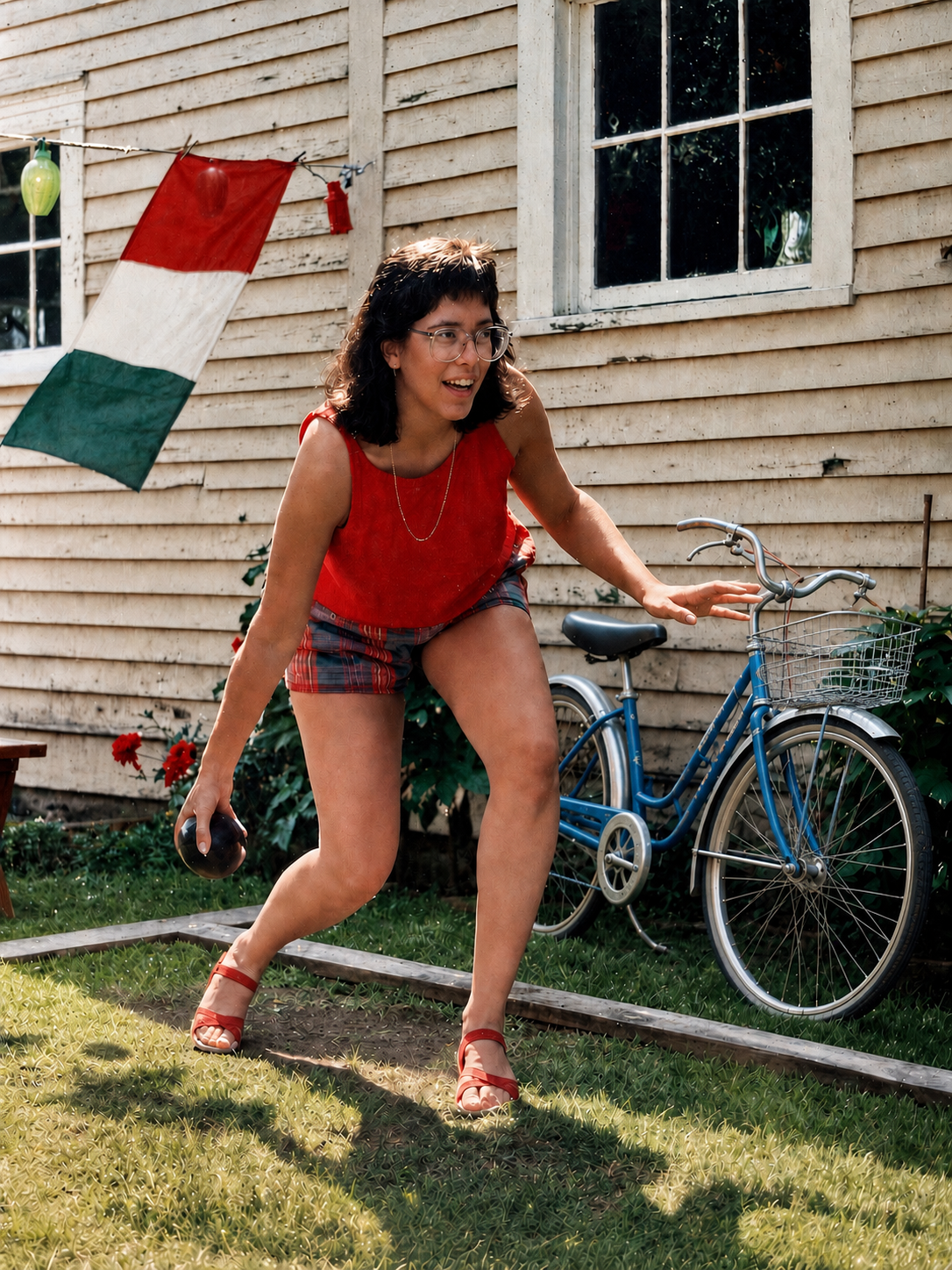
Home from Mac’s Restaurant in time for a bocce ball match in the backyard.
The Story
There was a time when owning a bicycle meant far more than having something to ride. For many suburban teenagers in the 1970s, it was our first taste of independence. Long before we had driver's licenses or our own cars, a bicycle gave us the freedom to earn a paycheck, see friends, and begin discovering who we were.
I earned my freedom one breakfast order at a time.
As a waitress at Mac's Restaurant at Higgins and Cumberland in Park Ridge, Illinois, I hurried from table to table balancing ham-and-cheese omelets, eggs over easy, pancakes with extra butter, dry rye toast, and endless cups of coffee. At the end of every shift, my paper coffee cup was heavy with quarters, dimes, nickels, and an occasional dollar bill. To a fifteen-year-old in 1975, those tips felt like a fortune.
With my first earnings, I bought a blue-and-silver, 26-inch Schwinn bicycle with a basket.
At fifteen and a half, I had wheels.
I could pedal home from Mac’s Restaurant in time for a bocce ball match in the backyard.
I wouldn't be driving for another year, and with two older sisters already competing for the family car, I knew my turn behind the wheel would be limited anyway. My Schwinn changed everything. It fit my six-foot frame, and it carried me wherever I wanted to go. More important, it carried me into adulthood.
It took me to Maine South High School, just a mile and a half from home. It took me to work before sunrise on weekends. It took me to friends' houses without asking anyone for a ride. Every trip reminded me that I was becoming responsible for my own life. The freedom wasn't simply in getting somewhere. It was in knowing I could.
For many teenagers then, bicycles quietly filled the space between childhood and adulthood. They taught us to manage our time, keep commitments, earn our own spending money, and solve our own problems. Parents weren't tracking us on phones. Once we pedaled away from the driveway, the day belonged to us, and with that freedom came responsibility.
When I left for Illinois State University, my Schwinn came with me.
The quiet roads winding through the cornfields around Bloomington-Normal became new territory to explore. The bike carried me to classes, to friends, and to another waitressing job at Monical's Pizza on the Beltline. After long shifts serving pizza, salad, and pitchers of soda, the cool evening air greeted me as I rode home beneath the glow of the little generator-powered light attached to the wheel. The rhythm of pedaling through the night made the world seem both larger and more welcoming.
Freedom, of course, carried risks.
One afternoon, riding along Route 51 near Illinois Wesleyan University, a passing car came too close. Whether startled by the traffic or simply losing my balance, I crashed onto the curb. My faithful blue-and-silver Schwinn escaped with little damage, but I wasn't so fortunate.
As I sat stunned on the sidewalk, friends from the Newman Center happened to drive by. Bonnie and Bernie Bernardi recognized me immediately, loaded both me and my bicycle into their van, and took me to the doctor. There were no urgent care centers in those days. The diagnosis was a broken foot.
On the way home, we stopped at Steak 'n Shake for burgers and fries to go.
The bicycle had given me independence, but that day reminded me that independence never meant being completely alone. Communities looked after one another.
I even crossed the stage to receive my college diploma wearing a cast.
Eventually I climbed back onto the Schwinn and kept riding.
The bicycle stayed with me through young adulthood and into the years that followed. Like many faithful companions, it quietly waited through life's busier seasons. It leaned against garage walls while careers, family, and responsibilities claimed more of my attention. I always found comfort simply knowing it was there.
After thirty-seven years together, another move forced a difficult decision. My old Schwinn had become one more thing that needed to find a new home. I wheeled it to the curb, hoping someone would recognize its worth and give it another life. Perhaps another tall teenager discovered the same freedom it had once given me.
Today the bicycle is gone, but what it represented remains.
Years later, while serving on a board advocating for children, I often listened to my friend Bill Lenters, a hospital chaplain affectionately known as "Spiritual Bill." He liked to compare raising children to teaching them to ride a bicycle. At first, someone runs alongside, steadying the handlebars. There are wobbles and falls. Then, almost without anyone noticing, the child finds balance and rides away on their own.
Looking back, I realize my blue-and-silver Schwinn had been teaching me that lesson all along.
It carried me through a world where teenagers first learned independence one mile at a time. It asked me to be responsible, to trust myself, and occasionally to accept help when I needed it. Like so many young Americans of that era, I thought I was simply riding a bicycle.
In truth, I was learning how to ride through life.
Threads to Follow
1. How did owning a bicycle change the daily lives of American teenagers before cell phones and widespread access to cars?
2. What kinds of jobs were commonly held by high school and college students in the 1970s, and what could they earn?
3. How did suburban communities such as Park Ridge, Illinois, shape the experiences of young people during the 1970s?
4. Why did bicycles become an important symbol of independence for generations of American children and teenagers?
5. How have concerns about traffic, safety, and technology changed the way young people experience freedom today?
6. What lessons about responsibility and self-confidence do young people learn when they are trusted with increasing independence?
7. How did local restaurants like Mac's Restaurant and Monical's Pizza serve as gathering places and first workplaces for many teenagers?
8. Think about a possession—a bicycle, a musical instrument, a first car, or something else—that helped you become more independent. What did it teach you about growing up?
Author
Name: Catherine Inserra
Place of Residence: Park Ridge, Cook County, Illinois
Primary Sources: Memories
Subject
Place reported: Park Ridge and Normal, Illinois
Timespan: 1970-80
Most descriptive characteristics: Neighborly, community