
Story 26: We Could Have Been Rich
A Blacksmith’s Choice
By Sam Redding
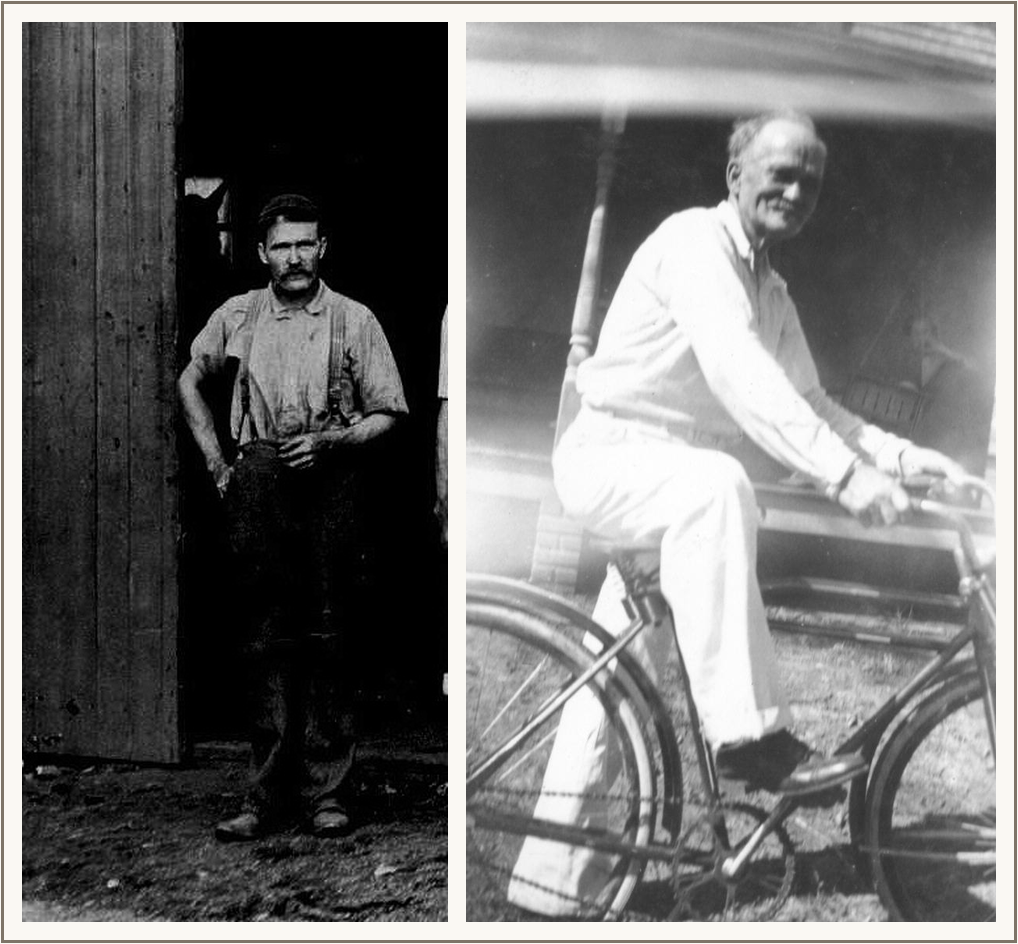
Sam Allen, left, at his blacksmith shop in Valley Falls, about 1912. Sam Allen, right, still on the move at 70, with stories to tell.
In this Star Hitchers story, the author relays a family story of his grandfather’s decision that may have cost the family a fortune but gave them something more valuable. Tell your story at StarHitchers.com. Subscribe FREE at starhitchers.substack.com.
The Story
My mother and aunt often lamented, in good humor and with a sense of irony, that their family could have been rich if only their father had made a different decision, years before they were born. Before their father was even married, he left home in Kansas for Indian Territory in search of his main chance.
A blacksmith with perhaps three years of schooling, Sam Allen sought to improve his fortunes in the Land Rush for homesteaders in what is now Oklahoma.
The opening of Indian lands to white settlement in 1889 brought together several interests. Reformers believed that dividing tribal lands among individuals and encouraging farming would help Indian people assimilate into white society. Economic interests saw an economic boom, with land for railroads, ranches, towns, and settlement. For poor families struggling through hard times, the prospect of a farm offered hope of a better life.
Indian people held differing views about allotment and the future of their nations. Some accepted or supported it; others fought to preserve their lands, communal ownership, and tribal governments. Ultimately, however, federal policy—not the wishes of the Indian nations themselves—determined the course of events.
Back to the story. Sam Allen was born in a sod dugout in Washington County, Kansas, in 1870. He remembered Indians peering through the window of the family's home. He recalled no threat or hostility, only the startling presence of people whose world was rapidly being displaced by the settlers moving onto the prairie.
The Otoe-Missouria reservation included land in Washington and Marshall counties, Kansas, and Jefferson County, Nebraska. The Pawnee were removed to Indian Territory in the 1870s; removal of the Otoe-Missouria began in 1880 and continued into 1881. Sam’s recollection does not establish the identity of the people he saw.
Sam’s father failed to thrive as a homesteader, and moved the family back to Jefferson County in 1875. Sam took up the blacksmith trade at fifteen, and when he was sixteen manned his own shop in Rock Creek.
Making a go as a blacksmith in a tiny settlement was tough business, especially for a teenager. It got tougher in the great agricultural depression from 1882 to 1885, which eased up only long enough for a devastating drought in Kansas in 1889 and a recession that set in from 1890 through 1891.
In May of 1891, Richard Allen, Sam’s father, wrote to his son Eugene, mentioning that Sam was still at Rock Creek and doing a little better. “Times are hard here yet but if we have good crops everything will be all right.”
The letter went on to appeal to Eugene for a loan. “Last winter when Maud [Sam’s younger sister] was sick and after her death I had to have money and we have a very fine cow that I mortgaged for $20, now my note comes due June 17, 1891, and from the way things look now I am afraid I will lose my cow. We have just got a life size crayon picture of Maud it looks very much like her. It cost me $8.00 but it is a good picture. If I can get anything to do I can make it. Well I am still Police Judge but it don’t pay much and work is very dull. It is hard times here this spring.”
About then, Richard Allen, in desperation, petitioned for a pension for his service in the Civil War. He was fifty-six, deaf in one ear, partially blind in both eyes, left arm partially paralyzed, with urinary and heart disease.
From these conditions at home, Sam Allen set out to improve the family’s prospects by staking a claim in Indian Territory.
He was still in Kansas when his father wrote the letter to Eugene in May of 1891. We aren’t sure if he made it to the September run that year, or maybe it was the 1892 run the following September.
The land openings attracted thousands of hopeful settlers. In the September 1891 run, about 20,000 people competed for 6,097 homesteads. At the signal, they raced on horseback, in wagons, and on foot to claim available land.
On January 16, 1893, Sam wrote to his family that he was renting a blacksmith shop in Edmond.
Dear Father and all,
Well, I received your letter some time ago, but I have been so busy I have not had time to answer: that is I have been busy doing nothing. I told you in my last letter that I had rented a B.S. shop here in Edmond. I am right in the center of town next door to the post office. There is five shops in this place and they have all been here longer than I have but I get more work than any one shop in town.
You folks coming down at the opening of the new country? If you do Edmond is the best place to come to and you could come and stay with me. Okay I have quit chewing tobacco and smoking too and I don’t drink a drop now. I have quit that also. Now I am not lying about this, it is true.
I must close. Write soon. With love to all,
Sam Allen
The letter gives us a glimpse of a young man establishing himself in a new town, while inviting his family to join him.
We don't know how long Sam stayed in Oklahoma, or the details of his efforts to stake a claim. From the family story, we know that he came home with a team of horses and told them he had traded his stake for them.
That was the decision that his family lamented.
My mother and her siblings are certain, with no real proof, that his stake would have later produced a flood of oil. And the family would have been rich.
Back in Valley Falls, Sam Allen returned to blacksmithing, served as the township constable, and married. His father died in 1899, and his wife Grace died after childbirth in 1906, leaving Sam with a son, Don, and daughter, Beth.
Sam and his children moved in with his mother Malinda. He later married my grandmother, Myrtle, who brought with her a daughter, Berene. Sam and Myrtle had three more children—Samuel Clyde, Raymond, and my mother, Margie Jean.
That is another story.
Sam Allen, though unschooled, was not without learning. In fact, he was well-read and possessed of a prodigious memory.
His children grew up with heads full of verse learned from their father. “The Face on the Barroom Floor,” “The Shooting of Dan McGrew,” “The Cremation of Sam McGee,” “Abdul Abulbul Amir,” and “Snowbound,” were among their favorites.
Sam Allen died at his anvil on August 8, 1941. His obituary in the Tonganoxie Mirror, the newspaper in the town where Sam moved his family in 1935, read in part:
He was well informed on politics and public affairs and had the faculty of inspiring his children to advance themselves. His son, Don, is now the state's pardon attorney at Topeka, a good lawyer, and has served as county attorney and state senator in Jefferson county. Sam was very proud of this as he had a right to be. The other children likewise have shown aptitude and promise.
There is no greater satisfaction than that of a parent observing his progeny make the most of things. Sam had that satisfaction. Many children have watched Sam at his forge—among them the writer.
The village blacksmith has been glorified in one of our country's notable poems. To us Sam was a typical one. Now that he has laid down his tools at a mature age—his last job finished—we want to put in a word with old St. Peter on behalf of a firm friend, a first-rate father and a blacksmith who viewed the world at large from his forge with understanding and intelligence.
Sam Allen's life produced material for many more stories after his return from Indian Territory with a team of horses. My mother and her siblings believed he had passed up a fortune. Whatever the truth about the land he left behind, his children remembered a father who gave them something more lasting than wealth.
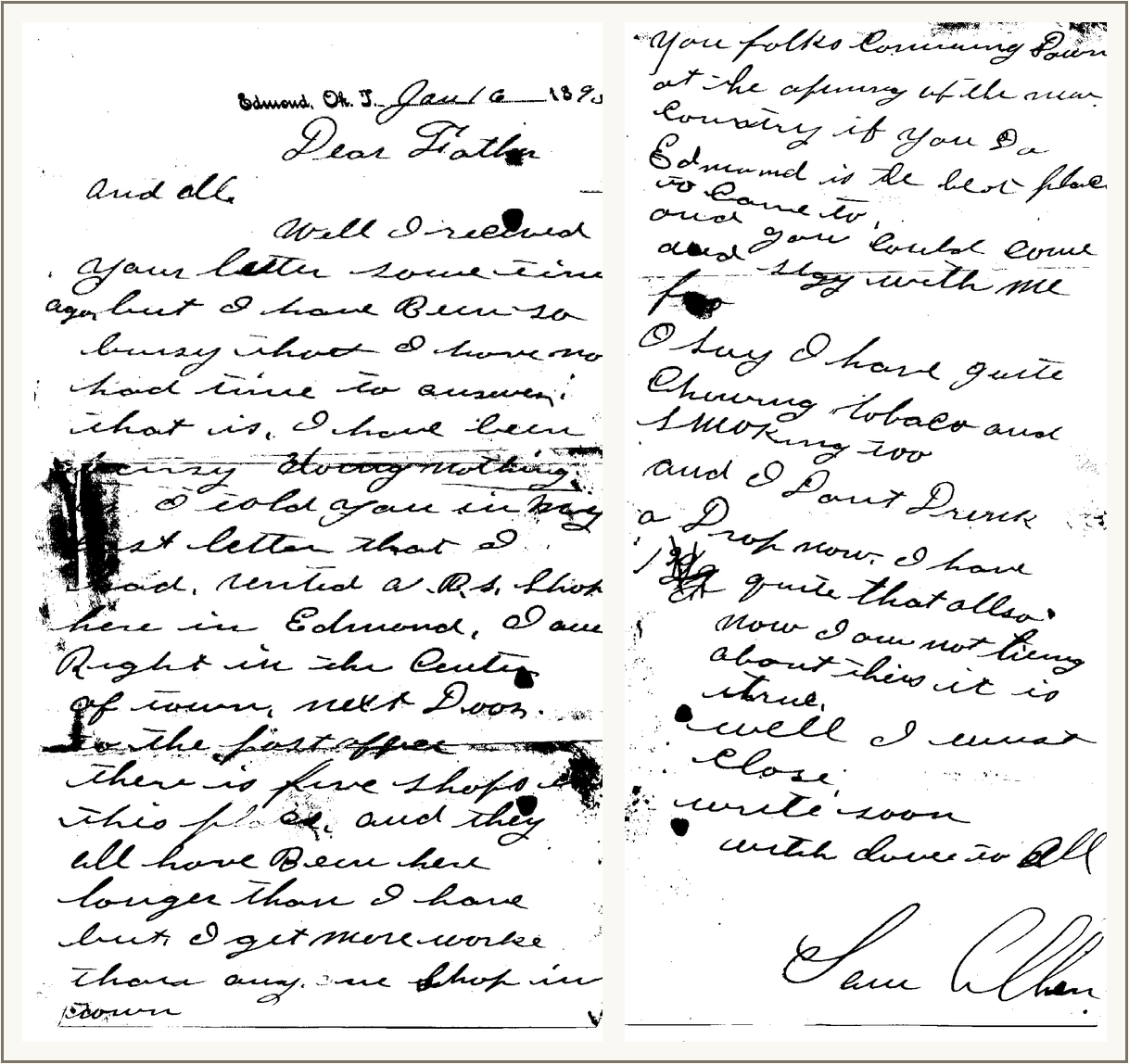
Sam Allen’s 1893 letter home, passed down by his family and given to me by my cousin Patty Haas Brown.
Threads to Follow
Threads to Follow are questions to prompt further discovery, conversation, and discussion.
The land Sam left behind. Can land records, claim registers, or other documents establish whether Sam Allen participated in the 1891 or 1892 Oklahoma land opening? Can we learn what became of the land he may have considered claiming?
The family’s lost fortune. Where did the belief that Sam gave up land that later produced oil originate? Is there evidence connecting his prospective claim to land on which oil was subsequently discovered, or was this a family story built around a decision whose consequences could never be known?
The people at the window. Who were the Native American visitors Sam remembered seeing at his family's dugout in Washington County, Kansas? What can local histories and tribal records tell us about Native American presence and movement in that area during his childhood?
The fortunes of the land seekers. What can we learn about the tens of thousands of hopeful land rushers in what became Oklahoma? Which ones prospered? Which ones returned home?
The consequences of allotment on Native Americans. What do know about the consequences of the allotment program on the Native Americans themselves? How are land holdings managed by them in Oklahoma today?
Sources
• Allen, Richard. Letter to Eugene Allen, May 1891. Family collection.
• Allen, Sam. Letter to his family, January 16, 1893. Family collection; reproduced above.
• “Sam Allen obituary.” August, 1941, Tonganoxie Mirror.
• Family recollections. Recollections of Sam Allen and the family’s belief about the Oklahoma land, as passed down through his children and remembered by the author.
• Kansas Historical Society. “Washington County, Kansas.” Kansapedia. https://www.kansashistory.gov/kansapedia/washington-county-kansas/20742
• Oklahoma Historical Society. “Sac and Fox Opening.” Encyclopedia of Oklahoma History and Culture. https://www.okhistory.org/publications/enc/entry?entry=SA002
• Kansas Historical Society. “Kansa-Pawnee War.” Kansapedia. https://www.kansashistory.gov/kansapedia/kansa-pawnee-war/12109
• Oklahoma Historical Society. “Opening Western Oklahoma.” https://www.okhistory.org/learn/opening5