
Story 25: From Emden to Emden
How East Frisians Found a New Home in Illinois
By Sam Redding
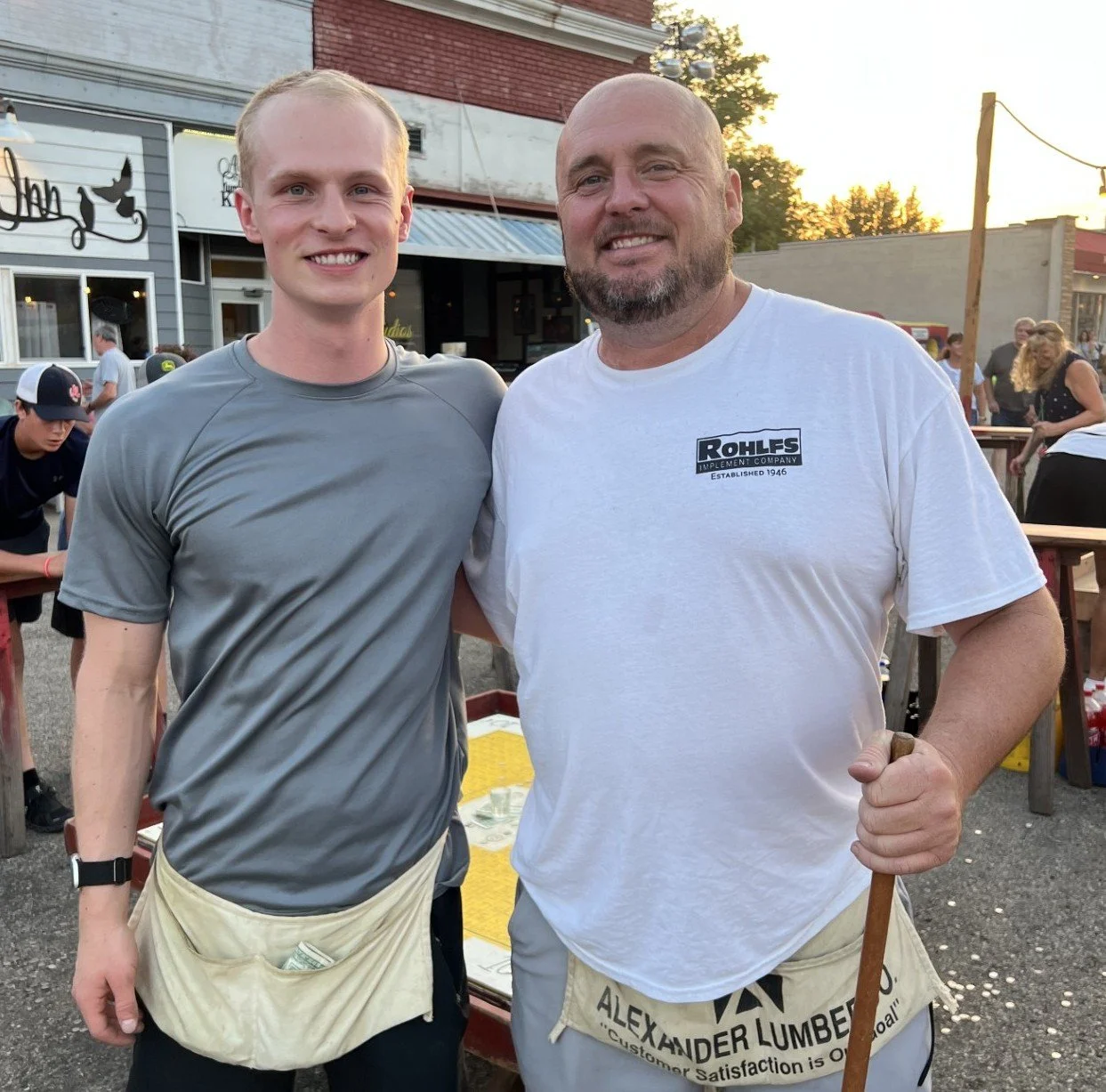
Evan Rohlfs (left) and his father Nathan pitching in at the annual Emden (Illinois) Homecoming. Nathan and his father Leslie, and Leslie’s brother Mike, operate Rohlfs Implement Company, providing and servicing farm equipment in Logan County. Evan grew up in Emden and is now a software engineer in St. Louis. Leslie’s great-grandfather Gerhardt Rohlfs and great-grandmother Anna Aper Rohlfs both had roots in East Frisia. Gerhardt was born in Esens, and Anna was born in Illinois soon after her parents arrived here from Aurich.
This Star Hitchers story is about two towns named Emden and the families that moved from one to another, across the sea. Tell your story at StarHitchers.com. Subscribe FREE at starhitchers.substack.com.
The Story
This is the tale of two Emdens: one in Ostfriesland (East Frisia) and the other in Illinois. It is also the story of the people who migrated from one to the other, and two men, one a German and one an Irishman, who drew them there.
The Frisians’ skills grew over the years, in farming the lowlands and building and maintaining the infrastructure that made farming successful. They built windmills to power the pumps that moved water along canals they carved into the wetlands. They formed dikes and levees to protect their crops from high water.
The farmers learned to yield crops from the rich soil when the water was managed. Cattle thrived on the lush grass. A dairy industry evolved, with exports that contributed to the economy.
Agriculture in the north of what became Germany and Holland required more than the farmers who tilled the soil and shepherded the livestock. Water management with windmills and canals, mills driven by streams, farmers’ wagons and implements—all these relied on skilled artisans. Blacksmiths, mechanics, carriage painters, carpenters, wainwrights, and wheelwrights, all were needed.
The Frisians were limited mostly by the acreage available to them. They reclaimed land from the sea with their dikes and levees, but by the nineteenth century, their population was outgrowing their territory.
The skilled trades first absorbed the ambitious young men that family farms were too small to accommodate. At some point, however, there simply was not enough good work for the men and the families they supported.
As this demand for jobs and land increased to a near breaking point in the middle of the nineteenth century, the Revolution of 1848 spread across Europe and further disrupted the villages and farmlands of East Frisia, then part of the Kingdom of Hanover.
As the situation seemed dire, opportunity came to the East Frisians.
One of their own, a man named Teis Smith (Smid) twenty-one-years old, migrated to America with his parents in 1848. They arrived in Pekin, Illinois, a town founded twenty years earlier on the Illinois River.
The Smith family came from Hamswehrum, East Frisia, a village eleven miles northwest of Emden, the area’s major town near the North Sea. Teis Smith, himself a blacksmith with an eye for business, began making wagons for the farms in central Illinois.
As the Smith Wagon Works took root on the Illinois River in Pekin, the Smiths (Teis and his brothers) returned to recruit workers from their homeland. They knew where to find ambitious young men, skilled in the trades and hungry for opportunity.
About the same time, William Scully, an Irishman with modest land holding in his native country, traveled to the United States where he discovered the government and railroads were selling the swampy prairie land in the Midwest for fifty cents an acre. Scully purchased 8,000 acres in central Illinois in 1850 and another 23,000 in 1851. He had land. He needed farmers.
Where could Scully find farmers who could make low, marshy ground productive? Early settlers had passed by the low prairies of Illinois, considering it poor ground for farming. Scully knew from his experience in Ireland that wet ground could be drained and made productive.
At first he brought fellow Irishmen to take farmsteads as his tenants. When he needed more farmers adept at tilling low ground, he hit upon the Frisians. Whether Teis Smith had anything to do with that connection, we don't know.
The tradesmen of East Frisia, often sons of farmers, longed for land, for the independence of farming. The young men who worked for Teis Smith aspired to gain a foothold for themselves in farming. Some became Scully tenants. Others saved money and bought their own land. Others took up trades that serviced the agriculture industry. Many stayed in central Illinois, building a network of East Frisian families and businesses.
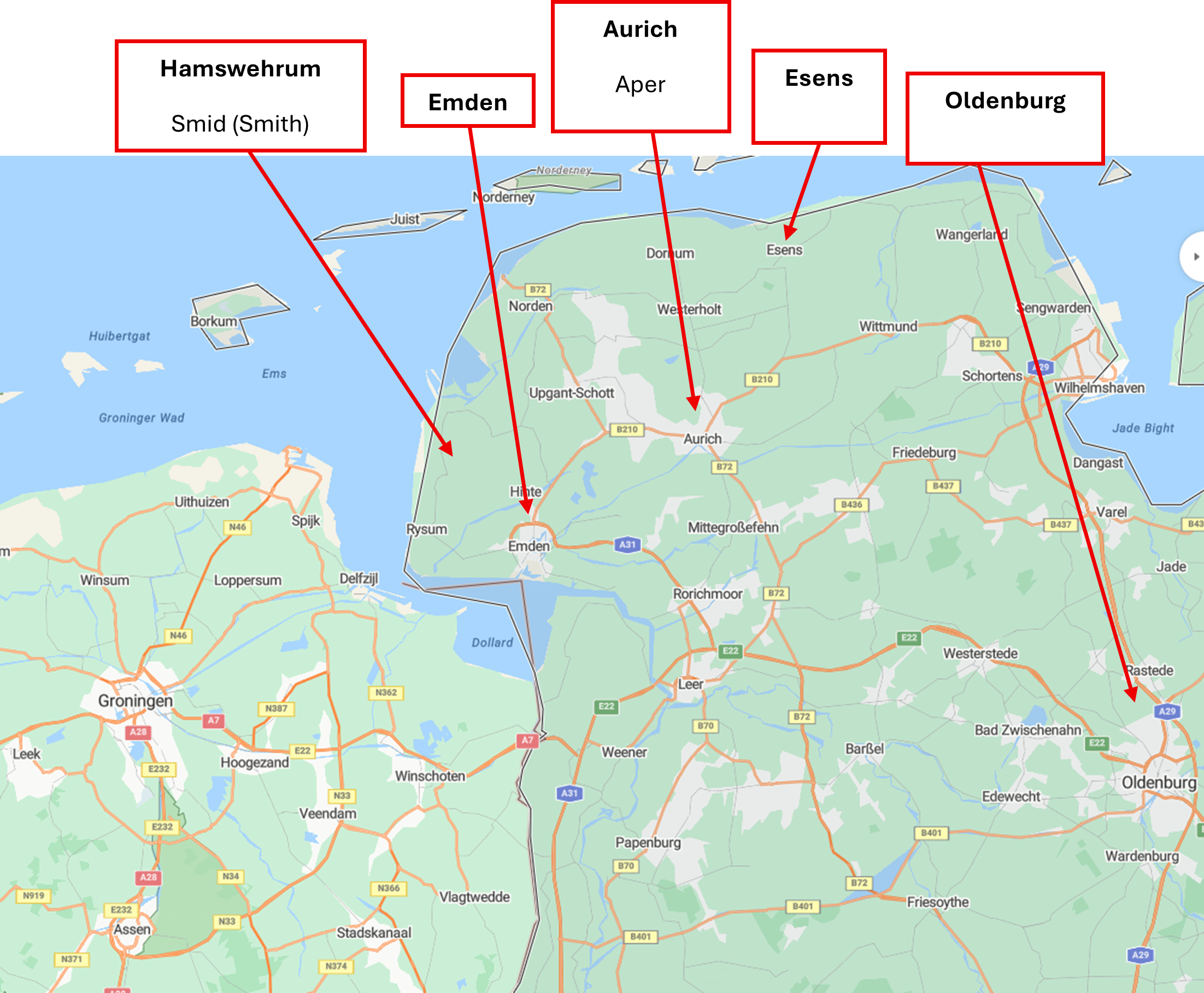
Emden lies in East Frisia on the German side of the Ems estuary. Across the Ems to the west lies the Netherlands. Frisia extends along the North Sea coast through both countries.
The Rohlfs Brothers
Harm Peter Rohlfs was born in Esens, East Frisia, Kingdom of Hanover (now Lower Saxony, Germany) in 1851. He took up the trade of blacksmith and then, at age 17, he bound for America, perhaps at the persuasion of Teis Smith. We cannot know whether Smith recruited Harm. But the circumstances are suggestive.
Harm landed in Pekin (Tazewell County), the town where Teis Smith was building his business and in need of skilled artisans.
Harm Rohlfs married Annetta (Nettie) Lubbers (Luebbers) in 1873. Nettie Lubbers was born in Aurich, East Frisia, 19 miles northeast of Emden. She came to America with her family in 1870 when Nettie was 19 years old.
By 1880, Harm was a farmer in Tazewell County with Nettie and two sons. By 1900, they were on a farm in West Lincoln, Logan County, not far from Emden, a town founded in 1871 on land purchased by William Scully in 1851.
Ralph (Ralf) Rohlfs/Rolfs, Harm’s older brother, born in 1843, arrived in Tazewell County, in 1870, two years after Harm, with the skills of a blacksmith. That year he was a farm laborer near Manito. In 1872, Ralf married Helena Knatzen, a native of Oldenburg in East Frisia. In 1880, Ralf had settled into his occupation as blacksmith in Manito.
Gerhardt Harm Rohlfs, Harm’s much younger brother, born in 1867, left East Frisia and came to Illinois in 1882. Gerhardt married Anna Aper in St. Peter Lutheran Church in Emden in 1888. Anna Aper was born in 1868 in Peoria, Illinois, the year her family arrived from Aurich, the same town in East Frisia where Annetta Lubbers was born. Within a few years, the Apers were living near Emden in Logan County, her father a carpenter.
In 1888, Harm and Gerhardt Rohlfs were naturalized on the same day, October 19, 1888, in Urbana, Illinois. Ralf became a citizen in Tazewell County in 1892. They had established new lives in a new land and were here to stay.
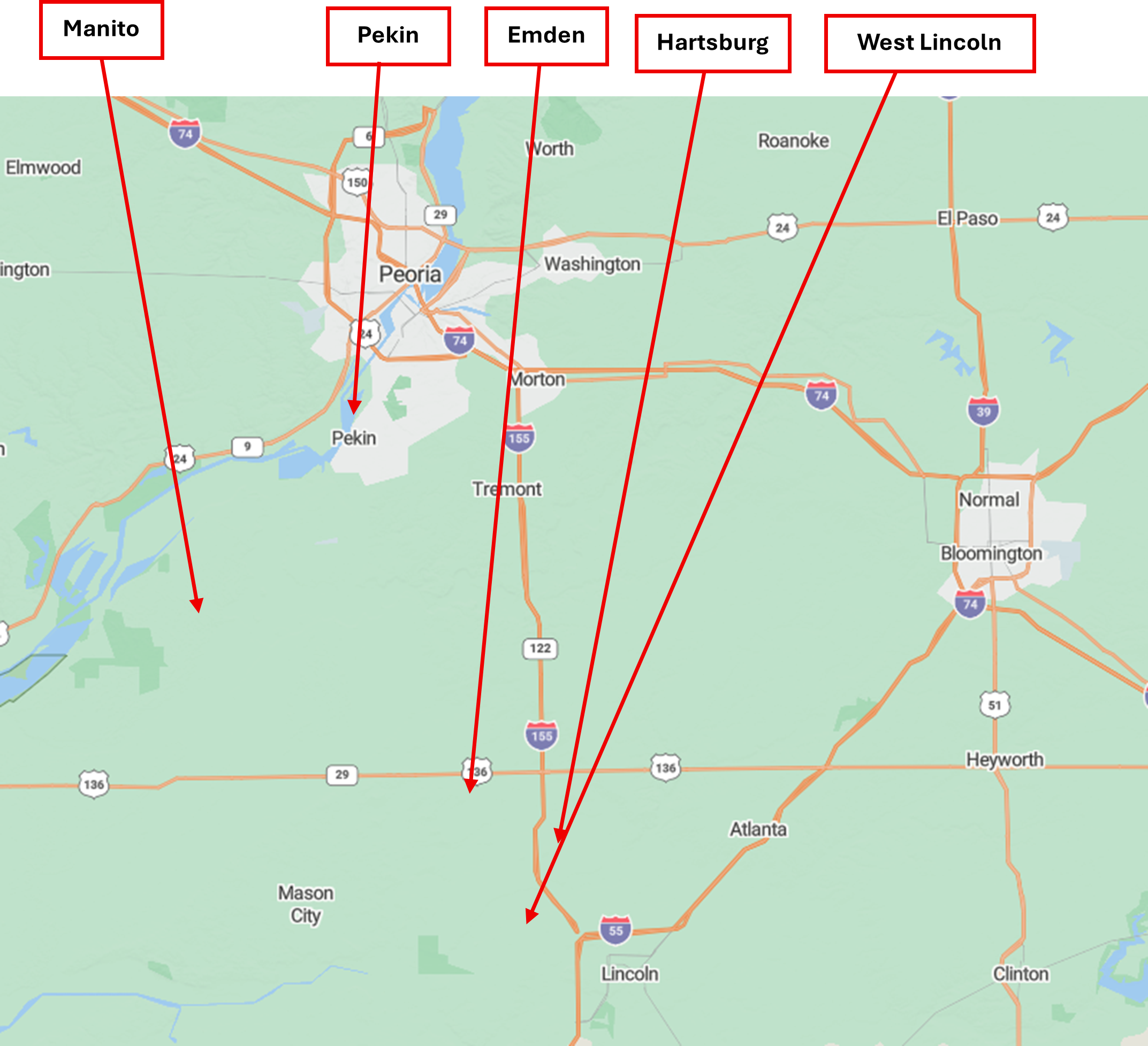
Map of central Illinois. For reference, the distance from Peoria to Bloomington is 40 miles.
The Rohlfs brothers came as artisans. Their German in-laws came as artisans and farmers. Both streams converged in the German community that grew around Emden, where Scully's enormous land holdings created opportunities for immigrant farmers.
Perhaps this was how the migration worked more broadly. A young man with a trade could find work in Pekin. A family looking for land could find opportunity farther south. Once established, family and community connections helped draw others from East Frisia.
The German migration into central Illinois may have had two complementary economic stages: skilled German immigrants could first find work in Pekin's wagon and carriage industry, while the expanding agricultural economy around Scully's Logan County holdings offered another place for German families to settle and farm.
The name Emden may have helped reinforce the attraction of the new community for East Frisian immigrants who had first migrated to Pekin and the industries along the Illinois River.
The families we have followed from East Frisia to central Illinois—Rohlfs, Aper, Lubbers, and Knatzen—all married spouses with roots in East Frisia in their first generation in America.
Today, Rohlfs are plentiful in central Illinois. Some are farmers, others artisans who service farmers. Many have taken new routes in life. Including a software engineer.
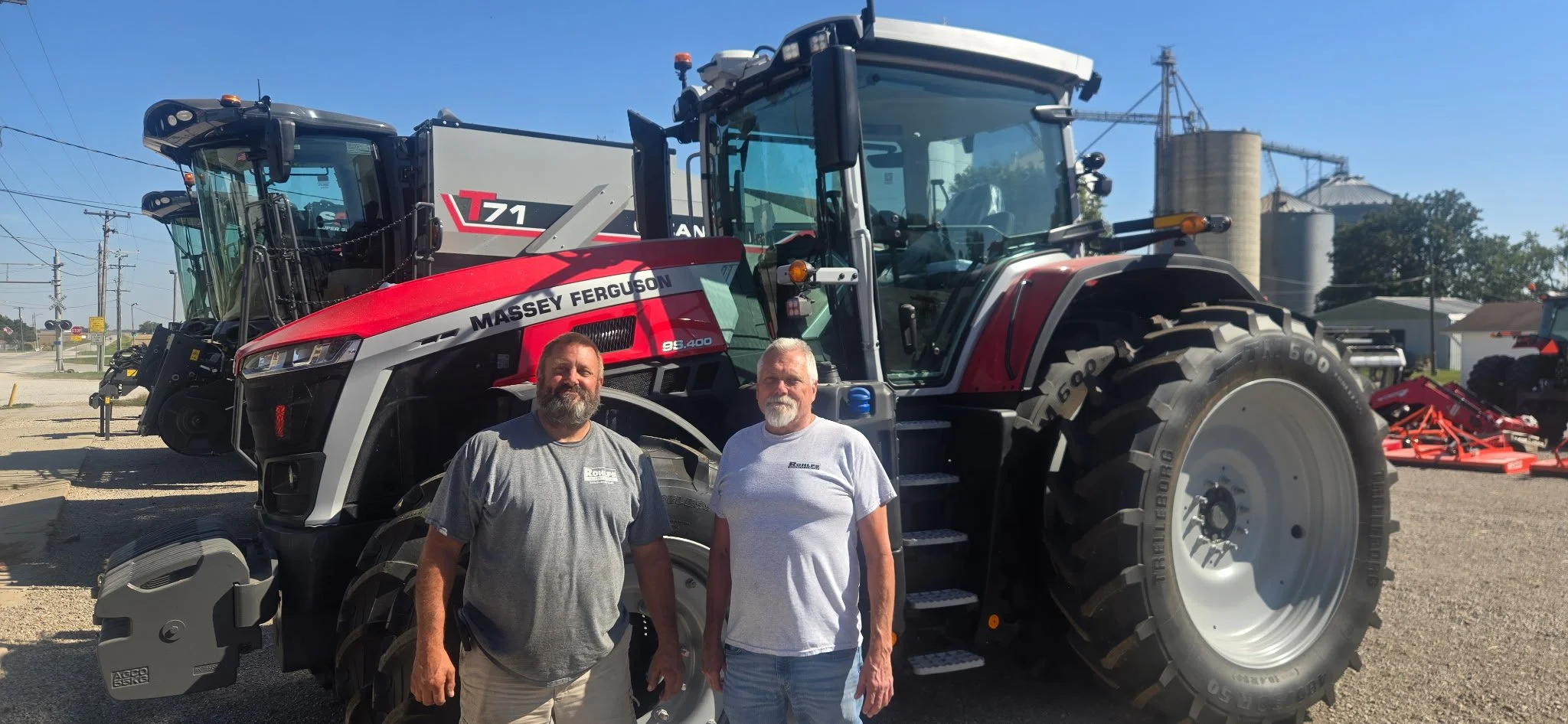
Mike Rohlfs (left) and Leslie Rohlfs, with brother Tom (retired), took over the implement business from their father, Alvin Rohlfs. They operate stores in Hartsburg and Greenview.
Threads to Follow
Threads to Follow are questions to prompt further discovery, conversation, and discussion.
1. How many East Frisian families came to central Illinois through the networks created by Teis Smith and William Scully?
2. Did other skilled tradesmen follow the same path from East Frisia to Pekin and then into the farming communities around Emden?
3. What became of the East Frisian identity carried by the families who settled around Emden, Illinois?
4. What other immigrant groups followed a similar pattern, pursuing opportunities for work and land and settling within a common area?
Sources
Interviews with members of the Rohlfs family
1971 Emden Centennial Historical Book, compiled by the Emden Historical Book Committee
Obituary of Harm P. Rohlfs
Obituary of Anna Aper Rohlfs
Landlord William Scully, by Homer E. Socolofsky, 1979
William Scully and the Scully Estates of Logan County, Illinois, by Paul J. Beaver, 2003
Ancestry.com access to:
Records in Germany, including baptisms and marriages in the Lutheran Church
U.S. Census accessed through Ancestry.com
Illinois Marriage Index
Evangelical Lutheran Church in America Records
East Frisia, Germany, Fire Insurance Registration
U.S. Immigration Records
U.S. Find a Grave Index
Historical Encyclopedia of Illinois and History of Tazewell County
Author
Name: Sam Redding
Place of Residence: Towanda, McLean County, Illinois
Primary Sources: Please see sources above.
Subject
Place reported: East Frisia and its major city, Emden, and the area in Illinois where East Frisian settled and founded a town called Emden there
Timespan: 1840-1888, plus some more current
Most descriptive characteristics: Historical, agricultural