
Story 27: One Move Too Many
The Man Who Didn’t Return
By Sam Redding
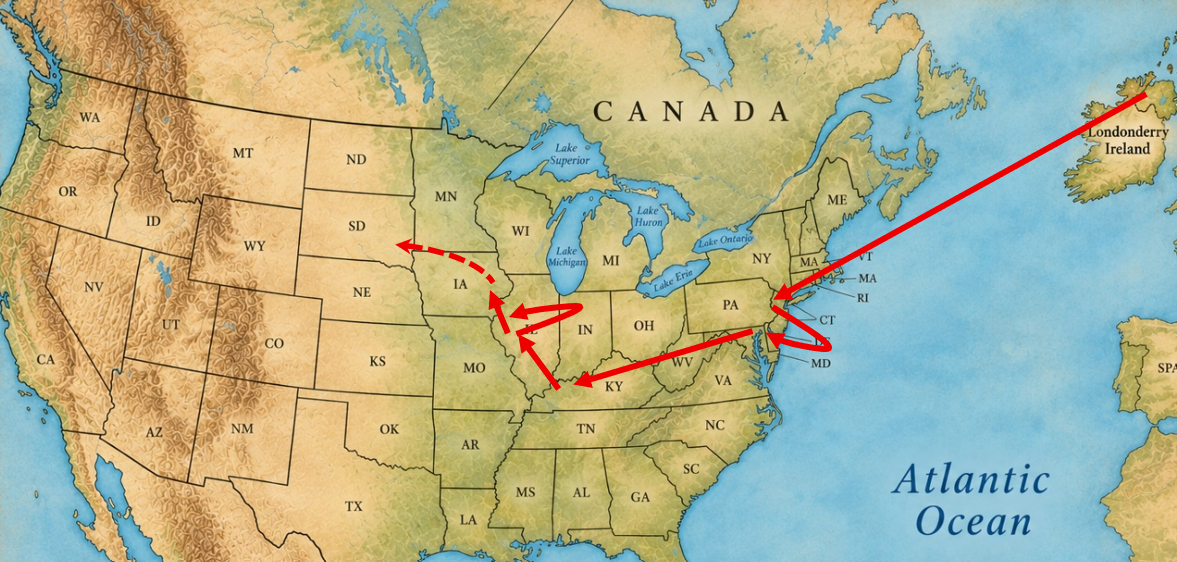
This map traces the movement of one of many branches of the Gilliland family, described in this story.
This Star Hitchers story is about a family from Ireland that moved ever westward, and one man who moved one too many times. Tell your story at StarHitchers.com. Subscribe FREE at starhitchers.substack.com.
The Story
The historian Frederick Jackson Turner once described the Scots-Irish frontiersman as “altogether too restless to have his continual abode within the space of two hundred acres.” For some families, the frontier was never simply a place to settle. There was always another place to go.
The Gillilands were such a family. For generations, they moved westward, following the opportunities that opened before them. But one move, made in 1850, would leave a wife and children behind, with no certainty about what had happened to the man who left.
A Family on the Move
Thomas Gilliland, grandfather of our subject, also named Thomas, came to America in 1737 from County Londonderry in Ulster, Ireland. He arrived as an infant, possibly born at sea. The family settled first in Pennsylvania, then moved to Maryland, where Thomas’s son Robert Gilliland was born, and later to Kentucky.
Robert married Nancy Roberts, daughter of Abner Roberts, a Virginian and veteran of the Revolutionary War. Their children grew up on Plum Creek in Shelby County, Kentucky. According to a biography of their grandson, Dr. William Gilliland, an Illinois physician, Robert was one of Kentucky's honored pioneers and a friend of Daniel Boone.
Two of Robert and Nancy's sons, Thomas and William P., carried the family tradition of moving into new territory.
Thomas was born in Kentucky in 1798. He married Polly Juett there in 1818, and by 1824 they had moved to Morgan County, Illinois. William P., born in 1805, married Letitia Curry in 1827. That same year, William P. and his father, Robert, moved their families to Illinois, near Thomas.
In Illinois, William P. farmed and tanned leather; Thomas farmed. Both served in the Black Hawk War in 1832. Both purchased public-domain land in Morgan County between 1828 and 1836, acquiring 240 acres each at $1.25 an acre.
They had land and livelihoods. But they weren't there to stay.
Settlers from Illinois moved into what is now eastern Iowa after the Black Hawk Purchase opened the land to settlement. Thomas was among those who made the journey. So were Francis Redding and his father, James. The two families' paths crossed in Diamond Grove Township, Morgan County, where John B. Redding, son of Francis, was born in 1826.
The Gillilands and Reddings would become connected in ways that mattered long after they left Illinois.
Two Brothers, Two Paths
In 1841, Robert and William P. Gilliland moved from Morgan County to Adams County, Illinois. This time, they stayed.
Robert died in 1854; Nancy lived until 1869. William P. settled on a farm near Mendon, raised nine children, and remained there until his death in 1897. His obituary remembered him as a pioneer of Adams County, an earnest and conscientious citizen who took an interest in public affairs and held local offices.
William P.'s son William E. also put down roots. After farming, including two years in Kansas, he attended medical college in St. Louis and returned to Adams County. He practiced medicine for more than thirty years and served as a justice of the peace and held offices in the Methodist Church.
William P. had moved from Kentucky to Morgan County and then to Adams County. He had traveled a considerable distance, but he had found his place.
His brother Thomas was different. For him, there always seemed to be another place to go.
Iowa: A Family Established
Thomas and Polly Gilliland had lived in Iowa for years. Their daughter Margaret married Joseph P. Parker in 1845. In February 1850, their daughter Mary Ann married John B. Redding, the young man born in Morgan County when the families lived there. Two months
later, their son John William married Mary T. Settle. All three marriages took place in Des Moines County.
The family appeared established. Yet by the time of the 1850 census, Thomas was gone.
Family tradition says he had been drawn to California by the discovery of gold. The records establish neither his destination nor his motive, but the timing fits the great movement westward that followed the California Gold Rush.
Whatever Thomas intended, he left Polly with a family still needing her care.
In 1850, Polly was living in the household of her newly married son John William and his wife. With her were daughters Sarah and Rebecca and her daughter Nancy, then twenty-six. Nancy had an intellectual disability and would remain with her mother throughout her life.
Thomas's departure left Polly responsible not only for herself but also for Nancy. His absence would shape the lives of both women for decades.
The Man Who Didn't Return
The public record offers fragments of Thomas's fate, but no final answer.
On July 12, 1849, the dead letter list in the Burlington (Iowa) Hawk Eye listed Thomas Gilliland or Josiah Parker and Company and a Sarah Gilliland.
On November 16, 1851, Polly Gilliland filed a petition for bounty land based on Thomas's service in the Black Hawk War. She described herself as the widow of Thomas Gilliland, deceased. She recounted their marriage in 1818 and his military service, stating that her husband had “died at or near Agency.”
Agency was the area set aside for the Sac and Fox Indians, near the Missouri border, where the Gillilands had settled. Polly received forty acres in 1852 for Thomas’s military service.
But she apparently did not know precisely when or where Thomas had died.
In 1855, she petitioned for additional acreage under a new act of Congress. An affidavit submitted by William and Josiah Parker offered a different account: Thomas had died en route to California in the spring of 1852, rather than in 1850. There was no indication of how far he got or where he died. Polly received another 120 acres in 1856 and assigned that acreage to James Redding, brother of John B. The reason for the assignment is not known.
The two accounts leave questions unanswered. Did Polly initially believe Thomas had died near Agency and later receive information that he had gone west? Was the later date based on something Parker knew firsthand, or was it family understanding repeated in an affidavit? The surviving evidence cited here does not tell us.
Later family stories remembered Thomas as a man who set out for California in search of gold and never returned. That tradition may preserve the truth of his destination, but his death remains unverified.
Thomas's final move may have been no different in spirit from the many moves that came before it. He had always been the first in the family to seek new land. This time, however, the consequences were different. Whatever happened to him, his family had to carry on without him.
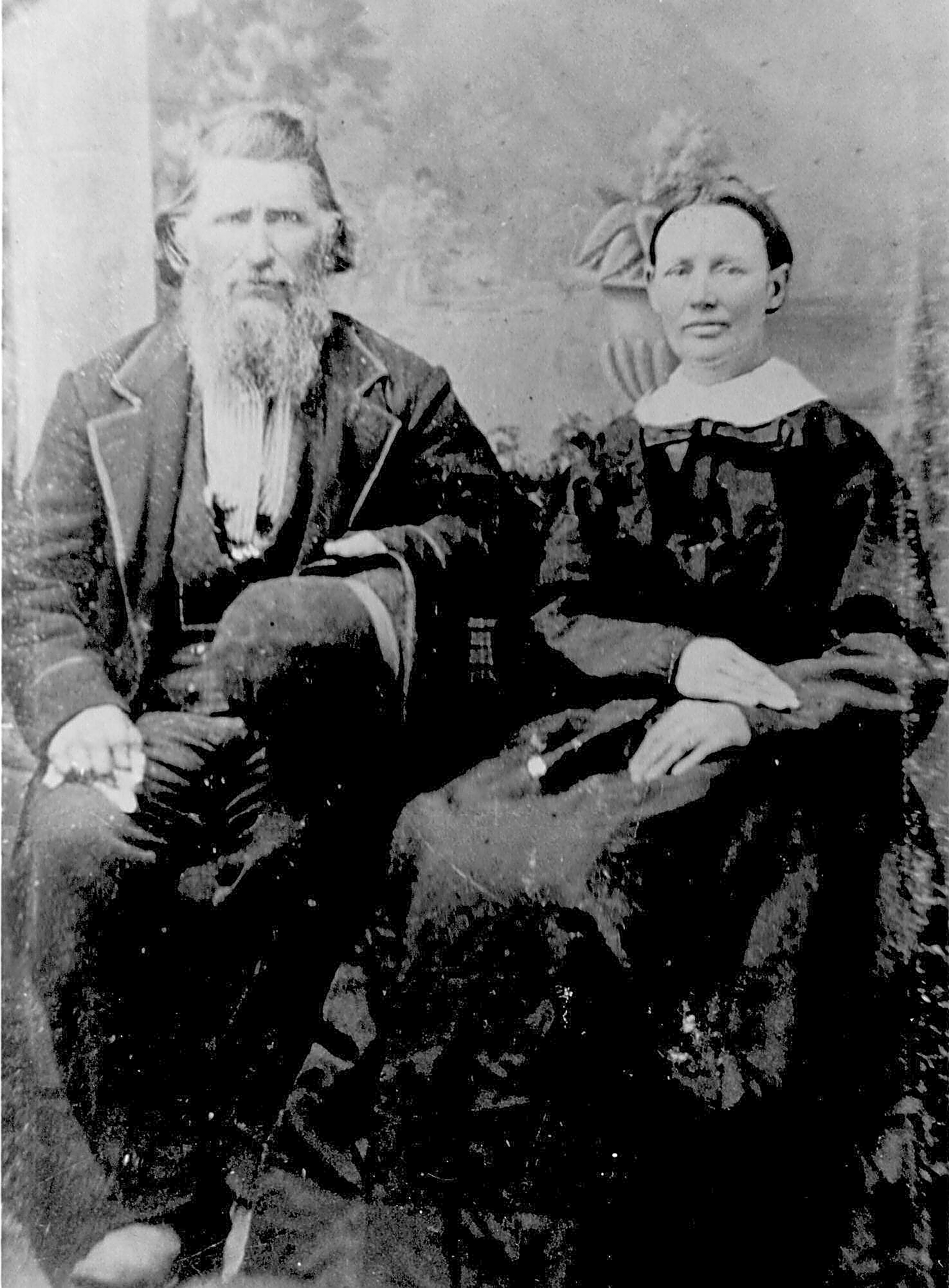
John B. and Mary Ann Gilliland Redding in Missouri about 1865.
Family Made Room
Polly and Nancy did not face the years that followed entirely alone. They moved among relatives who took them in.
In 1852, Polly's son John William set out for Oregon. Polly and Nancy then found refuge with her daughter Mary Ann and son-in-law John B. Redding.
The Reddings themselves were preparing to move. In a letter written in March 1856, Catherine Berrier McClure told her uncle that James Redding had moved to Missouri the previous fall and that Francis Redding, the family patriarch, had sold his land and planned to follow. Others in the extended family were also moving west.
About 1856, John B. and Mary Ann Gilliland Redding moved to the Iowa-Missouri border. They established small farms on both sides of the state line and became known for their orchards. John B. and his father, Francis, were among the few literate men in the area, and their names appeared as witnesses on many legal documents.
In 1860, Polly, then fifty-eight, and Nancy, thirty-three, were living with John B. and Mary Ann in Putnam County, Missouri. The household also included the Reddings' seven children.
Mary Ann's family had made room for them. Polly and Nancy had a place to live, and they remained together.
By 1870, John B. and Mary Ann had ten children. The household had grown, and Polly and Nancy were back in Iowa. The census found them in Benton Township, Des Moines County, apparently maintaining a household of their own next door to Polly's daughter Rebecca Johnson and her family.
Polly was seventy-three; Nancy was forty-two. The records do not tell us why they left Missouri or how they managed their daily lives. But once again, they were close to family.
Both women had died by 1880. Rebecca and her husband, Elijah Johnson, had moved on to Nebraska.
That is where the documentary trail of Polly and Nancy ends.
One Move Too Many
The Gilliland story began generations earlier with a family that crossed an ocean and continued moving across America. Thomas followed that pattern from Kentucky to Illinois, then Iowa, and finally—according to family tradition—toward California and the promise of gold.
His brother William P. also moved, but eventually settled in Adams County, where his family prospered. Thomas's last move left a different legacy: a wife who filed petitions to secure land, a daughter who depended on her, and a family left to piece together what might have happened.
We may never know where Thomas died, or even whether the family's account of his journey to California was entirely accurate. The petitions preserve uncertainty, not a definitive answer.
But another part of the story is clear. Polly and Nancy kept moving, too. They lived with a son, then a daughter, then near another daughter. Wherever they went, family made room for them.
Thomas disappeared from the record. Polly and Nancy did not disappear from the family.
Perhaps that is the other lesson of this story. The restless frontier offered new opportunities, but it also carried risks that could be borne by those left behind. Thomas made one more move. His wife and daughter spent the rest of their lives finding a place to stay.
Threads to Follow
Threads to Follow are questions to prompt further discovery, conversation, and discussion.
Black Hawk War and Iowa settlement: The soldiers who served in the war to remove the tribes from Illinois in 1832 were among those who settled in the land opened across the Mississippi River in 1834 and also received bounty land for their military service. What became of Black Hawk and the Sac and Fox people?
Thomas's final journey: Can the original bounty-land file or other surviving records establish what Polly and her family knew about his departure and death?
The California story: When does the family tradition of Thomas's gold-rush journey first appear in surviving records?
Polly and Nancy: What can census, land, and family records reveal about their lives in the households of John William, Mary Ann, and Rebecca?
The Redding connection: How did the extended Redding family provide practical support for Polly and Nancy as households moved and grew?
Families that moved and settled: What does the story of the Gillilands tell us about the reasons families moved in frontier days and why they moved together in kinship groups?
Sources
Frederick Jackson Turner, The Frontier in American History, Chapter III, “The Old West.”
Illinois Black Hawk War database Illinois Black Hawk War Veterans
Illinois, U.S., Public Land Purchase Records, 1813-1909 - Ancestry
1851 and 1855 bounty-land petitions of Polly Gilliland, including the affidavit of Josiah Parker.
Federal census records, 1820, 1830, 1840, 1850, 1860, and 1870 accessed through Ancestry.com
March 1856 letter of Catherine Berrier McClure to her uncle Jacob Berrier.
Biographical account of Dr. William Gilliland and obituary of William P. Gilliland.
Family research documented in adi.org/redding