
Story 23: A Letter from a Virginia Jail
And the Wedding It Touched in Kansas
By Sam Redding
In this Star Hitchers story, the author finds his great-grandparents at the center of a great national drama, where he had not expected to find them. Tell your story at StarHitchers.com. Subscribe FREE at starhitchers.substack.com.
The Story
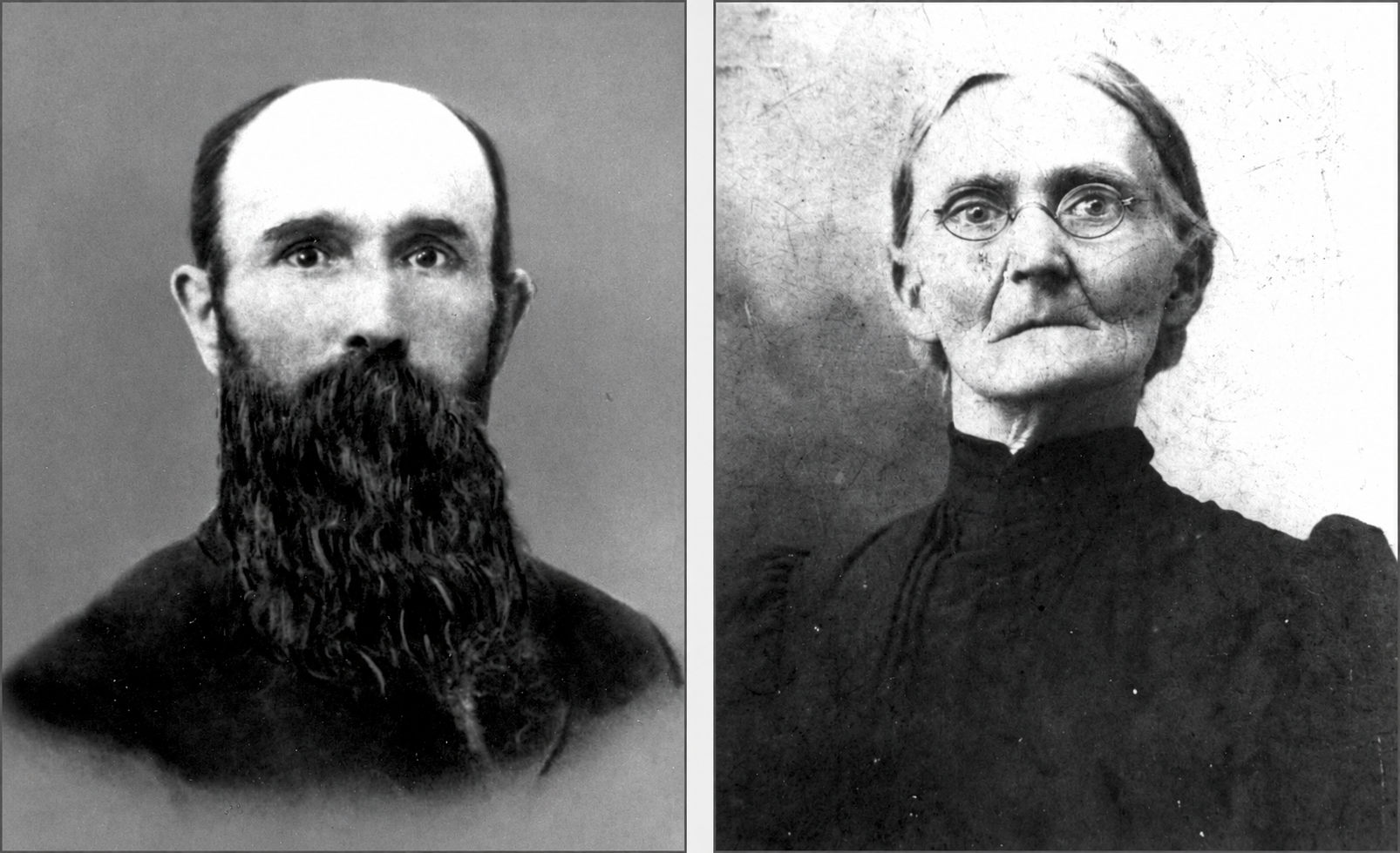
Two small, black-framed photographs hung side-by-side on the kitchen wall when I was growing up. They were black-and-white pictures of a man and a woman. The man was bald, with a long black beard and beady eyes. His beard was thick and wavy and covered his mouth. The woman was bespectacled, with large eyes and hair pulled tightly behind her head. Her closed mouth sank behind thin lips, and her head tilted back, giving her a look of surprise and defiance.
These were our mother's grandparents, we were told. Richard and Malinda Allen.
Mom never knew them. They died before she was born, and my brothers and I knew very little about them. The photographs seemed to tell us all we needed to know: they were ancient and unattractive.
Years later, when I caught the genealogy bug, I began digging into their lives, and my impressions changed. The photographs had captured something, but not what I had thought. Behind those stern faces were lives shaped by migration, religion, slavery, and the violent divisions of the country in which they lived.
Their lives are too large to tell in one story, so I have chosen a point in time: Tuesday, August 14, 1860, the day Richard Allen and Malinda Reynolds were married in Atchison County, Kansas. The wedding is the center of this story, but to understand the people who came to it, we have to go back.
Pardee
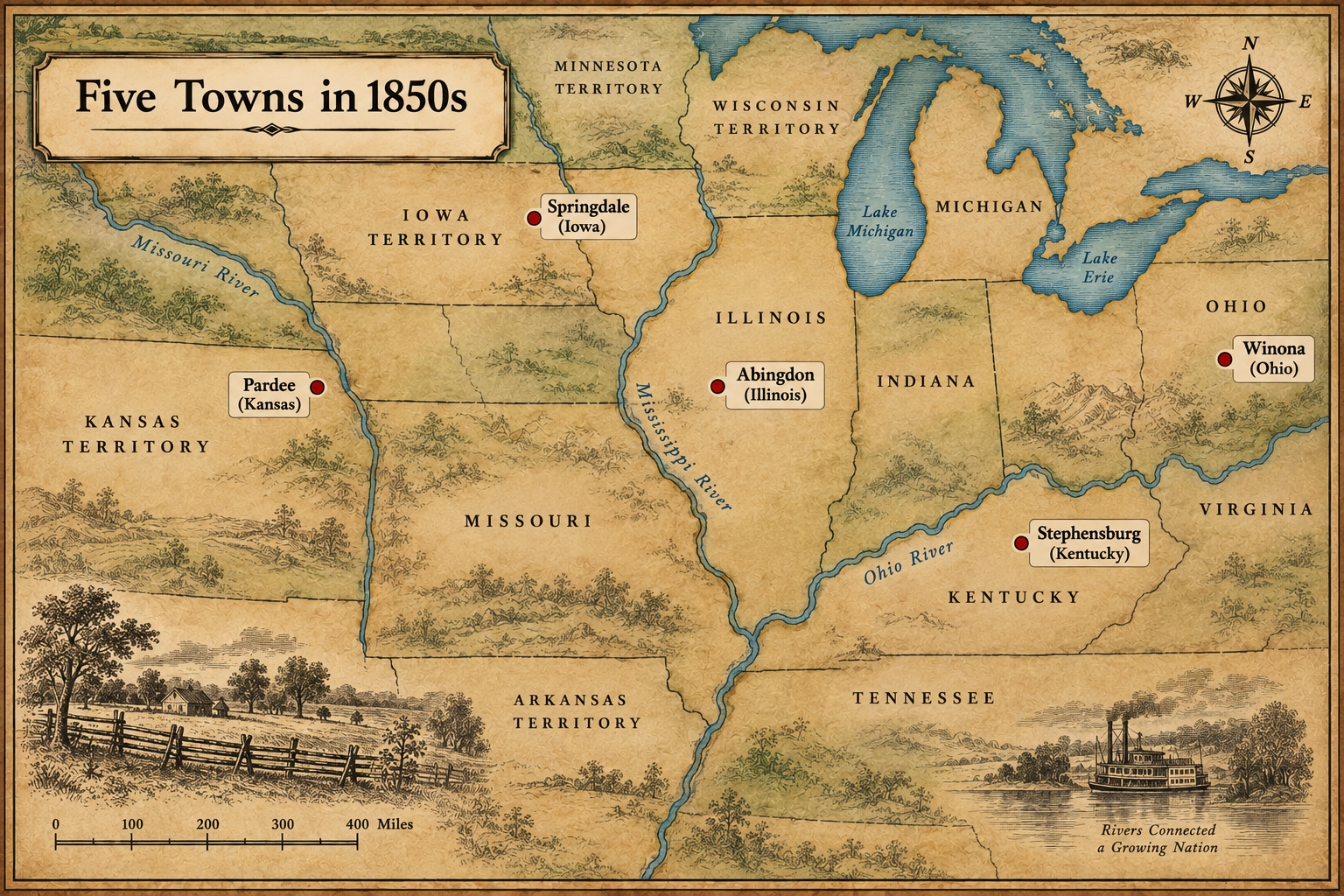
Pardee was a tiny settlement in Atchison County, named for Pardee Butler, the Christian Church preacher who arrived in Kansas in 1855. Butler had come west from Iowa and Illinois, where he had preached and helped establish churches. In Kansas he quickly became an object of hatred to pro-slavery Missourians and their allies. They put him on a raft and set him adrift on the Missouri River. Later, when they caught him again, they covered him with tar and cotton and hung a crude sign around his neck.
Butler stayed, and so did the settlement that came to bear his name. But by the time Richard Allen arrived, Pardee was more than a small Christian Church community. Its Quaker settlers had become part of the antislavery network stretching between Kansas and Iowa, and Pardee was one of the centers from which men undertook expeditions into Missouri to rescue people escaping slavery. A later history describes a cabin at Pardee as a division headquarters of the Underground Railroad. It was a remarkably active place for such a small settlement.
Richard
Richard Allen came from Columbiana County, Ohio. In 1854, at nineteen, he left home for Springdale, Iowa, a Quaker settlement in Cedar County. Family tradition says that Richard and his father, Christopher, disagreed over the Quaker commitment to pacifism in the face of slavery, and Richard left home. Whether that story is entirely true, I don't know. What I do know is that Richard went to Springdale.
Springdale was not simply a Quaker settlement. By the time Richard lived there, it had become a center of antislavery activity and part of the Underground Railroad. There he lived with John and Cynthia Ball and worked on their farm.
The Ball family, like Richard's, had roots in Columbiana County. John Ball's brother Benjamin and his family had arrived in Springdale in 1852, and Benjamin's son Charles was about Richard's age. The Coppoc family, cousins of the Balls, had come from the same part of Ohio. Edwin and Barclay Coppoc were young Quakers who had gone to Springdale to live with their mother.
The community Richard entered was therefore a small one, but it was connected to a much larger movement. Freedom seekers passed through Iowa on their way north, and Quaker families provided places where they could be sheltered and helped along. Springdale's connection to John Brown would soon make it even more important in the story of antislavery resistance.
Brown and his followers spent time in Springdale in the years before the infamous raid on Harpers Ferry, and the young Coppoc brothers became associated with Brown's movement. Richard Allen left Springdale for Kansas in 1856. Benjamin Ball moved to the Pardee area with his family the following year, and Charles went with them.
That does not prove that Richard knew Edwin Coppoc or Charles Ball in Iowa, although the case is strong for Charles Ball. Richard had lived with and worked for Charles's uncle in Springdale. More importantly, Richard had moved from one Quaker community deeply involved in antislavery activity to another community in Kansas that was becoming an important center of the Underground Railroad.
The Balls, the Coppocs, and Richard Allen were moving along the same path at a remarkable moment in American history.
Malinda
Malinda Reynolds arrived by a different route. Her father, Joseph Reynolds, was a physician and farmer who moved his family from Kentucky to Warren County, Illinois, in 1838. His brother Alexander had preceded him and was a preacher in the growing Christian Church movement. Malinda was born there in 1840, but the family did not remain in Illinois.
Joseph returned to Kentucky in 1844, and after his first wife died, he remarried. In 1854, he moved his family back to Illinois, where Malinda attended Abingdon College, a school her family helped found. Years later, Malinda's brother Walter, in a letter to his sister Anzonetta, remembered the Lincoln-Douglas Debate in Galesburg in 1858, just eleven miles from their home.
In 1859, just months after the Lincoln-Douglas Debate, Joseph Reynolds moved once more, this time west to Kansas, where he settled near Pardee and practiced medicine. Malinda's sister Lydia was already living nearby with her husband, Sam Hogan, in Grasshopper Falls. The Reynolds family joined the Christian Church congregation associated with Pardee Butler.
Now the two migration stories converge. The Quaker boy from Ohio and the daughter of a Kentucky-born Illinois physician had arrived in the same little corner of Kansas, a place where Christian Church families, Quakers, and antislavery activists were increasingly drawn together.
Sometime in 1859, Pardee Butler baptized Richard Allen in a rite uncommon in the Quaker faith.
The Letter
Then came John Brown's raid on Harpers Ferry. On October 16, 1859, Brown and his followers seized the federal arsenal, and Edwin Coppoc was among them. He was captured and imprisoned at Charlestown, Virginia. While awaiting trial, Coppoc wrote a letter to the editor of the Virginia Free Press in which he attempted to answer accusations about his character and his activities in Kansas.
Coppoc said that he had gone to Kansas in 1858 to purchase land. He denied taking part in the Kansas troubles and said that he had not known John Brown until later. Then he named seven men in Pardee who could attest to his account.
One of the names stopped me: Richard Allen.
There it was. A man whose photograph had hung on our kitchen wall was named in a letter written by a young Quaker sitting in a Virginia jail, awaiting death for his part in John Brown's raid. Until then, Richard Allen had been primarily a name in my family tree and a picture on the wall. Now he had become part of a story I knew from American history.
On December 2, Abraham Lincoln delivered a two-hour speech to an overflow crowd in Atchison, Kansas, twelve miles from Pardee. It must have reverberated with Joseph Reynolds.
Two weeks later, on December 16, Edwin Coppoc was hanged at Charlestown. That, however, was not the end of violence back in Kansas.
The Wedding
Six months after Coppoc’s hanging, Richard was back in Ohio. The 1860 census places him in his father's household in Columbiana County, less than two months before his wedding. Why did he make the difficult trip home? Perhaps he went to tell his family about his coming marriage. Perhaps he hoped to repair a relationship with his father. Maybe he was rattled by the violence in Kansas. Possibly there was another reason that has disappeared with him. We don't know.
While Richard was in Ohio, Malinda was in Kansas. That spring she was a common-school teacher living with her sister in Grasshopper Falls. Later that summer, and closer to the wedding, she was in her father's household.
Then, on August 14, Richard and Malinda were married near Pardee.
The family records are clear about the man who performed the ceremony: Elder Pardee Butler. Walter Scott Reynolds, Malinda's brother, later identified Butler as the minister, and the family's obituaries do the same. The Kansas marriage index identifies Milo Carleton as the official who recorded the marriage. At the time, a pastor could perform the ceremony while the marriage was subsequently recorded by the official responsible for the civil record.
Richard and Malinda were married.
For a moment, the story could have ended there. It did not.
What Happened Next
In September, Charles Ball and several other young men from the Pardee community crossed into Missouri. This was not simply a group of young men wandering into the borderlands looking for adventure. They were part of the antislavery network that had developed around Pardee, and their purpose was to bring people out of slavery.
They brought twelve people escaping slavery—a family of seven and five others—to Springdale, Iowa. The route itself is revealing. The young men from the Kansas Underground Railroad were carrying freedom seekers north to the same Quaker community where Richard Allen had lived, worked, and been surrounded by the Coppoc and Ball families.
It was a successful expedition, but the men soon planned another, this time with the objective of rescuing the relatives of three African Americans who had escaped from their Cherokee captors in Kansas and were living in Springdale.
The men reached Osawatomie, Kansas, planning a rescue, but the plan was abandoned when they could not obtain enough support. William Quantrill (going by the name Charley Hart to disguise his identity) had learned of the men’s intentions and had gained Charles Ball's confidence. Quantrill then proposed another course of action: an expedition against Morgan Walker's plantation in Missouri.
Ball went, along with Edwin Morrison, Chalkley Lipsey, Albert Southwick, and Quantrill. The expedition ended in an ambush, orchestrated by Quantrill. Morrison was killed, Lipsey was wounded, and Ball and Lipsey were later found and killed.
The young people who had gathered around Pardee and Springdale were no longer simply talking about slavery. Some were willing to risk their lives trying to change it.
The Photographs
On November 6, 1860, Abraham Lincoln was elected president. On December 24, South Carolina declared that it was leaving the Union. The country was coming apart, and Richard and Malinda had been married for only four months.
I don't know what they thought about the election, the secession crisis, or the violence that was coming. I don't know how much Richard knew about Charles Ball's death, or what he thought about Edwin Coppoc, who had cited him as a character witness. There is much I don't know.
But I know more now than I did when I was a boy staring at those two photographs.
Richard Allen was not simply an old man with a black beard. He was a young Quaker from Ohio who went west, lived in a Quaker settlement in Iowa that was part of the Underground Railroad, moved to the contested territory of Kansas, settled in a community that had become an important center of antislavery activity, became associated with a Christian Church community, and was named by a condemned participant in John Brown's raid as someone who could speak to his character.
Malinda Reynolds was not simply the stern-faced woman beside him. She was born into a family that had moved repeatedly between Kentucky and Illinois before making another difficult migration west to Kansas. They were a family of preachers and teachers, farmers and doctors, and she was a teacher when she married.
The people around Richard and Malinda were moving across state and territorial lines, joining churches, teaching school, arguing about slavery, helping people escape bondage, and, increasingly, risking their lives over the future of the country.
The photographs on the kitchen wall never told me any of this.
My impressions of the people in those photographs are not the same now.
They earned those stern countenances.
No, that is not all of the story of Richard and Malinda. The rest will have to wait. But two details from what came after their wedding make me wonder even more about the people behind those faces.
Richard, once a Quaker, and two of Malinda's brothers, enlisted in the Union Army and fought in the Civil War. And when Richard's father, Christopher, died in Ohio in 1876, he left Richard three books: Whittier's poems, William Penn's No Cross, No Crown, and William Edmundson's Journal. All three were written by Quakers.
I cannot know what those books meant to Richard. But they seem to leave the door open on a story that began with a young Quaker who could not reconcile himself to his father's position. His father had not given up on him.
Threads to Follow
Threads to Follow are questions to prompt further discovery, conversation, and discussion.
1. Does it seem likely that Richard Allen was involved in the Underground Railroad?
2. Why was it central to the story that the author found the letter in which Edwin Coppoc named Richard Allen?
3. What connected Springdale and Pardee? What about Columbiana County, Ohio?
4. How does the Reynolds family’s Disciples of Christ affiliation play a role in this story? Their Kentucky roots? The Cane Ridge Revival?
5. What do you think happened to Richard's Quaker beliefs through these years?
6. What can we discover about Malinda's experience?
7. What does this story tell us about the people who served in the Underground Railroad?
8. What do you see in the faces of Malinda and Richard in their pictures late in life? Do you wonder what was ahead for them after their wedding?
Sources
Primary and Family Sources
Coppoc, Edwin. Letter to the editor of the Virginia Free Press, November 14, 1859. Reproduced in C. B. Galbreath, “Edwin Coppoc,” Ohio Archaeological and Historical Society Publications, vol. 30. The letter is the principal source for Coppoc's list of character references, including Richard Allen.
Reynolds, Walter Scott. Letter to his sister Anzonetta Hayward, April 17, 1926. Family correspondence identifying Elder Pardee Butler as the minister who married Richard Allen and Malinda Reynolds.
Family obituaries of Richard Allen and Malinda Reynolds. These independently identify Pardee Butler as the minister who performed their marriage.
United States Census, 1860. Columbiana County, Ohio. Richard Allen appears in his father's household shortly before his marriage.
Kansas marriage records/index. Richard Allen and Malinda Reynolds, August 14, 1860, Atchison County, Kansas. The record identifies Milo Carleton in the civil recording of the marriage.
Kansas Territorial Census of 1859.
Christopher Allen's will, 1876. The will leaves Richard Allen Whittier's poems, William Penn's No Cross, No Crown, and William Edmundson's Journal.
Pardee Butler
Pardee Butler: The Definitive Collection, Bradley S. Cobb, 2014. The life and writings of Pardee Butler.
Underground Railroad and Kansas Sources
Miller, Diane. To Make Kansas Free: The Underground Railroad in Bleeding Kansas. National Park Service, 2008. This is particularly important for the Pardee section. It identifies the Quaker “Iowa boys” who settled in Pardee, describes their 1860 expeditions into Missouri, and documents the September expedition that carried twelve fugitives to Springdale, Iowa.
Lutz, Reverend John J. “Quantrill and the Morgan Walker Tragedy.” Transactions of the Kansas State Historical Society, 1903–1904, vol. VIII, pp. 324–332. Miller cites Lutz's account for the September 1860 expedition and the subsequent events involving Charles Ball and the other Pardee men.
Kansas State Historical Society. Materials relating to the Underground Railroad in territorial Kansas, including the sources cited by Miller for the Pardee expeditions.
Springdale and John Brown
State Historical Society of Iowa. Iowa and the Underground Railroad. This provides institutional documentation of Springdale's role in the Underground Railroad and its connection with John Brown and the Coppoc brothers.
Galbreath, C. B. “Edwin Coppoc.” Ohio Archaeological and Historical Society Publications, vol. 30. This is an especially useful source because it brings together Coppoc's Ohio background, his years in Springdale, John Brown's time there, the Coppoc brothers' participation in the Harpers Ferry raid, and Coppoc's November 1859 letter.
Iowa PBS. “Iowans Help Abolitionist John Brown.” Iowa Pathways. Useful for the Springdale/John Brown connection and the role of the Coppoc brothers.
Reynolds, David S. John Brown, Abolitionist, 2005.
Soike, Lowell J. Necessary Courage, Iowa’s Underground Railroad, 2013.
Allen and Reynolds Family History
Redding, family history. Richard and Melinda Reynolds Allen, by Sam Redding. This family-history account brings together census, church, migration, military, and family evidence concerning Richard and Malinda.
The account is particularly useful for the chronology of Richard's movement from Ohio to Springdale to Pardee, Malinda's education and teaching, the Reynolds family's move to Kansas, and the later lives of Richard and Malinda.
Author
Name: Sam Redding
Place of Residence: Towanda, McLean County, Illinois
Primary Sources: Please see sources above.
Place reported: Pardee, Kansas; Springdale, Iowa; Columbiana County, Ohio; Warren/Knox Counties, Illinois; Hardin County, Kentucky
Timespan: 1850-65
Most descriptive characteristics: Principled, historical