
Story 22: York and William Clark
The Contradictions of Freedom
By Sam Redding
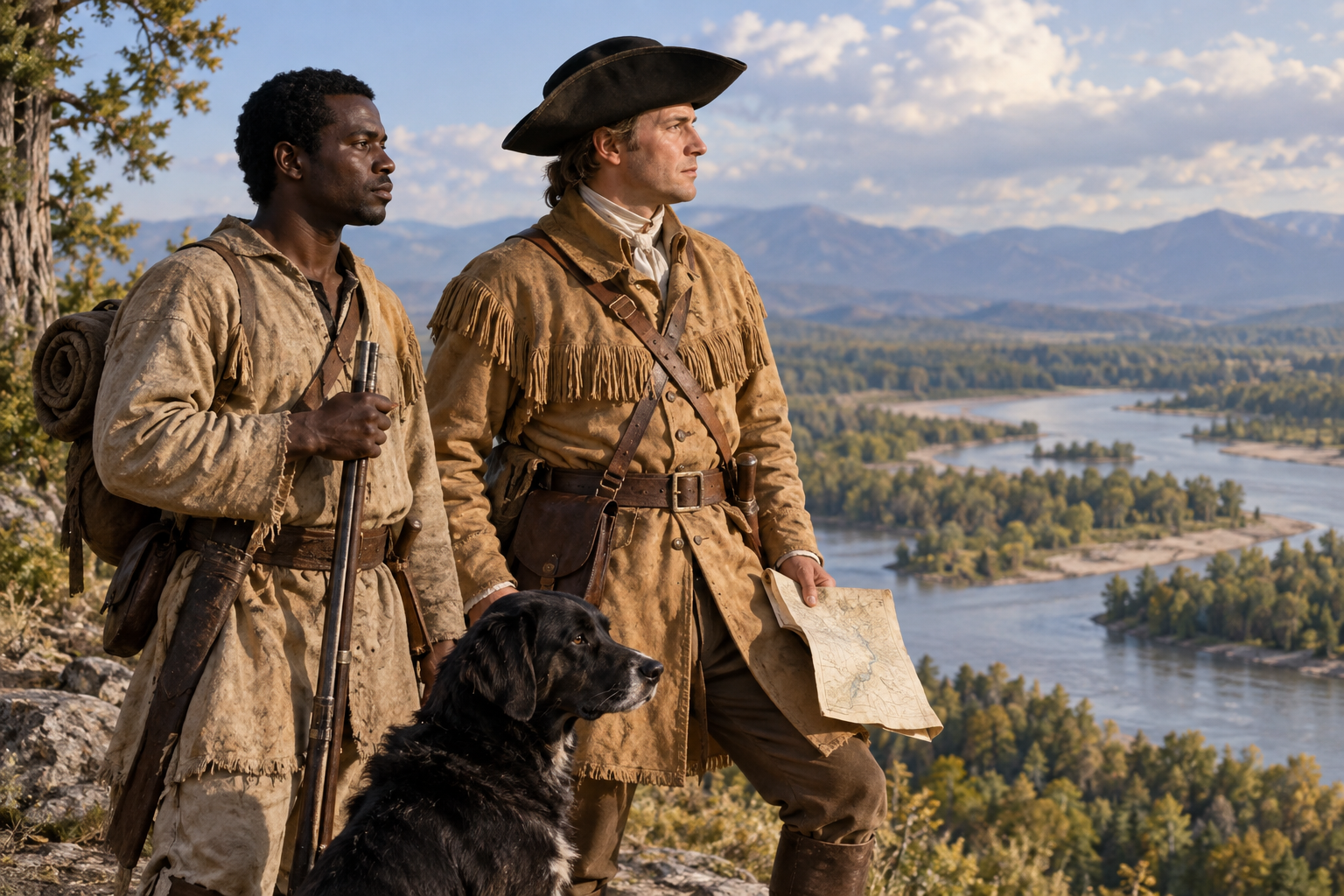
York and William Clark, Lewis and Clark Expedition, 1804-1806
This Star Hitchers story examines the relationship between York and William Clark, the man to whom York was enslaved. Tell your story at StarHitchers.com.
The Story
I'll admit to a fascination with the Lewis and Clark Expedition. The 1804-to-1806 exploration of the American West is an extraordinary adventure story. To have been with those men—the Corps of Discovery—rowing upstream on the Missouri, slipping into dark, unfamiliar forests, and moving into a wilderness almost unknown to Americans is every boy's dream.
The nation was young, the Louisiana Purchase had doubled its size, and the unknown seemed limitless. President Thomas Jefferson chose his private secretary, Meriwether Lewis, to lead the expedition. Lewis brought an interest in science and natural history. When he recommended his fellow Virginian William Clark as co-leader, he added a seasoned military man with experience on the frontier.
Together they assembled a remarkable party. The expedition mapped rivers and mountains, recorded plants and animals, established relationships with Native nations, and carried Jefferson's vision of western exploration thousands of miles into the continent.
The minor characters intrigue me almost as much as the famous ones. They are largely lost in the shadows of Lewis and Clark.
Charles Floyd was one. He was the only member of the Corps to die on the expedition. Just three months after leaving St. Louis, the 22-year-old sergeant died, apparently from a ruptured appendix. His comrades buried him near what is now Sioux City, Iowa, and named a nearby stream and bluff in his honor. When they passed the grave on their return journey two years later, they restored its marker.
Sacagawea was another. In studying her life, I found a woman whose experiences went far beyond the brief textbook description of “guide and interpreter.” She had been captured as a child by a rival tribe, reunited emotionally with her brother during the expedition, traveled with her infant son, and lived for a time in St. Louis after the expedition.
Then there was York.
When Lewis and Clark were chosen to penetrate the Louisiana Purchase, Clark brought with him a man strong of body and skilled in the practical arts. His name was York, and he was enslaved by Clark.
York had been Clark's companion and personal servant for years. They were roughly the same age and had grown up together in the Clark household. I found myself hoping that their long association had produced something more than the usual relationship between master and slave. I wanted to find a warm bond between them. I wanted to find mutual respect.
What I found was more complicated.
During the expedition, York was clearly valued. He hunted and trapped, providing meat for the party. He paddled canoes and helped carry them overland. He carried a firearm, unusual for an enslaved man. He could swim, a skill Clark specifically noted in his journal and one that proved useful in a country where rivers were obstacles and dangers.
York was also, at times, treated as a participant in the life of the Corps rather than merely as someone's property. When the men considered where to camp, the expedition journal records that York and Sacagawea were among those whose opinions were sought.
His presence also fascinated Native people who had never seen a Black man. York's appearance and his role with the expedition sometimes helped open conversations with Native communities.
He was useful. He was trusted. He was respected for what he could do.
And for the duration of the expedition, he was far from his owner and far from the institutions that normally enforced slavery. Yet he remained with the Corps.
But he was still enslaved.
That became clear when the expedition ended.
The officers and enlisted men received additional pay for their service, and the enlisted men were awarded 320 acres of land. York received nothing. He returned to Louisville and to the service of William Clark.
The contrast becomes even sharper in the years that followed.
Jefferson appointed Lewis governor of Upper Louisiana, with his headquarters in St. Louis. Clark became brigadier general of the Louisiana Territory and was given responsibility for Indian affairs. Clark also became guardian of Sacagawea's son, Jean Baptiste Charbonneau, whom he helped educate in St. Louis.
But Clark's relationship with York was not so generous.
In letters to his brother Jonathan, Clark described York as demanding his freedom as compensation for his service on the expedition. Clark refused.
York also wanted to remain in Louisville because his wife was enslaved by another man there. Clark refused that request as well and ordered York to follow him to St. Louis. He threatened that if York continued to resist, he would sell him to what he described as a “severe master.”
When York eventually returned to St. Louis, Clark wrote that York was “insolent and sulky.” Clark then described beating him: “I gave him a Severe trouncing the other Day and he has much mended.”
The words are jarring.
Here was the man who had traveled thousands of miles with Clark, hunted for him, carried out difficult work, and helped make the expedition successful. Here was a man who had been trusted in dangerous circumstances and whose abilities had been recognized by both his fellow travelers and Native people they encountered.
And when that man asked to be free, his master refused.
York's life after this becomes uncertain. One tradition held that he eventually escaped westward and lived among the Sioux. That story has largely been discredited.
Another version came from Clark himself. According to Clark, after roughly twenty years of enslavement, he eventually freed York and established him in a business hauling freight between Nashville and Richmond. The business failed, Clark said, and York later contracted cholera and died somewhere in Tennessee.
There is no surviving documentation confirming that Clark actually emancipated York.
So York disappears into the uncertainty that surrounds so many enslaved Americans. We know something about him because he happened to travel with Lewis and Clark. We know less about him afterward because the records of his life were not preserved in the same way as those of the white men who traveled beside him.
Meriwether Lewis's life also took a very different path. He struggled with debt, drank heavily, and became increasingly troubled. In 1809, at age 35, he died from gunshot wounds at an inn along the Natchez Trace. Suicide was long the accepted explanation, although members of his family believed he had been murdered and the circumstances remain debated.
William Clark's career continued. He became a prominent official in the western territories, served as governor of the Missouri Territory, and remained involved in Native American affairs. When Missouri became a state, Clark lost the election for governor in 1820. He remained an important figure in St. Louis until his death in 1838.
The contrast between the post-expedition lives of Lewis, Clark, and York is striking. But the story of York and Clark raises a larger question.
What did slavery actually mean in the daily lives of the people caught inside it?
I began this story hoping to find a warm bond between York and William Clark. I think there probably was one, in some form. They had grown up together. They had spent years together. Clark trusted York with responsibilities that would have been unthinkable for many enslaved people.
But whatever affection, loyalty, familiarity, or mutual dependence existed between them never erased the fundamental fact of ownership.
On the expedition, York seems to have been valued for what he could do and respected for what he knew. He hunted, trapped, paddled, carried, swam, and contributed to the work of the Corps. For a time, the boundaries separating him from the white men around him seem to have blurred.
But they never disappeared.
York returned from the expedition enslaved. The other men received pay and land. York received neither. When he asked for his freedom, Clark refused. When York wanted to remain in Louisville with his enslaved wife, Clark ordered him to leave—and, by Clark's own account, beat him when he resisted.
That may be one of the most revealing contradictions of slavery.
Slavery did not require masters to be indifferent to the people they enslaved. A master could depend upon a slave, trust him, admire his abilities, become attached to him, even feel affection for him—and still insist upon owning him.
The expedition carried York thousands of miles into a world where, in some respects, he was treated as a man among men.
Then it brought him home to a world in which the law said he was property.
That is not the story I set out to find.
It is a more troubling one.
And perhaps a more revealing one.
Threads to Follow
Threads to Follow are questions to prompt further discovery, conversation, and discussion.
How did York's experience on the Lewis and Clark Expedition compare with that of other enslaved people who accompanied their owners into frontier territory?
How much freedom did enslaved people actually exercise when they were far from the institutions that enforced slavery?
What can the letters of slaveholders tell us about the difference between personal attachment and genuine recognition of another person's freedom?
What happened to York after the expedition—and why is it so difficult to know?
Why might dependence upon one another in the wilderness have produced a greater measure of mutual respect than life within society? What does that suggest about human nature?
Sources
Stephen E. Ambrose, Undaunted Courage: Meriwether Lewis, Thomas Jefferson, and the Opening of the American West, 1996.
History.com: Corps of discovery suffers its only death.
William H. Goetzmann, New Lands, New Men, 1986; “I Wish You to See & Know All”: The Recently Discovered Letters of William Clark to Jonathan Clark, 1992.
National Park Service article; Sacagawea’s Voice and the 19th Amendment
Author
Name: Sam Redding
Place of Residence: Towanda, McLean County, Illinois
Primary Sources: Sources cited above
Subject
Title: York and William Clark
Subtitle: The Contradictions of Freedom
Name of Subject at Birth: York
Birth Date: About 1775
Birthplace: Caroline County, Virginia
Name of Subject at Death: No change
Death Date: After 1815
Place of Death: Probably Tennessee
Spouse(s): Name not known
Other Key Locations: St. Louis, Louisville, and the West
Most admirable qualities: Determination; Resilience