
Story 24: Home on the Range
Not All It’s Cracked Up to Be
By Sam Redding
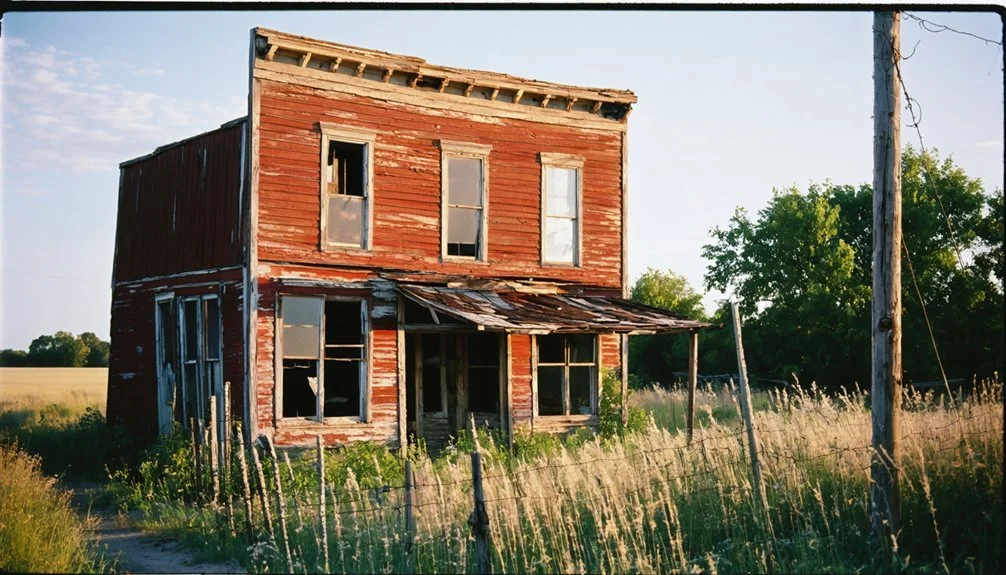
Pardee, Kansas Ghost Town. From Kansas Ghost Towns by Jason Smith.
In this Star Hitchers story, the author describes the plight of women on the Kansas prairie when the men go to war in 1861. He uses his great-grandparents as examples. Tell your story at StarHitchers.com. Subscribe FREE at starhitchers.substack.com.
We cross the prairies as of old
The Pilgrims crossed the sea,
To make the West as they the East
The homestead of the free.
—John Greenleaf Whittier, The Song of the Kansas Emigrant, 1854
The Story
We like to imagine our pioneer ancestors as people who went west because they were brave.
Perhaps they were. But bravery wasn't necessarily what sent them there.
They went for land. For opportunity. For a church to build. For freedom. Sometimes simply for the chance to make something of themselves.
The Reverend Pardee Butler came to Kansas in 1855, according to his son Charles, determined to “establish a home, and vote to make this a free state.” He also saw Kansas as a place where a man might achieve financial independence and where there were churches to build.
Richard Allen came for some of the same reasons. He was a young Quaker from Ohio who had become increasingly uncomfortable with his father's pacifism in the face of slavery. At nineteen he left home for Springdale, Iowa, a Quaker settlement and station on the Underground Railroad. Two years later he followed other Quakers west to Kansas.
Malinda Reynolds came for a different reason. Her family moved from Illinois to Atchison County in 1859, joining the stream of settlers trying to make homes on the new prairie.
Richard was twenty-five when he married Malinda, twenty, on August 14, 1860. The wedding took place in the tiny settlement of Pardee, Kansas, named for the man who performed the ceremony.
Their wedding was the subject of the story I told last time.
Now comes the part that interests me just as much.
What happened after the wedding?
The answer begins with the place itself.
Pardee was hardly a town. It had been platted only three years earlier. A schoolhouse had gone up in 1857, and Pardee Butler had preached his first sermon there. The first store opened the following year. The post office was new.
Everything was new.
Everything was unfinished.
Walter Scott Reynolds, Malinda's brother, remembered the family's arrival in Kansas in March 1859. There were no railroads to carry them west. They came from Illinois by covered wagon with two yoke of oxen. Missouri was “just one mud hole,” the Mississippi was out of its banks, and the journey seemed almost impossible in retrospect.
Their father moved onto a large farm near Pardee. The boys raised corn and hauled it across the frozen Missouri River to Weston, Missouri, where they traded it for lumber. Load after load, they exchanged corn for boards until they had enough to build a proper house.
That was how a home was made on the Kansas prairie.
Piece by piece. Crop by crop. Board by board.
It was not the romantic West of song and story.
The summer of 1860 brought drought. The dry spell had already begun the previous year and would last into November. Crops failed. Grasshoppers attacked what survived. Settlers were forced to appeal to churches back in Illinois and Indiana for relief.
Joseph Reynolds, Malinda's father, and Pardee Butler were among those who traveled east on behalf of the Kansas Relief Commission, visiting the Christian Church congregations they had known before moving west.
Still, people planted. They built. They married. They had children.
Richard and Malinda did not wait long to begin their family. On May 11, 1861, nine months after their wedding, their first child, Charles S., was born.
For a little while, perhaps, they could imagine that the life they had come to Kansas to build might actually be possible.
But the prairie was not the only thing changing around them.
The presidential election came that November. Abraham Lincoln won. The country broke apart. Kansas, which had spent nearly a decade fighting over whether it would enter the Union as a free or slave state, was now part of a much larger war.
Joseph Reynolds joined Pardee Butler at a Union Party rally on May 2, 1861. Soon afterward he ran for the state assembly, winning the nomination but losing the election.
Then the young men began to leave.
Malinda's brother Charley had already found his way into the dangerous world beyond the settled prairie. On his way to the California gold fields, he stopped to become a teamster and then joined a company of Plains hunters. An encounter with the killing of a Native woman disgusted him, and he returned to Atchison County, where he carried the mail and helped his brother William on the farm.
On July 16, 1861, nineteen-year-old Charley joined the Atchison Home Guards.
The war was no longer something happening somewhere else.
On August 22, 1862, it came directly into Malinda's house.
Richard Allen enlisted at Pardee for three years in Company F of the 13th Kansas Infantry.
He was twenty-seven years old, a farmer, with dark complexion, black hair and black eyes.
Two days later, Malinda's brother William Reynolds, described on his military papers as a farmer with fair complexion, light hair and blue eyes, enlisted in the same company.
William had married Jemima Jane Elliott only eight months earlier. Like Richard, he was leaving a young wife behind.
And Malinda was not simply a young wife.
She was a young mother, pregnant with another child.
Richard's departure left her with one-year-old Charles and another baby on the way.
There were women around her. Her father and stepmother lived nearby. Her sister Lydia Hogan was on the farm at Grasshopper Falls. Jemima was there too.
But they were all living the same strange life.
The men went away. The women stayed. And the children kept coming.
Malinda, newly married when the war began, gave birth to three children during the war and seven more after the war.
Jemima Reynolds gave birth to Flora on October 31, 1861. Jemima would eventually have twelve children.
Malinda's stepmother, Lydia Burton Reynolds, raised the nine children Joseph had fathered with his first wife, Malinda's mother, and gave birth to nine more of her own.
Malinda's sister Lydia Hogan, with four children, gave birth to a daughter, Susan, on June 10, 1862, only weeks before the men enlisted. Lydia would eventually have seven more children.
Women helped each other as they could, but were stretched to the limit managing their own households.
The war experience would be different for Charley, Richard, William and, eventually, Sam Hogan.
For their wives, the experience was remarkably similar.
They remained on the Kansas prairie.
They raised children. They tended farms. They watched the weather.
They stood guard for the border ruffians that still preyed on free-soil families.
They endured the uncertainty of a war that was being fought hundreds of miles away but had already changed the shape of their lives.
We tend to remember the men who went west as pioneers.
We remember the men who went to war as soldiers.
It is harder to see the women. They labored heroically, and silently.
They had helped make the new home possible. Now they had to keep it alive.
And the home they were trying to preserve was hardly the comfortable homestead promised by Whittier.
It was a cabin or a newly built house on the prairie. A garden threatened by grasshoppers. A farm dependent on rain. A community only a few years old. A place where Native families sometimes appeared at the door asking for food. A place where the railroad would eventually pass it by.
Pardee would never become the town its founders imagined.
By 1880 it had only about one hundred residents. Its post office closed in 1903. Today, Pardee is now a ghost town.
But in August 1860, none of that was known.
Richard and Malinda stood together in a little Kansas settlement and began a life.
They could not know that within two years Richard would march away in a Union uniform.
They could not know how long the war would last, what it would cost, or what it would do to the young community they had chosen as home.
They knew only what pioneers always know when they begin:
There was land.
There was work.
There was hope.
And there was a home to be made.
Threads to Follow
Threads to Follow are questions to prompt further discovery, conversation, and discussion
1. What did it mean to “make a home” on the Kansas prairie?
What did a family actually need to survive in a place where there were few roads, no railroad, uncertain crops, and little infrastructure? What did it take to turn a claim into a home?
2. What did the women of the Kansas frontier sacrifice?
We know the names of the men who enlisted and marched away. Wh, soat can we discover about the women who stayed—how they managed farms, raised children, supported one another, and coped with the absence of husbands and fathers?
3. How did the Civil War change life for families who never saw a battlefield?
Richard, William, and Sam Hogan left Kansas to fight, but Malinda, Jemima, Lydia and other women experienced the war from their homes. What did the war mean for food, labor, money, safety, communication and family life on the home front?
4. Why did Richard Allen go to war?
He had been raised in a Quaker tradition that emphasized pacifism, yet he enlisted in the Union army. How did his experiences with slavery, the Underground Railroad, and the struggle over Kansas shape his decision?
5. What became of Pardee?
Pardee began with the optimism of a new settlement and the ambitions of people determined to build homes and a free-state community. Why did it remain so small, and why did the railroad pass it by? What happened to the families who built their lives there?
6. What was Kansas like when these pioneers actually entered?
The popular image of the West often emphasizes opportunity and open land. What did settlers encounter alongside those opportunities—drought, grasshoppers, border violence, Native peoples being displaced, slavery's expansion, and the uncertainties of frontier life?
7. How does the pioneer story change when we look beyond the men?
What happens to our understanding of westward expansion when the story is told through the women who cooked, planted, gave birth, raised children, endured absences, and kept households functioning?
8. What can one small Kansas community tell us about America in 1860?
Pardee was tiny, but its residents brought together many of the forces reshaping the country: migration, religion, slavery and freedom, westward expansion, immigration, and eventually civil war. How much of the larger American story can be found in one place?
Sources
Primary and family sources
Kansas marriage records/index. Richard Allen and Malinda Reynolds, August 14, 1860, Atchison County, Kansas. The record identifies Milo Carleton in the civil recording of the marriage.
United States Census, 1860. Columbiana County, Ohio. Richard Allen appears in his father's household shortly before his marriage.
Kansas Territorial Census of 1859.
Reynolds, Walter Scott. Letter to his sister Anzonetta Hayward, April 17, 1926. Family correspondence identifying Elder Pardee Butler as the minister who married Richard Allen and Malinda Reynolds.
Family obituaries of Richard Allen and Malinda Reynolds. These independently identify Pardee Butler as the minister who performed their marriage.
Redding, Sam. Richard and Melinda Reynolds Allen. Family-history account bringing together census, church, migration, military, and family evidence concerning Richard and Malinda.
Historical and secondary sources
Harrell, David Edwin, Jr. “Pardee Butler: Kansas Crusader.” Kansas Historical Quarterly, vol. 34, no. 4 (Winter 1968), pp. 386–408. This is a particularly important secondary source for understanding Butler and his activities in territorial Kansas.
Cobb, Bradley S. Pardee Butler: The Definitive Collection. 2014. A collection of writings and biographical material concerning Pardee Butler, including Harrell's Pardee Butler: Kansas Crusader, Butler's autobiography, and other biographical material.
Arnold, Anna E. A History of Kansas. 1914. An early general history of Kansas, originally published as a Kansas school textbook.
Stratton, Joanna L. Pioneer Women: Voices from the Kansas Frontier. New York: Simon & Schuster, 1981. Based on approximately 800 reminiscences of Kansas pioneer women collected by Lilla Day Monroe.
Best, Tom. Monmouth College. Research on Lonesome Charley Reynolds, including work of Dr. John Gray.
Online archival sources
Kansas Memory. Kansas Historical Society digital collections. Kansas Memory
Kansas Historical Society, State Archives. “Kansas Relief Committee storehouse at Atchison, Kansas.” Kansas Relief Committee storehouse
Image of Pardee from: Pardee, Kansas Ghost Town
Author
Name: Sam Redding
Place of Residence: Towanda, McLean County, Illinois
Primary Sources: See sources listed above.
Subject
Place reported: Pardee, Kansas
Timespan: 1855-1862
Most descriptive characteristics: Historical
In this Star Hitchers story, the author describes the plight of women on the Kansas prairie when the men go to war in 1861. He uses his great-grandparents as examples. Tell your story at StarHitchers.com. Subscribe FREE at starhitchers.substack.com.