
Story 03: Diamonds in the Rough
Growing Up in a Small Town 50 Years Ago
By Jeff Collins
This essay is adapted from the more detailed account, Article 05: Diamonds in the Rough.
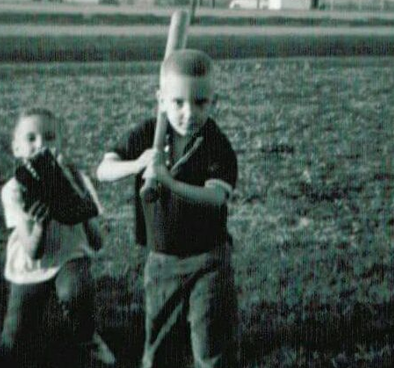
Picture: Jeff Collins hitting, brother Jim catching
The Story
There was only one thing that could stop a wiffle ball game in Towanda.
Not heat. Not rain. Not arguments over balls and strikes.
A car could.
One summer morning in the early 1970s, four of us were playing in the backyard—just another game on one of Towanda’s many makeshift diamonds. Then a car came off Route 66, cut through the ditch, and barreled straight toward us. We scattered. The car missed an apple tree, a clothesline pole, and somehow missed us too before bumping into the house.
We stood there stunned. For a moment, we thought one of us—Tom—was under the car. He wasn’t. He had run home and crawled under a bed, scared out of his mind.
My mother heard the commotion from the grocery store where she worked and came running.
Then, just as suddenly as it started, it was over.
That’s the only time I remember a game truly stopping.
I grew up in Towanda, Illinois, a town of a few hundred people just northeast of Bloomington-Normal, along the old U.S. Route 66 corridor. My parents, my siblings, and I lived there my entire childhood. I live near there still.
Towanda hasn’t changed as much as you might think. Some things are gone—the shops downtown, the school teams, the old softball field—but the feel of the place remains. What I remember most are the ballgames.
We played everywhere.
Our backyard.
McCurdie’s lot across North Street.
The McLeese yard, with its homemade backstop.
If there was open space, it could be a field.
We’d start early, sometimes with the dew still on the grass. Breakfast was quick—cinnamon toast, Cap’n Crunch—and then we were out the door deciding where to play and who could show up. Six or eight players was ideal, but we made do with whatever we had. Sometimes it was one-on-one, settling our own calls, turning the game into a home run derby to avoid arguments.
We didn’t need much.
A plastic bat.
A wiffle ball.
Maybe a lawn chair for a catcher.
We chased every ball, whether it landed in the yard, the street, or someone’s garden. Ike Hirst’s garden in right field caught more than a few of them. That usually meant trouble, but it didn’t stop us.
Nothing did.
When we got thirsty, we drank from a hose or rode our bikes to the store for a cold soda—orange or grape Nehi if we were lucky. Snacks came from wherever we could find them: apples, cherries, even green onions pulled from the ground.
We played in the heat.
We played in the rain.
We slid whether we needed to or not.
Grass stains and mud weren’t problems—they were proof.
And while we were just kids in a small town, we weren’t just ourselves out there. We were the players we watched and admired—Aaron, Mays, Gibson, Seaver. On those fields, with no fences and no crowds, we were all of them at once.
Looking back, those games were more than something to pass the time.
They were how we learned.
No umpires.
No rule books.
No adults stepping in to settle things.
We figured it out ourselves—fairness, arguments, competition, forgiveness. A fight in the morning might end a game for a few hours. By afternoon, we were back at it like nothing had happened.
Years later, you could still see faint baselines in the grass in some yards around town. Thin lines worn down by hundreds of games. If you knew where to look, you could still see where we had been.
That day the car came through the yard, four of us ran for our lives.
Years later, those same four boys—Brian Risen, Jim Collins, Tom McLeese, and me—would go on to play baseball at Normal Community High School.
At the time, we were just playing.
But maybe we were becoming something too.
Growing up in Towanda meant you were never very far from a field—even if it was just a patch of grass behind someone’s house.
We didn’t know it then, but those fields were shaping us.
Not just as ballplayers.
As people.
Threads to Follow
1. What has replaced the kind of unsupervised play Jeff describes—or has anything?
2. What do children lose (or gain) when play becomes organized?
3. Why do certain moments—like the crash—stay vivid for a lifetime?
Author
Name: Jeff Collins
Place of Residence: Normal, McLean, Illinois
Primary Sources: Conversations with friends, memories, Pantagraph articles, When We Were Hornets website
Place reported: Towanda, Illinois
Timespan: 1960-1980
Most descriptive characteristics: Historical, Educational, Nurturing