
Story 02: Desperately Seeking Susan
My Search for an Elusive Ancestor
By Sam Redding
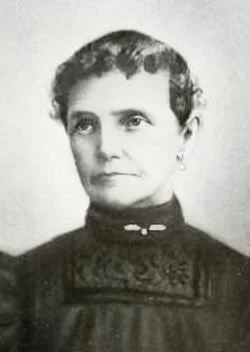
Saluda Keylon Loyd Granade, sister of Susan Green Loyd Granade
This essay is adapted from the more detailed account, Article 01: Desperately Seeking Susan.
The Story
A Name Without a Story
I had spent years writing about my family—following the Reddings, the Allens, and the Bittners through time, piecing together their movements, their struggles, their small triumphs. But one figure remained stubbornly out of reach.
Susan Green Loyd, my great-great grandmother, was little more than a name.
I knew she had married my great-great grandfather, Hervey Wynn Granade. I knew she had lived in Arkansas. Beyond that, almost nothing. She appeared only in fragments—references in old letters, hints in family lore, a passing mention in documents gathered long before I was born.
What the Old Letters Preserved
Those fragments came largely from my great-aunt, Clyde Ethel Anderson Walker, who served for years as postmistress in Mountain View, Missouri. Aunt Clyde had no children, but she had a passion—for family history, and especially for the Granade line. In pursuit of membership in the Daughters of the American Revolution, she assembled letters, records, and family stories, corresponding in the 1930s with a distant relative in Texas. Her application was approved in 1955, and in the process she preserved a trove of material that would eventually pass down to my mother, and then to me.
Some of what Aunt Clyde believed turned out to be more hopeful than factual. She was fond of a story that linked our family to Louis XIV, tracing the Granades back to French nobility. Later research suggests a more modest origin—likely German or Swiss immigrants who arrived in North Carolina in the early eighteenth century. Still, I owe Aunt Clyde a great deal. She and my great-grandmother, Laura Ellen, were the ones who first made family history feel alive to me.
And yet, for all their work, Susan remained in the shadows.
A Clue in Thread and Cloth
My search truly began with a piece of cloth.
Stitched into a sampler passed down from my great-grandmother were the words: May I govern my passions with absolute sway and grow wiser and better as life wears away. Beneath that, carefully sewn: Mary Turner Williams, Granville County, North Carolina, 1825.
A note explained that Mary Turner Williams was my great-grandmother’s “mother’s mother’s mother”—the grandmother of Susan Green Loyd. For the first time, Susan stood within a real family line, rooted in a real place: Granville County.
From there, the search gathered momentum.
Leaving North Carolina
Susan was born there on August 10, 1832, to William Loyd and Mary Williams. The spelling “Loyd” would later shift to “Lloyd,” but during her lifetime the simpler form prevailed. I turned to the work of Harold A. Lloyd, whose careful study of the Lloyd families of the region traces many of them back to Virginia roots. Even so, the deeper ancestry of Susan’s immediate family remains uncertain.
What does emerge clearly is movement.
By the mid-1840s, families of modest means were leaving North Carolina, heading south and west in search of better prospects. Sometime around 1846, the Loyd family joined that migration, making the long journey—some 400 miles—to Newton County, Georgia.
A Marriage—and a Disappearance
It was there, in Georgia, that Susan first stepped into adulthood.
In 1849, at just seventeen, she married James Barnett. For a long time, I could not find her in the 1850 census, searching under “Loyd.” When she finally appeared, it was under her married name—Susan Barnett—living near her parents and siblings.
Then, just as quickly, she vanished again.
Records suggest that the Barnett family, or part of it, moved on to Bolivar County, Mississippi. Her husband disappears from the record, and the most likely explanation is that he died in the 1850s. By 1860, her parents appear to have died as well. Her siblings were scattered. One younger sister, Saluda, remained with her.
A Second Beginning in Arkansas
At some point in those uncertain years, Susan met Hervey Wynn Granade—a widower more than twenty years her senior, with nine children. Hervey was visiting a friend in Mississippi at the time, and it is likely that is where they met.
They married on December 18, 1859, probably in Greene County, Arkansas, and life began again for both of them.
Within a year, the nation was at war. The American Civil War reached even into their corner of Arkansas. While Susan raised children—hers and his—and cared for her younger sister, the war reshaped the family. Southerners, the Loyds in Georgia and Granades in Tennessee served the Confederacy. A brother was killed. Another wounded. A stepson died. Another was imprisoned.
These were not distant events. They were part of daily life as armies skirmished near their home in Arkansas.
Widowed Again
When the war ended, there was little peace to follow. In 1870, Hervey Granade died, leaving Susan once more to rebuild.
She did so the only way she knew how—by moving forward.
Sometime after Hervey’s death, she married again, to J.R. Gatlin, a younger man who had boarded with the family. By 1880, they were living along Bennetts Bayou in Fulton County, near the Missouri line. Her two children were still with her. There was also a young child in the household, likely from this final marriage.
The Last Crossing
Susan died on March 23, 1883, at the age of fifty.
Family memory places her death in Bakersfield, Missouri, but she was buried just across the line in Baxter County, Arkansas. It is a fitting image—that final resting place on a border, after a life marked by movement from one place to another.
Her daughter Laura Ellen, writing in 1934, recalled the loss with quiet grief. She had been days away by horse and buggy when her mother died. By the time word reached her, it was too late.
“I never saw her grave,” she wrote. “Now I long to do so.”
What Remains
Four months after Susan’s death, her husband remarried. Life moved on, as it so often did.
But looking back now, the outline of her life is clear.
A girl born in North Carolina. A young bride in Georgia. A widow. A migrant again. A mother during war. A widow again. A wife once more. A life shaped by loss, endurance, and constant motion.
For years, she was a mystery to me.
Now she is something else—a life recovered, piece by piece.
Her daughter’s words remain the best measure of who she was:
“I had the dearest mother on earth. She was far above the average women of her time.”
Threads to Follow
1. Susan’s family left Granville County, North Carolina, for Newton County, Georgia, in the 1840s. What forces were pushing families of modest means out of North Carolina during this period, and how typical was such migration?
2. Susan married at seventeen, was widowed young, and remarried more than once. How common were these patterns for women in the mid-19th century South, and how did they shape family structure?
3. During the American Civil War, her extended family experienced death, injury, and imprisonment. How did families in frontier regions like northeast Arkansas experience the war differently from those nearer major battlefields?
4. After the war, Susan rebuilt her life in northern Arkansas near Fulton County. What opportunities—and hardships—drew families into that region during Reconstruction?
5. Susan’s story survives only in fragments. What other sources—local records, land deeds, church archives, or community histories—might help recover the lives of women like her?
Author
Name: Sam Redding
Place of Residence: Towanda, McLean, Illinois
Primary Sources: Family: Letters and documents between great-grandmother, great-aunt, grandmother, mother
Subject
Title: Desperately Seeking Susan (Essay)
Subtitle: The short, eventful life of Susan Green Loyd (1832-1883)
Name of Subject at Birth: Susan Loyd
Birth Date: 1832
Birthplace: Granville County, North Carolina
Name of Subject at Death: Susan Gatlin
Death Date: March 23, 1883
Place of Death: Fulton County, Arkansas
Spouse(s): James Barnett; Hervey W. Granade; James Gatlin
Other Key Locations: Granville County, NC; Newton County, Georgia; Mississippi; Greene County, Arkansas; Fulton County, Arkansas
Most admirable qualities: Resilience, Devotion to Family, Hard Work
Sources of Information:
Publications: The Lloyds of Granville and the “Harricanes.” (2004) Harold A. Lloyd; web-based docs--cite
Websites: Ancestry.com, familysearch.org, ncgenweb.us/ncgranville/; findagrave.com
Artifacts: Stitchery by Great-great-great grandmother; family crest/coat of arms
Genealogists: Diane L. Richard (mosaicrpm.com); Deloris Williams, County Coordinator for the USGenWeb Project in Granville County; Erin Bradford, Reference Librarian at State Library of North Carolina
Photographs of Main Character(s): Yes
No picture of Susan Green Loyd is available. This picture is of Saluda, the younger sister she raised who grew up to marry Susan’s stepson, John A. Granade.