
Article 03: I Must Contend With Many Obstacles
The Life of Christopher Allen (1804-1876)
By Sam Redding
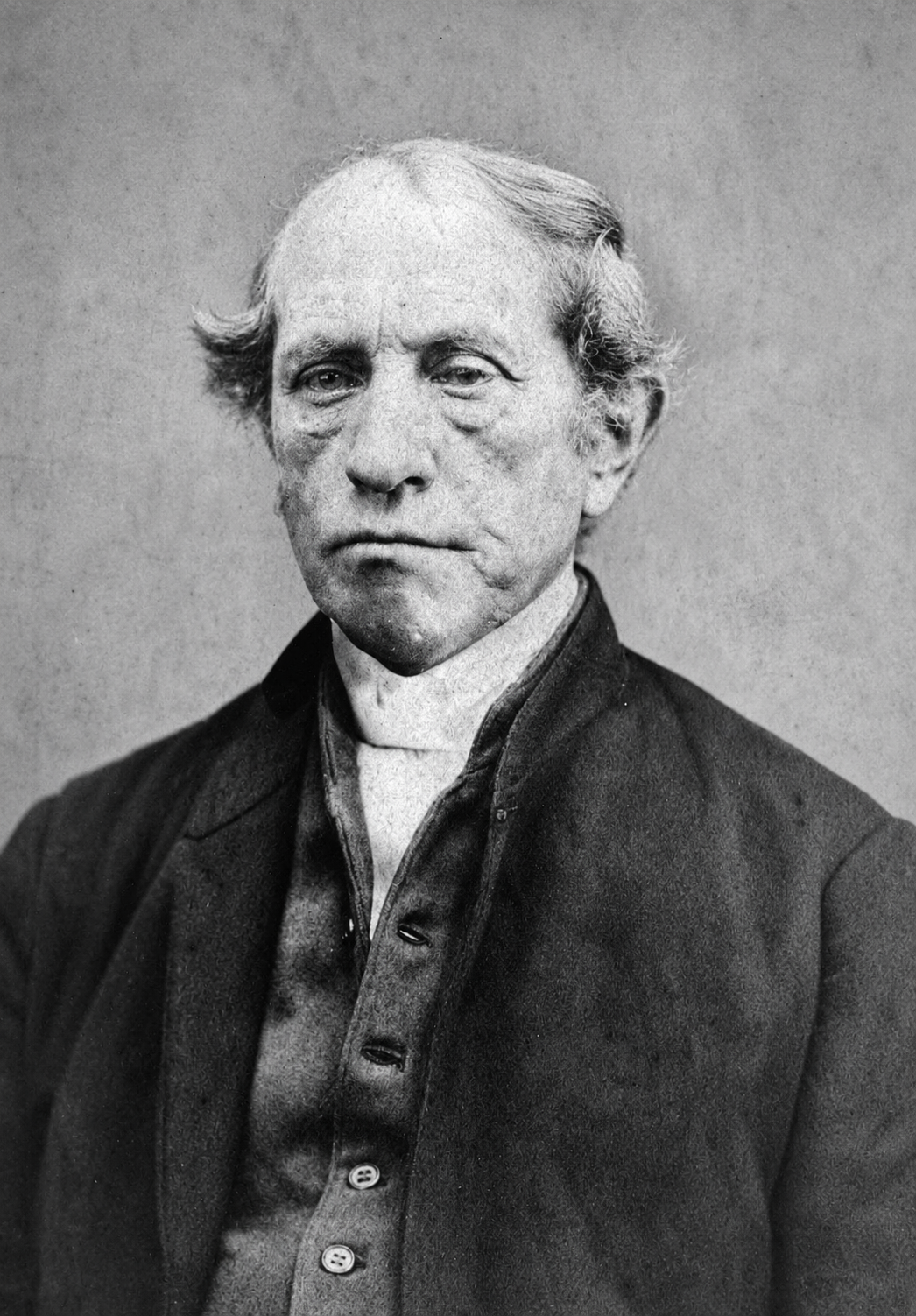
Christopher Allen, 1804-1876
The Story
Background
· Author’s Relationship to Subject
· Author’s Interest in Family History
· Author’s Reason for Focusing on this Subject
I grew up as the eldest of four boys. When each of us was born, our aunt, Beth Allen, pleaded with my mother to name us Christopher. My mother resisted the plea. When I was old enough to listen to Aunt Beth’s stories, she explained why she favored the name Christopher. Christoper was her great-grandfather, a man who died thirty years before Aunt Beth was born. But Aunt Beth was in possession of an important family document, a copy of a journal Christopher Allen kept on his visit from Ohio back to England, his homeland, in 1866. The document was actually a typed copy of his journal, prepared by someone in the family who had then passed it on. The document also included notes entered by Christopher’s daughter Mary at the time of his death.
I was always hungry for information about my family, and for most of our family lines little seemed to be known. What we did know was mostly not interesting to us boys, except for my grandfather’s uncle Lonesome Charley Reynolds, a scout for General Custer. Charley was our one claim to fame.
The best my dad could do when asked where our paternal line, the Reddings, originated, was to say that his father was born somewhere in Missouri, in a town with the word “Union” in it. I envied kids with grandparents and cousins nearby, with roots where they lived. We had moved away from our “roots” when I was nine, but Aunt Beth came with us from Kansas to Illinois. She was my source for family stories, and Christopher Allen’s journal was hers.
I came to understand that people’s ancestry could often be assumed through their surname, and my buddies bore names that were obviously Irish, German, Italian, or Polish. The surnames in my family were very bland by comparison, mostly English, and to young boys, the English were either snobby royalty or wimpy dudes. We watched a lot of Westerns. The Englishman was the greenhorn, fussy, immaculately attired, a bowler hat perched atop his head, hiding a Derringer in his Wellies. Not at all like Matt Dillon.
The combination of knowing very little about most of my family’s history and being blessed with glimpses to it through Aunt Beth’s stories and Christopher Allen’s journal, instilled in me an interest in genealogy, or more specifically family history. It became a lifelong passion.
Many years after beginning my search for information about Christopher Allen, a distant relative in Ohio gave me the following letter that Christopher wrote to his 19-year-old nephew Joseph Stratton in 1874. Written as a Quaker would write, Christopher told of his education as a boy in Manchester, England. Christopher, I realized now, was neither a snob nor a wimp.
My going to day school terminated when I was about ten years of age, could hardly read and write when I was put to work in a factory in Manchester and then for the first time I began to think for myself. I saw if I obtained no more learning I must eventually become a carter, laborer or common factory hand, but if I aimed at any higher position I must contend with many obstacles and pursue learning under no small difficulties. This I resolved to do, carrying my book in my bosom, looking occasionally at my task and working my examples on the carding machine.
For a short time I attended a night school but found after 13 hours of work each day I was in a poor condition of mind or body to study so as to make much advancement. Having access to a large library I read many useful books such as History, Biography, Science and Poetry. After being apprenticed to a trade about 15 years of age a number of poor boys like myself, who were struggling to improve ourselves, met a friend [Quaker] named Ralph Nicholson, who benevolently offered to teach a grammar class without charge to as many as would conform to his rules. This was a great lift to many of us and I never knew any person so conversant with Lindley Murray rules and notes as he was.
I had to go 2 miles to this class every week for near to two years and altho I was far from being perfect yet I shall ever gratefully remember the benefit received. At another time W.S. Buckingham, M.P., gave me a course of lectures on Palestine. We all wanted to have this privilege but poverty said "No." Two shillings and six pence for each lecture equaled half a week's wages and was a barrier to our going. After consideration we agreed that one of twelve was to attend, writing to the rest. I need not say this was a great means of improvement. There was an eminent writing master visited Manchester of whose lessons we all wished to profit, poverty again set our wits to work. We selected one to take the lessons and teach the remainder of the class.
This sketch will give thee some idea of my opportunities fifty years ago.
Christopher Allen was my great-great grandfather, my mother’s great-grandfather. Here is his story and how I discovered it.
Subject’s Life
· Summary of Subject’s Life
· Sources of Information
I was very fortunate to have an aunt, Beth Allen, who kept family history alive and had possession of a journal kept by her great-grandfather in 1866. Seldom, in my experience, does such a document exist, and even more rarely has it survived in the family for more than 100 years. Much of what I now know about Christopher Allen came not directly from his journal, but also from a fortuitous meeting with distant relatives in Ohio and my dogged pursuit of information via the internet and on my one visit to England.
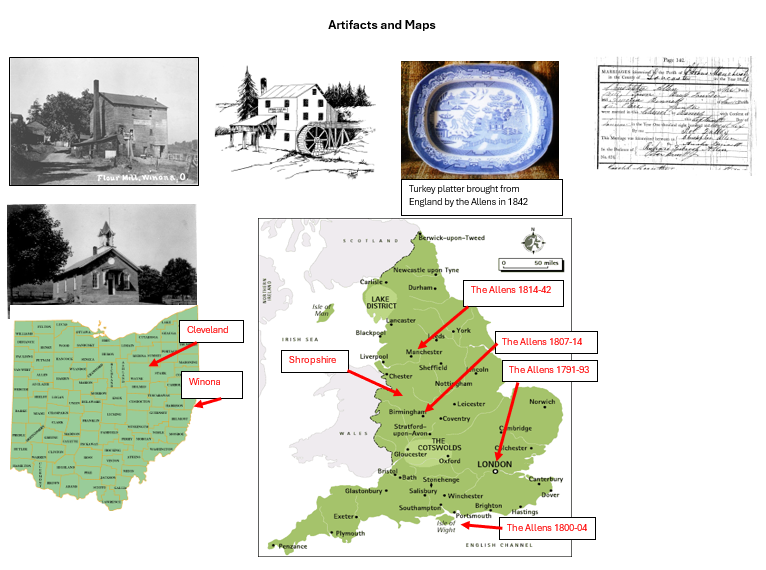
My cousin Patty Haas Brown (Christopher’s great-great granddaughter) held a treasure trove of artifacts from our mutual ancestors, the Allens. She passed on to Aunt Beth a postcard to my grandfather, Sam Allen, from Martha Stratton, a cousin in Ohio. The postcard showed an old mill which Christopher Allen once owned, and printed on the postcard were the words, “Flour Mill, Winona, O.,” giving us an exact location of the Ohio origins of the Allens. Prior to that, I knew only that the Allens were Quakers from Ohio, a fact known primarily because Aunt Beth remembered a visit to Valley Falls, Kansas, by Quaker cousins from Ohio when she was a young girl. We had the Ohio references in Christopher’s diary, but no exact location.
In May of 1993, my mother (Margie Jean Allen Redding) and I drove from Illinois to Cleveland, Ohio, to visit my brother Rodney and his wife, Meredith. Rod was a pilot with Continental Airlines, living in Cleveland. One day Rod and I decided to take a drive to Winona, some 90 miles southeast of Cleveland, to see if we could unearth any evidence of the Allen family’s origins.
We arrived first in Salem, Ohio, a larger community near Winona, where we dug into genealogical records at the public library. We found that a man named Stratton was a teacher at the junior high school and was somehow connected with the Martha Stratton who had written the postcard nearly a hundred years earlier. We went to the junior high school, found Mr. Stratton, and learned from him that we should proceed to Winona.
In Winona we inquired first at a lovely new Quaker church. The church secretary explained that there were two Quaker groups in Winona, and the Allens, she believed, were connected with the other congregation, a more traditional one. She thought a man by the name of Gamble knew a great deal of early Winona history and directed us to his house. We found Mr. Gamble at home, but when we said we were interested in the Allen family, he pointed us toward his cousin, Albert Gamble, who lived in the country outside Winona.
Rod and I drove to Albert’s home, where we were warmly welcomed by 86-year-old Albert and his wife Ethel. Chatting with them, we learned that Albert’s grandmother, Amelia Whinnery, was Christopher Allen’s daughter. Albert showed us a round, steel stencil, perhaps 30 inches in diameter that said, “Albion Mill” across the top and “S. Allen” across the bottom. Albert explained that Christopher Allen had owned the local grist mill for a few years in the 1850s and his sons, including Sam, had operated the mill. The stencil was used to paint the mill’s imprint on barrels and sacks. The mill, he said, was still standing.
From Albert’s house, Rod and I drove back into Winona and located the small, traditional Quaker meeting house where Albert and Ethel still attended. We found the mill. We found the rolling countryside at the edge of town where Christopher Allen once owned property.
In August of 1993, on a trip to celebrate their 50th anniversary, my parents Roy Lee and Margie Jean Allen Redding stopped at Winona and met Albert and Ethel. They corresponded with them thereafter, as did Aunt Beth.
My two sons, John and Tom, traveled with me to Washington, D.C., in 1994, and we stopped in Winona on the way home. Albert was hoeing his garden, head bedecked with a straw hat. John, Tom and I visited with Albert and Ethel and learned a little more about the Allen family.
Albert and I wrote to one another for several years. Along the way, Albert found a photo album that contained pictures of Christopher Allen and several other family members. This was a rare find, one that I could never have imagined a few years before.
As I began to put my research to words, Albert critiqued my writing and corrected me where I had gotten off track. His niece, Esther Ewing, wrote to me on several occasions and provided new information and anecdotes. Who could ever have imagined that I would have renewed familial ties with a branch of the Allen family separated from mine by my great-grandfather Richard’s move west a century and a half ago?
Christopher Allen was born on the Isle of Wight off the southern coast of England in 1804. By 1807, his family was living in Birmingham, where his brother was born. By 1814, the Allens were in Manchester, where Chrisopher, his mother, and his siblings were working long hours in the cotton mills. Through self-education, Christopher earned an apprenticeship and became a brass founder. He married Amelia Bennett in 1826. To them eight children were born, some in England and some in America.
In 1842, Christopher, Amelia, with children Christopher, Jr., Samuel, Richard, Amelia, and Elizabeth, sailed from Liverpool to New York aboard the Roscuis. They settled near Cleveland, Ohio, where Amelia’s brother Thomas had previously settled. Three more children were born in Ohio—Ebenezer, Mary, and Rachel. Rachel died in infancy. Christopher established a brass foundry and, about 1850, became a farmer, purchasing a farm and grist mill near Winona, Ohio. Amelia died about 1851, just as Christopher was establishing himself as a farmer and mill owner. In 1853, Christopher remarried to the widow Abigail Stratton Reed, also a Quaker.
Christopher helped establish a public school in Winona. In 1866 he traveled to England and kept a journal. He and Abigail both died in Winona in 1876.
Family Roots
· Brief summary of previous generations and where they lived
· Include sources of information
I have learned much about Christopher Allen, but not so much about his ancestral family. After my 1999 trip to England, I connected online with a woman in England who would look up records. She found that Christopher was born on the Isle of Wight in 1804 and his parents, Richard and Martha (I knew their names from records in Manchester), were married in London in 1791. Wow! Not Manchester and not even the Isle of Wight. That led me to the birth of Richard and Martha’s daughter Mary, born in London in 1792, and daughter Jane born on the Isle of Wight in 1800.
The name Allen is very common in England, so sorting them out in the online records was always a challenge. The marriage record for Christopher’s parents, Richard and Martha, informed me that Martha’s maiden name was Fosbrook. With that information, it didn’t take long to find record of the 1807 birth in Birmingham of Richard Fosbrook Allen, son of Richard and Martha. Bingo. Christopher’s journal told of his life in Birmingham during the Napoleonic Wars, when Birmingham gunsmiths made rifles, the beginning of Birmingham’s famous arms industry.
With public records now online, I started putting pieces together. Christopher had a sister Mary, born in London in 1792, sister Martha, born on the Isle of Wight in 1801, sister Jane born on Isle of Wight in 1802, and brother Richard born in Birmingham in 1807.
Searching for more information on Jane Allen, I found that, in the 1861 census, she was living with her sister Mary in Stretford, Manchester, Lancashire. Mary, 68 years old in the census, reported that she was born at St. Giles, London. A search of baptism records found a Mary Allen, daughter of Richard and Martha, born May 14, 1792, and baptized June 10, 1792, at St. Marylebone, borough of Westminster, in London. St. Marylebone would be near St. Giles.
I now had Christopher, son of Richard and Martha, with a brother Richard (as per Christopher’s journal and Birmingham birth records), and sisters Mary, Martha, and Jane. Scanning back through Christopher’s journal, I realized that Christopher mentioned visiting his sister Elizabeth in Shropshire on his 1866 trip. Digging into English records, sure enough, there was Elizabeth Allen. The register of baptisms shows an Elizabeth Allen, daughter of Richard and Martha, born December 2, 1793, baptized December 26, 1793, at Percy Chapel, St. Pancras, another nearby London parish. Michael Sharpe, an England-based genealogist, discovered that a Sarah Allen, daughter of Richard and Martha, was baptized at Ribbesford, Worcestershire on May 13, 1810. I have found nothing more about Sarah, but Ribbesford is located between Birmingham and Manchester, so a possible stopping point in the Allens’ move between those cities.
Subject’s Early Years
· Parents, Location
· Include Sources of Information
Christopher Allen’s parents, Richard and Martha Fosbrook Allen, married in London in 1791 and were on the Isle of Wight by 1800. In 1807, they were in Birmingham, possibly in Ribbesford in 1810, and by 1814 in Manchester, where Richard died in 1832. Martha died in Hulme, a Manchester suburb, in 1843. I have found no explanation for their moves and proved nothing about their ancestry.
By 1814, according to Christopher’s journal, the Allens were living in Manchester, where Martha and the kids worked 13 hours a day in the cotton mills while Richard, a sometimes joiner (skilled carpenter), was struggling to overcome alcoholism. At some point, late in life, according to Christopher’s journal, Richard overcame his alcoholism, with the help of Methodists, and began attending church.
Subject’s Adult Life
· Locations Where Subject Lived and Died
· Marriages and Children
· Major Events
· Sources of Information
Christopher Allen married Amelia Bennett on January 16, 1826, at Manchester, St. Johns, Lancashire, a Church of England chapel that no longer stands but is marked by a monument.
Christopher established himself as a brass founder. About 1835, he became a Quaker. In 1842, Christopher and his family departed Manchester, which was in the throes of social and political upheaval. The Corn Laws that protected the agricultural interests of the aristocracy by laying heavy duties on imported grain, had the added effect of keeping food prices oppressively high for poor people in England.
In Cleveland, Ohio, Christopher first operated a brass foundry, but by 1850 he had changed occupations. In the census of that year, he was living in Brooklyn Township (Cleveland), Cuyahoga County, his occupation, a farmer; he was 48 and Amelia 45. Sons Samuel and Christopher, Jr. were no longer living at home. Richard, the oldest child at home, was now 15; Amelia was 12; Elizabeth 8; Ebenezer 6; Mary 4; and Rachel 8 months.
Sometime between 1850 and 1852, the Allen family moved to a farm near Hanoverton in Columbiana County, 100 miles southeast of Cleveland and only a few miles from Winona. They were members of the New Garden Quaker Meeting there and owned 160 acres where the northern finger of Lake Guilford now points toward the town of Winona. Sadly, Amelia died at this time (as did Rachel) and was buried at Sandy Spring cemetery (now obscure) near Hanoverton. Amelia was the mother of all of Christopher’s children.
In 1852, Christopher purchased a grist mill in Winona, Ohio, from David Whinnery (later the father-in-law of Christopher’s daughter Amelia). Christopher named the business Albion Mill, after his homeland. Christopher later sold the mill back to David Whinnery, and David’s son Nathan operated it for a while. Nathan later married Christopher’s daughter Amelia.
On December 28, 1853, Christopher married Abigail Stratton Reed, the daughter of Michael and Rhoda Stratton and the widow of Jonathan Reed (in Quaker records the name was Rood). A marriage certificate reveals that the marriage was witnessed by Christopher’s daughter Amelia, his sons—Samuel and Christopher, Jr.—and Samuel’s wife Margaret Allen.
In 1854, his mother dead and his father remarried, nineteen-year-old Richard Allen (Christopher’s son and my great-grandfather) set out for Iowa, where he stayed for two years before going to Kansas. It is possible that his brother Christopher, Jr., also headed for Iowa about this time, as we find him there in the 1870 census. Sisters Amelia and Elizabeth married local boys and stayed in Ohio. Years later Mary married S. A. Stevenson and moved to Kansas.
In the 1860 Census in Hanover Township, Columbiana County, Ohio, Christopher Allen was 56, a farmer, born in England, real estate valued at $2,400; with Abigail, 53, born in 1807; Richard, 23, farmer, born in England; Amelia, 21, teacher in common school, born in England; Elizabeth B., 18, born in England; Ebenezer, 17, born in Ohio; Mary, 14, born in Ohio. Enumerated June 28, 1860. This is an interesting census record, because Richard was married in Kansas in August of 1860 and had previously been in Iowa.
[Note: At this time, John Brown was recruiting young Quaker men to go to Kansas to vote for “free soil” and fight slavery. Quakers were torn between their pacificism and hatred of slavery. Quakers Edwin (born,1835) and Barclay Coppock (born,1839) were born in Salem, Ohio (near Winona), a center of abolitionism where such notables as William Lloyd Garrison, Susan B. Anthony, Horace Mann, and Ralph Waldo Emerson spoke at the meeting hall to anti-slavery crowds. Edwin and Barclay moved to Springdale, Iowa, with their family, met John Brown there in 1857-58, and were with Brown at Harper’s Ferry on October 16, 1859. They were hanged for their raid on Harper’s Ferry. Christopher Allen’s son Richard was in Springdale, Iowa, from 1854-1856, before moving to Kansas where he left the Quakers, was baptized into the Christian church in 1859, married in 1860, and enlisted in the Union Army in 1862.]
Christopher Allen returned to England for a visit in 1866. While there, he published poems in the Manchester newspaper. In the 1870 census, Christopher was in Butler Township (Winona), Columbiana County, a retired farmer, living with wife Abigail and daughter Mary. Christopher and Abigail both died in the same year, 1876. Christopher is buried in a cemetery behind the Winona Meeting House. Abigail is also buried there with her death date recorded as December 18, 1876.
Reflections on the Subject’s Life
· Summary of Major Events
· Author’s Impressions
· Subject’s Character
The 1969 Winona Centennial booklet includes a note by George Megrail, husband of Chrisopher’s granddaughter, that George presented at the 1932 Farmer’s Institute.
“Grandfather Christopher Allen was a genuine Englishman, who came to America in his early manhood and he and his family lived several years in Cleveland moving from there to a farm near Sandy Spring and later he and two of his sons bought the Winona Mill and settled in this neighborhood. He left some very worthwhile descendants; some of these still live here, others drifted away and became pioneers in Iowa and Kansas, and later in California. In 1920 a group of twenty-six were gathered together for a big family dinner at Valley Falls, Kansas. The men were blacksmiths and farmers, the girls were students and teachers.”
One man and his wife made the bold move of migrating from the chaos and poverty of Manchester, England, to the tranquil countryside of eastern Ohio. Christopher Allen overcame deep poverty, educated himself, learned a trade, crossed the sea, and, because of him, generations of his family have spread across America, making their own lives. With each new layer of information I uncovered about Christopher, my respect for him grew, as did my gratitude.
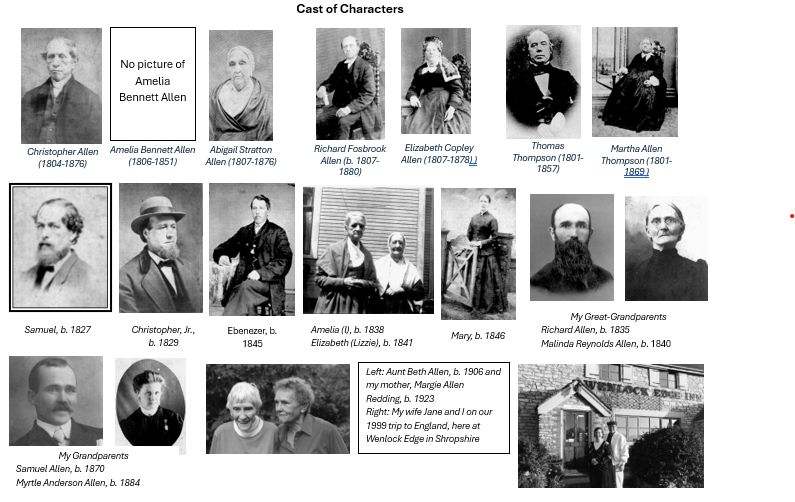
The Author
Name: Sam Redding
Place of Residence: McLean County, Illinois
Primary Sources: Subject's journal, family correspondence, Michael Sharpe (genealogist; www.writingthepast.co.uk), Ancestry.com
The Subject
Name of Subject at Birth: Christopher Allen
Birth Date: April 14, 1804
Birthplace: Newport, Isle of Wight, England
Name of Subject at Death: Christopher Allen
Death Date: 1876
Place of Death: Winona, Ohio
Spouse(s): Amelia Bennett and Abigail Stratton
Other Key Locations: Birmingham, England; Manchester, England; Cleveland, Ohio; Winona, Ohio
Most admirable qualities: Faith, Hard Work, Devotion to Family