
Article 04: Endurance
The Tenacity of Thomas Jefferson Gillihan
By Sam Redding
The Story
Background
Author’s Relationship to Subject
Author’s Interest in Family History
Author’s Reason for Focusing on this Subject
Thomas Jefferson Gillihan was my great-great grandfather, through the line of my paternal grandmother, Quintilla Gillihan Redding. I never knew my grandmother; she died in 1943, just as my dad was on his way to England aboard an LST to prepare for the D-Day invasion. I was born three years later. Since boyhood, my three brothers and I have heard stories of the Gillihans from our dad and uncle, but the only personal contact I had with the Gillihans was a family reunion sometime in the early 1950’s in Olathe or Lenexa, Kansas. I have only the vaguest of memories of that reunion. My particular interest in the Gillihans was sparked by family accounts that they were Irish, pioneers, some branches Cherokee, mostly farmers, and that my grandmother’s brothers were merchant marines. That was enough to pique my curiosity and send me seeking more information.
With a little digging, I was able to establish a correspondence (snail mail in those days) with Edwin Wayne Gillihan who lived in Johnson County, Kansas, the home county of our Gillihans. I learned that our Gillihan clan descended from William Gillihan, a Revolutionary War veteran, and his great-grandson, Thomas Jefferson Gillihan, a Civil War veteran. I found an online Gillihan genealogy group led by Nola Gillihan-Webster and began an email correspondence with her that lasted for several years. Those were the days before Google (launched in 1998) and Ancestry.com (1996). We relied on dedicated family members who searched census files stored on microfilm that was run through hand-wound projectors in our local libraries. We studied the old county history from the same libraries. We created family group sheets and mailed them to one another.
At some point, I connected with Joshua Young, a cousin I had never met. Josh was an Air Force Military Policeman in California at the time, but his home was near Johnson County. Josh had secured the military and pension records of Thomas Jefferson (T.J.) Gillihan, which he shared with me. Thus, I dug deeper into the life of T. J. Gillihan, discovering not only all that he endured but the several mysteries that surrounded his life, some of which I never solved.
My focus for this story is on T.J. Gillihan’s endurance through difficulties unimaginable to most of us living today. Much, but not all, of what he was required to endure resulted from the Civil War which disrupted his life, wounded him severely, left him nearly blind, and returned him home to provide for his wife and children.
Subject’s Life
Brief Summary of Subject’s Life
Sources of Information
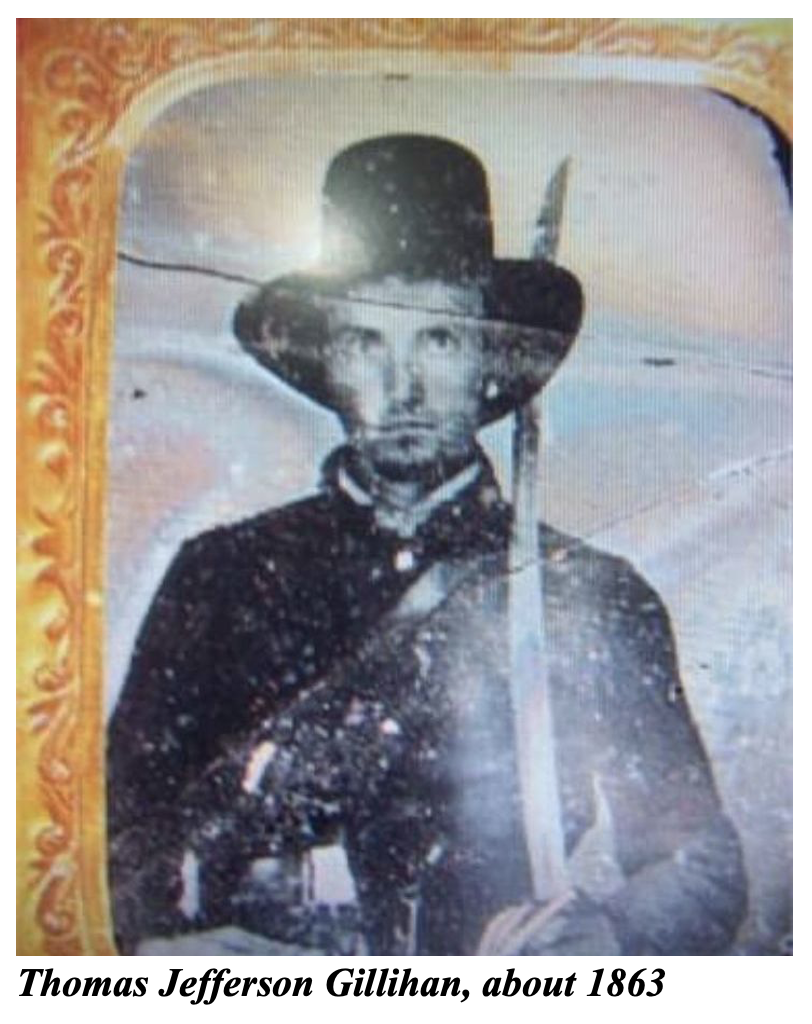
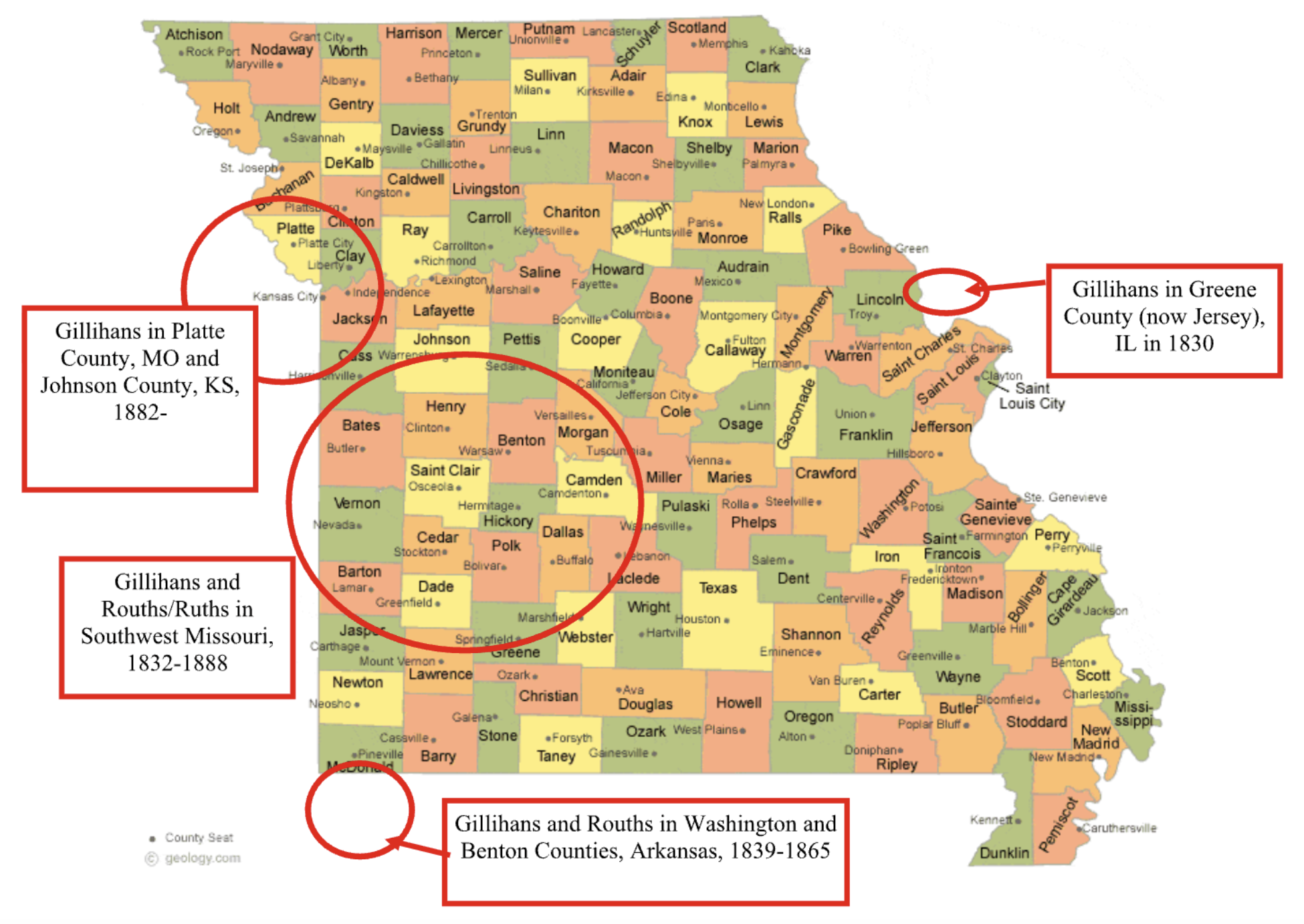
Thomas Jefferson (T.J.) Gillihan was born about 1832. The date varies in military and census records. He was probably born in Greene County (later Polk County), Missouri. He may have been born in Greene County (later Jersey County), Illinois, where his mother and grandparents lived in 1830 before moving to Missouri by 1833. T.J. was the son of J. Elizabeth Gillihan and an unknown father. According to one family story, Elizabeth’s betrothed was killed on a hunting trip. According to another family story, he returned to his home in Washington, DC, and didn’t come back. Whatever the truth, no record is left of Thomas Jefferson Gillihan’s father.
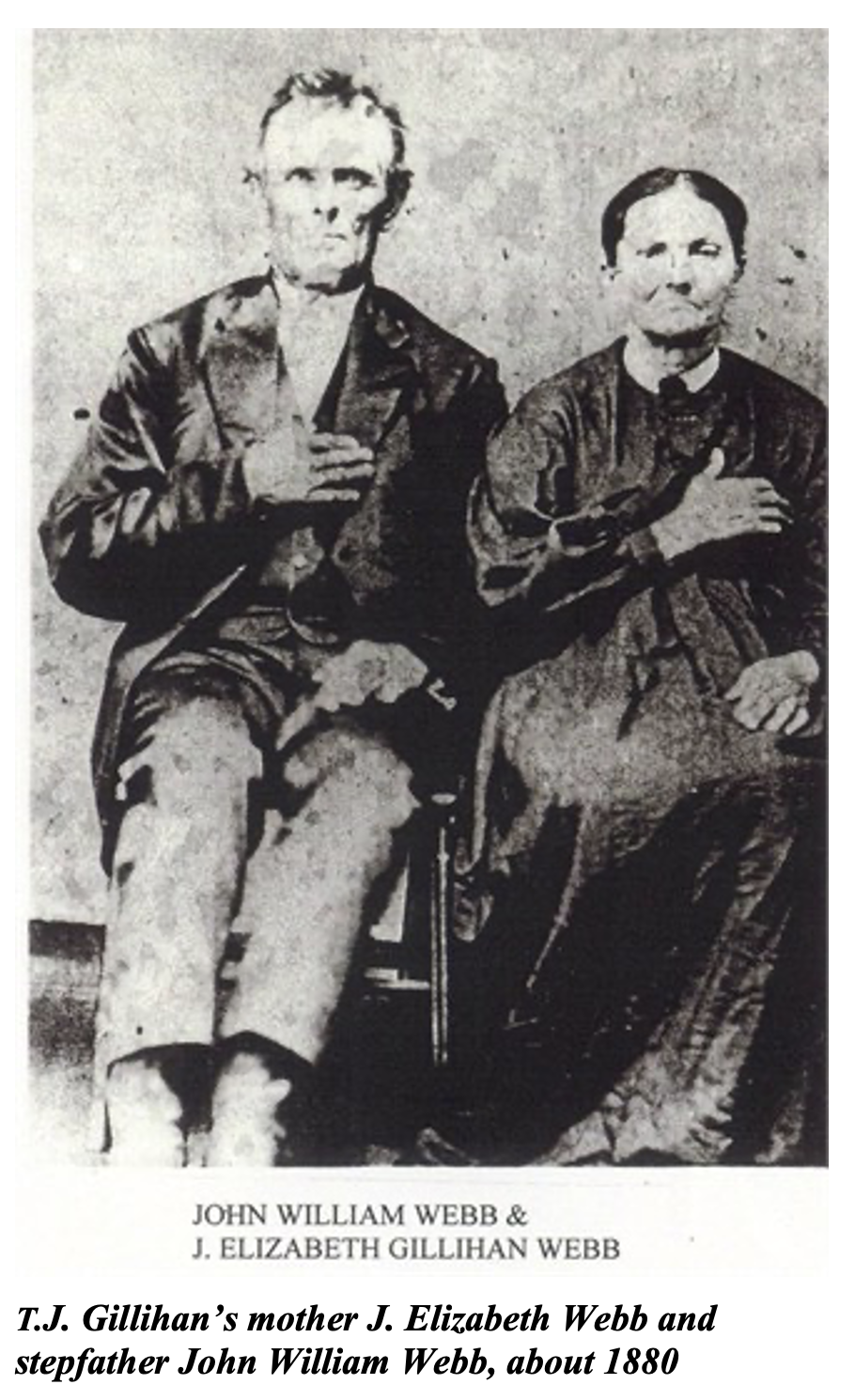
T.J. was raised by his grandparents, Thomas and Lucy, in Greene County, Missouri, in the area that became Polk County in 1837. In 1838, T.J.’s mother married John William Webb. In 1840, T.J.’s grandparents both died, and T.J. then lived with his mother and stepfather.
In 1850, T.J. Gillihan, 17 years old according to the census, was in the home of his mother and stepfather and their seven children in Polk County. On September 20, 1850, he married Susan T. Routh in Stockton, Cedar County, a county that bordered Polk County to its west. Susan, in the census that year, was 16 years old and living with her brother Jacob Ruth, 21, a farmer.
The Gillihans and some of the Routh family (sometimes spelled Ruth) came from Tennessee in the late 1820s to settle just north of St. Louis, on the Illinois side of the Mississippi River. While in Illinois, Reverend Isaac Routh (Susan’s uncle, born June 5, 1809, in Grainger County, Tennessee) married Frances Gillihan (daughter of Thomas and Lucy) on October 23, 1831. Their first child, Lucinda, was born in Illinois in 1832. In 1833, Isaac, a Methodist minister, was on the tax list in Greene County, Missouri, in an area that became part of Polk County in 1837.
In 1835, Rev. Isaac Routh’s brother Jacob died back in Grainger County, Tennessee. By this time, Isaac was already in Missouri and married to Frances Gillihan. Jacob was a widower when he died and left six children who were disbursed among his brothers to raise. Susan T. Routh is thought to be Jacob’s daughter and was living with Jacob’s known son, also named Jacob, in Missouri in 1850 when she married T.J. Gillihan.
On July 16, 1909, Jacob, 83, then living in Humansville, Missouri, signed an affidavit on behalf of Susan Gillihan, widow of Thomas J. Gillihan, stating that: “I am a brother of said Susan Ruth. I spell my name Routh, while my sister spells hers Ruth.”How did Susan, only two years old when her father died in Tennessee, get to Missouri? Her brothers Jacob and John were taken in by their uncle Stephen Routh when their father died. Jacob was then ten years old, and John was eight. Uncle Stephen proved to be a harsh taskmaster, according to an account passed down by Jacob’s son Edward. In the spring of 1837, the boys decided to run away. They set out on foot from Tennessee to find their Uncle Isaac, the Methodist minister, in Humansville, Polk County, Missouri. They had no idea that it was a 600-mile trek. That is one version of the story. On July 16, 1909, Jacob, 83, then living in Humansville, Missouri, signed an affidavit on behalf of Susan Gillihan, widow of Thomas J. Gillihan, stating that: “I am a brother of said Susan Ruth. I spell my name Routh, while my sister spells hers Ruth.”
Thus, in the 1850 census, John Routh (one of the runaways), his wife and two children, lived in Polk County, not far from his brother Francis (the brother living with Uncle Isaac when Jacob and John arrived in Missouri), Francis’s wife Elizabeth, and their two children. Not far from John and Francis was their brother Jacob (the other runaway), widowed the year before, now living with his sister Susan. T.J. Gillihan, at the time of the census, was living with his mother and stepfather and their seven children. Susan married T.J. Gillihan that September. Her brother, the widowed Jacob, married Eleanor Robinson in October in a wedding presided over by the Rev. Isaac Routh.
I found the story of the two runaway brothers here: The Routh Family—Ray Routh and his Ancestors: http://www.goodmanhistory.com/family-chronicles/routh-chronicles/routh-runaways.html
William Routh, also Susan’s brother, born in 1822 and the oldest of Jacob’s sons, was in Prairie Township, Washington County, Arkansas, in 1850 He would have been 13 when his father died. He may have been placed with his uncle Joseph, then living in Jefferson County, Tennessee. Joseph, in the 1840 census, was in Prairie Township, Washington County, Arkansas. Joseph’s son Benjamin was also in Prairie Township, and Benjamin’s eldest child was born there in 1839. Benjamin purchased 80 acres there in 1854 and served as a pastor in the Cumberland Presbyterian church.
The brother living with Uncle Isaac when Jacob and John arrived in Missouri was probably Francis who was 12 years old when their father died in 1835. In 1850, Francis was a farmer in Polk County, 25 years old and married with two small sons. How did Francis get to Missouri? Uncle Isaac was already there by 1835. A mystery.
The story of Jacob and John walking 600 miles to Missouri seemed possibly a tall tale. Then, at the depth of my questioning it, I found in a Google search an excerpt from the Washington County, Arkansas, Miscellaneous Record Book, 1841-1879. The court in Washington County had approved Benjamin Routh, guardian for Jacob, 13, and John, 15, sons of the deceased Jacob Routh, to assign the boys as apprentices to Benjamin’s father Joseph, the boys’ uncle.
Joseph and Benjamin Routh had arrived in Arkansas about 1837, the year John and Jacob were said to have walked across Arkansas on their way to Missouri. A likely scenario is that when Jacob Routh died in 1835, his brother Joseph took in William and moved with his own son Benjamin to Arkansas. The boys likely traveled with Joseph and Benjamin (and their brother William).
The Arkansas Connection
In 1850, the siblings Francis, John, Jacob, and Susan Routh were all in Polk County, Missouri. Francis had been in Arkansas prior to that. William was in Washington County, Arkansas.
About 1853, T.J. and Susan Gillihan and their infant son, along with Susan’s brother Jacob, moved to Washington County, Arkansas In the 1860 census there, T.J. was a farmer and shoemaker. He purchased 40 acres in Washington County, Arkansas on February 1, 1860. Jacob purchased 80 acres nearby in October of 1860. In 1860, Francis, Jacob, William, and Susan (then Gillihan) were in all in northwest Arkansas, as was Susan’s cousin Benjamin Ruth. A good life near kin seemed to be taking shape. Then came war.
The Civil War
On April 12, 1861, the Confederacy shelled Fort Sumter in South Carolina, and the Civil War began. In March of 1862, Union and Confederate troops fought the Battle of Pea Ridge, also known as the Battle of Elkhorn Tavern, on the Arkansas-Missouri border in Benton County Arkansas. The Union used the tavern as a hospital and convalescent facility thereafter, also recruiting and enlisting volunteers there. Thomas Jefferson Gillihan enlisted in the Union Army at Elkhorn Tavern on October 17, 1862. Back in Missouri, T.J.’s uncle Gideon entered service in the 44 th Regiment of the Missouri Infantry for the Union.
The accounts of T.J.’s Civil War experience are drawn from his military record and his pension applications. In late November or early December of 1862, Thomas was on a reconnaissance when he was wounded by a bullet in the left leg. The bullet was still in his leg when he died. In the Battle of Prairie Grove on December 7, 1862, a bullet went through Thomas’s right hand. After the battle, he recruited a company and then fell sick. He took a fever in March of 1863, due to infection in the wounded hand. He recovered and was back in service until falling from a horse on a foraging trip early in 1864. While in the hospital on February 15, 1864, he stood in line to receive lineament, and the hospital steward standing at his side removed the cork from a bottle of ammonia, which exploded into Thomas’s face and eyes. Thomas was blinded in his right eye and his vision was impaired in his left eye. He was then detailed to be a gravedigger for the remainder of his service, honorably discharged in August of 1865.
Two months after his discharge, Thomas made a claim for a pension due to his injuries. In a later application to renew the pension, Thomas reported that on June 16, 1872, his right eye “bursted plumb out.”
In the 1880 census for Bates County, Missouri, Thomas Jefferson Gillihan, 48, was a farmer in Deep Water, Butler Township, with Susan and four children. James Gillihan, eldest son of T.J. and Susan, farmed nearby, as did their eldest daughter, Rebecca, now married to John Hoover. T.J.’s mother Elizabeth Webb, now 66, was also in Bates County in the household of her husband William, 66, farmer.
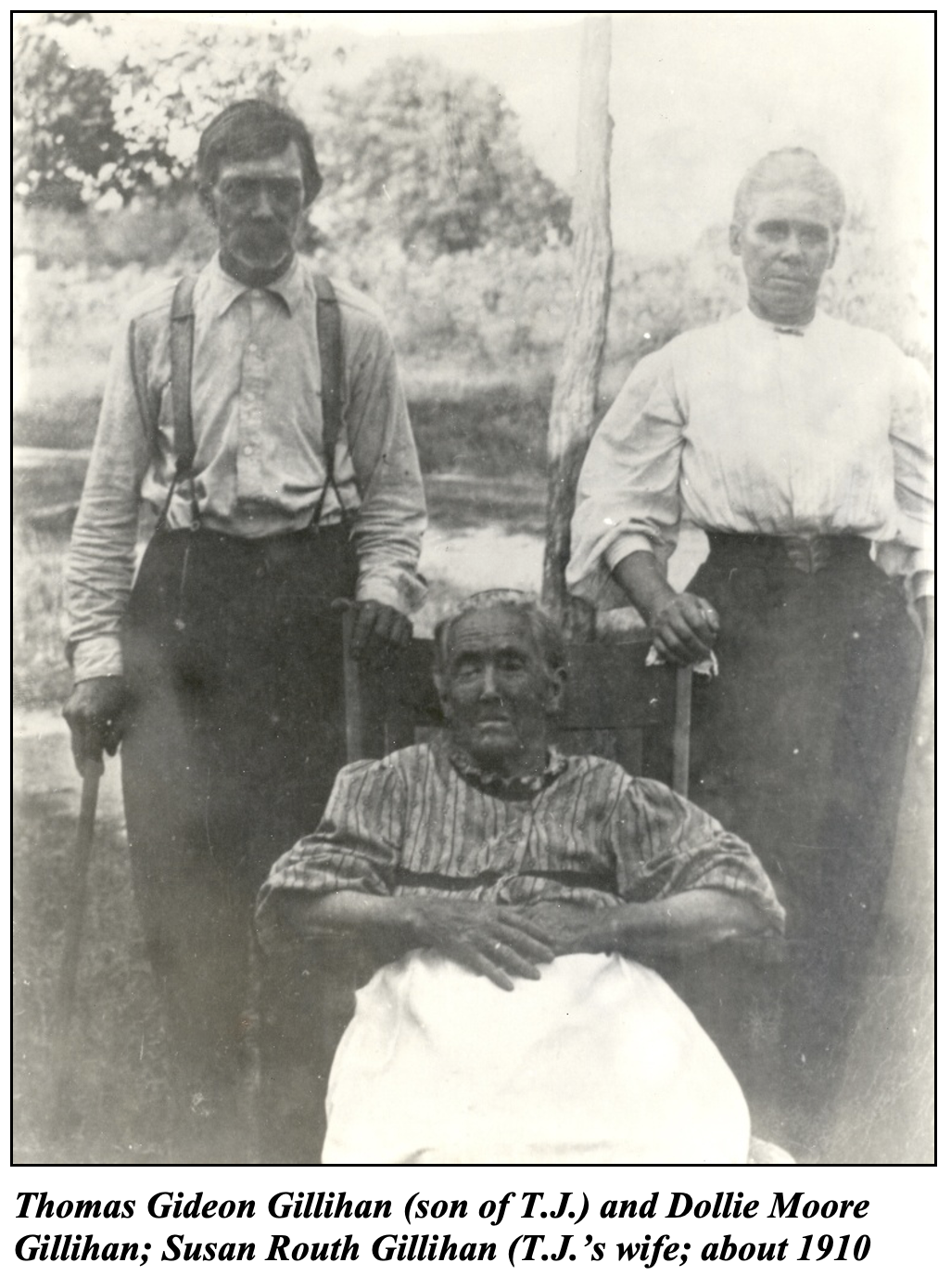
Missing from the 1880 census was T.J. and Susan’s son Thomas Gideon (Gid) who married Dollie Ann Moore on August 13, 1880. In the census earlier that year Dollie was living with her parents Lynch and Rebecca Moore, in Jackson County, Missouri. Lynch and Rebecca came to Missouri in 1853 from Kentucky, settling in Platte County. On January 12, 1887, Lynch was killed when a tree fell on him while working to clear timber for the railroad. Rebecca moved to Johnson County, Kansas, across the state line to live with her son William Richard “Dick” Moore. Thomas Gideon and Dollie Gillihan went to Kansas at the same time, and T.J. and Susan came not long after.
In the 1900 census, thirty-nine Gillihans lived in Olathe, Kansas: T.J., Susan, their children, and their children’s families. According to the census, Thomas J. Gillihan was 72, born in Missouri in March of 1828; Susan was 65, born in Tennessee in 1835, month not known. He was born in Missouri and his parents in Tennessee. She was born in Tennessee, her father in Tennessee, and her mother in Ireland. They could both read; he could write, but she could not. She was the mother of 13 children, with 7 living. They had been married for 49 years.
Thomas Jefferson Gillhan died June 28, 1909, in Olathe, Kansas. His funeral was held in the First Baptist Church, and he was interred in the special Civil War circle of graves that surrounds a monument. Susan died on October 12, 1911, also in Olathe.
Focus of This Story
Tell Story’s Focus
I titled this profile “Endurance” because Thomas Jefferson Gillihan endured a string of obstacles, disappointments, and setbacks as he marched on to establish a substantial clan of descendants that fanned out from eastern Kansas. It’s easy to skip through the documented milestones of a life and miss the themes. I have provided the milestones above and now address the theme.
Thomas Jefferson Gillihan was never certain of the date or place of his birth, born to a young, unwed mother, taken in by his grandparents who died when he was about eight years old, shortly after his mother married. T.J. then lived with his mother and step-father and their rapidly expanding crop of children until, in 1850, at age 17, he married the 16-year-old orphaned Susan who had arrived in Missouri by an unknown route.
Three years into their marriage, T.J. and Susan and their baby son moved to Arkansas, near several of Susan’s kin. T.J. purchased a small acreage, farmed, and was a shoemaker. In 1863, he enlisted in the Union Army. In the war, he was twice wounded and then nearly blinded, serving as a gravedigger for the duration. After the war, the Gillihans moved back to Missouri and followed the movement of their grown children who helped care for them and their livestock. Susan gave birth to 13 children, of whom only seven were living in 1900. That same year, 39 Gillihans lived in Johnson County, Kansas, a clan that had survived and grown across the miles and the years, enduring great hardship. And because of their endurance, I am here, and their descendants of many varieties are spread across the country.
Author
Name: Sam Redding
Place of Residence: Towanda, McLean County, Illinois
Primary Sources: Family correspondence; Ancestry.com; county histories; military and pension documents
Subject
Name of Subject at Birth: Thomas Jefferson Gillihan
Birth Date: 1830
Birthplace: Greene County, Missouri
Name of Subject at Death: Thomas Jefferson Gillihan
Death Date: June 28, 1909
Place of Death: Olathe, Johnson County, Kansas
Spouse(s): Susan T. Routh
Other Key Locations: Polk County, Missouri
Washington County, Arkansas
Bates County, Missouri
Most admirable qualities: Resilience, Patriotism, Service, Devotion to Family