
Story 14: Ranger and Me
Memories of My Best Friend
By David Hawkinson
This Star Hitcher story is about a time and place familiar to many of us in America, and a boy finding freedom and identity with a special friend. Submit your story at StarHitchers.com. See Kathleen Hawkinson’s story: Weekends in Another Time.
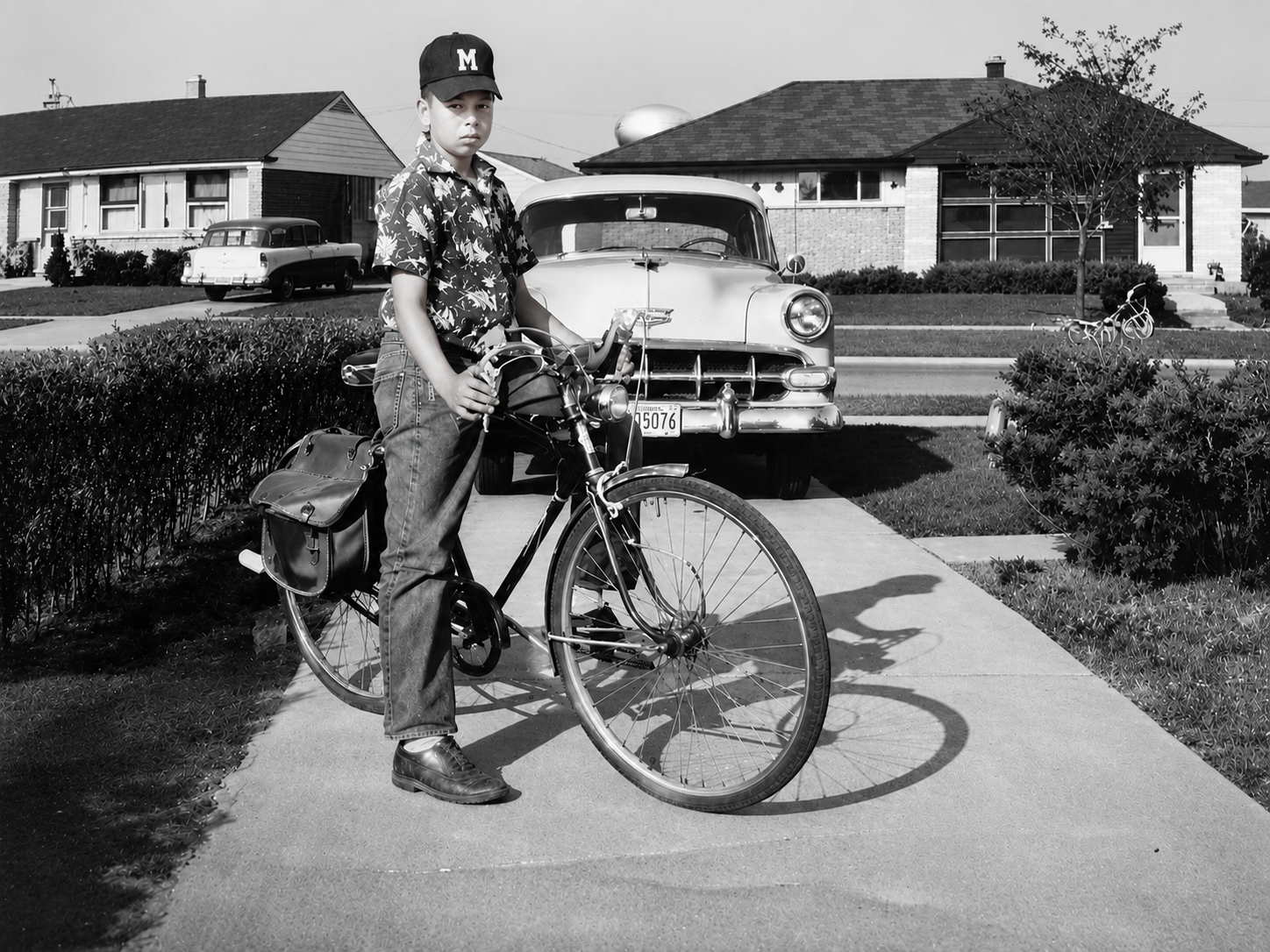
Ranger and me, and my dad’s ’54 Chevy
The Story
My suburban childhood was dense with people. It was easy to lose yourself in the crowd. Ranger, my bicycle, was what singled me out from the Baby Boomers that surrounded me.
Ranger was a Chicago-made, three-speed Schwinn World Traveler bicycle with bright stainless-steel fenders and the iconic “shark fin” front fender option. Ranger was my best friend.
Ranger enabled me to become familiar with our neighborhood in ways that other kids couldn't. I got around. I got to know people. Ranger was always ready for an adventure.
The Neighborhood
The neighborhood itself was an adventure because it was new. Millions of suburban homes were rising from former farm fields outside American cities to house returning veterans and their growing families. New schools soon followed. They saw us coming, and they prepared the way. It seemed as though the world had been built just for us.
Our family was part of that great migration. Dad had come home from the war and found work delivering fresh meat from Snuffy the butcher to Mom-and-Pop groceries and neighborhood meat markets throughout Chicago's ethnic communities.
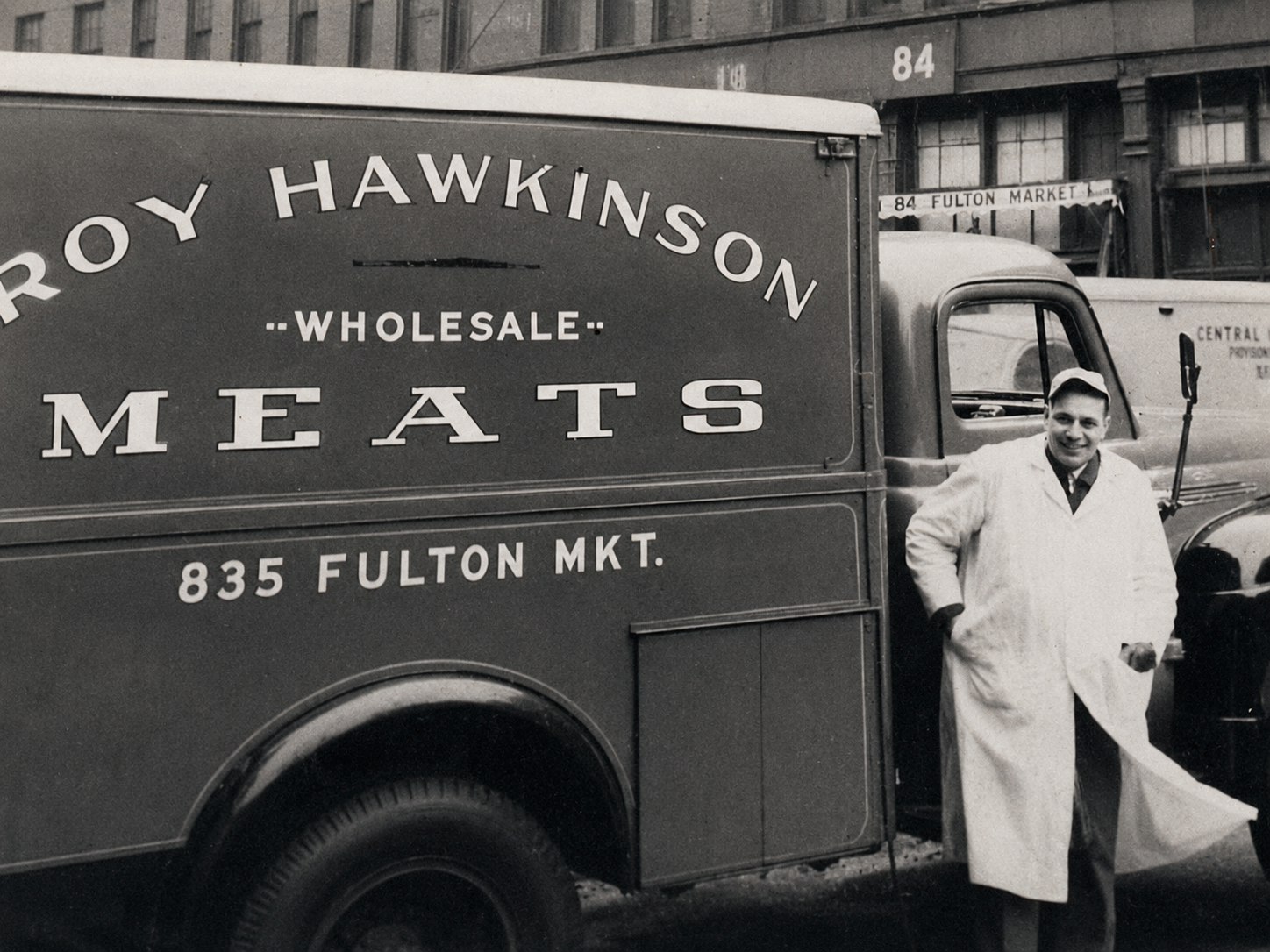
My dad, Ken Hawkinson, Chicago meat vendor with his brother Roy.
Mom did what all moms did, stayed at home and raised us kids. In fact, I had ten moms in the neighborhood and when one told me to do something, I did it. Moms were everywhere in those days.
Our garage had the only lighted basketball hoop in the neighborhood. Jack Hartman, the electrician, made it happen. On weekends, the dads had HORSE tournaments. The moms brought food and we all watched.
Ralph Tilden kept a perfectly arranged tool bench in his garage. He let me borrow whatever I needed because he knew I'd return it. I was one of the oldest kids in the neighborhood and had earned a reputation for being responsible. Ralph never reminded me to bring a tool back. He simply knew I would.
My dad supplied the meat for barbecues. His tool bench included the basics—hammer, screwdriver, wrench, and saw. Nothing like Ralph Tilden’s. But then, Ralph didn’t supply meat.
When Dad got home from peddling meat in city neighborhoods, he was reminded of why he worked so hard—the neighborhood. Moms, dads, and their Boomer kids, following familiar, comfortable routines.
Ranger and Me
As for me, I was a chubby, goofy 10-year-old kid in a world that seemed to swirl around me. Sometimes I felt lost within it. But not when I was with my best friend.
This snazzy ride sold for $90 back in the day. That’s about eleven-hundred bucks in today’s dollars. Dad fronted the purchase cash and taped a payback card on my bedroom wall. Every week I had to pony up a payment from my kid jobs—mowing grass, babysitting, and washing cars. I was responsible for keeping my bike in top shape and paying off the debt.
Ranger was sleek, fast, and took me on hundreds of adventures.
I had to trick out this beauty with loads of options that made it the envy of the neighborhood and schoolyard. Other kids had one-speed, coaster-brake rides with fat seats and big tires. Ranger boasted three speeds, slim wheels, hand brakes, and a nasty English racer seat that was not very comfortable.
My bike sported mudflaps, dual mirrors, a speedometer, saddle bags, a generator, and a two-beam headlight with flashing turn signals. Ranger was well equipped and never let me down.
Like most kids, I put playing cards and balloons on the fender braces, held fast by clothes pins. They rattled through the spokes when the wheels turned. Ranger sounded like a speeding motorcycle.
I imagined myself a ten-year-old championship dirt-track racer until the cards slipped off or the balloon popped. Those few minutes were pure kid bliss.
Trusted
Mel’s Milk Store sold milk, bread, candy, lunchmeat, and cigarettes. My dad stopped there a lot, and sometimes I went with him. One day Dad asked Mel if he could send me for cigarettes. Mel said sure, but he needed it in writing.
Dad gave me a permission note to buy cigarettes from Mel. Dad smoked two packs of Chesterfields each day and Mom a pack of Viceroys.
Mel was a smoker himself, always puffing away behind the cash register. He was a pretty casual guy, except for the deal about having a note. Mel was tall with dark hair and a pasty complexion. He wore an apron and puttered around the tiny store. He was always there.
I was very proud that my folks gave Mel a permission note so that their 10-year-old son could buy cigarettes upon request. The deal was that Dad gave me one dollar and I returned with two packs of Chesterfields and one pack of Viceroys at twenty-five cents a pack. The remaining quarter was my “tip” for candy or lunchmeat.
Neighborhood Hero
Ranger, with the three-speed hub, allowed me to be the reigning bicycle race champion for the course around the block. Also, I held the 3-to-5 lap title around the cul-de-sac’s closed circuit for years.
No one could touch Ranger and me for speed and endurance. Together we were always the team to beat.
I was pretty much a hero to the kids in the neighborhood. But one thing annoyed me, my little sister. Cher did not understand Ranger. In fact she didn’t understand bikes. She talked to her little bike like it was a horse. She made a tail out of yarn and attached it to the red reflector on the back fender. She thought her bike was a horse. I thought Ranger was a race car.
I kept Ranger’s parts oiled and tires filled. I polished Ranger. I took care of Ranger, but I found Ranger much more fun than a puppy. I could love my bike and not have to feed it or clean up after it.
Ranger took me to school, jobs, errands for neighbors, the swimming pool, and Cub and Boy Scouts in downtown Elmhurst. I stopped by Woolworth’s, bought a root beer, and, of course, made many trips to Mel’s for cigs and lunchmeat.
I felt pure freedom and joy aboard Ranger. I felt privileged because I was a 10-year old kid who was allowed to go anywhere within a ten-square-mile area as long as I was home when the street lights came on. What other kids were allowed to do that? I was responsible.
I have had many bikes since Ranger but none that I loved as much. My two wheeled wonder bike allowed me to learn and discover in my young world. It pointed me in a very unique direction for my adult life.
So Long, My Friend
I retired Ranger when I was sixteen. Dad bought me a used, blue Ford Falcon with three on the tree. He stuck another payback debt card on my bedroom wall. I had a part-time job at a grocery store and was making big bucks, so payback was not a problem.
I traded two wheels for four, had a fun job, was going to high school, and finally landed Cathy, the girl who lived just eight houses down the street. I won Cathy’s attention by squealing my tires when I drove my Falcon by her house. Life was good.
Looking back, I realize Ranger was never just a bicycle. He carried me through a neighborhood where adults trusted children to grow into responsible people. My parents trusted me with freedom, my neighbors trusted me with errands and borrowed tools, and Ranger carried me from one lesson to the next.
I was a fortunate Boomer.
Threads to Follow
1. How did bicycles shape childhood in America?
For more than a century, bicycles have given young people their first real taste of independence. How did the role of the bicycle change from the 1930s through the Baby Boom years, and why has that experience become less common today?
2. Why was Schwinn synonymous with quality?
Schwinn bicycles were built in Chicago and became one of America's most recognizable brands. What made a Schwinn different from its competitors, and how did the company become such an important part of American childhood?
3. Why were children given so much freedom?
Many Baby Boomers remember spending entire days away from home, riding bicycles, exploring neighborhoods, building forts, and returning only when it was time for supper. Why did parents feel comfortable granting children so much independence, and what social changes have made that kind of childhood far less common today?
4. What made suburban childhood unique?
The neighborhoods built after World War II created a new kind of childhood—one filled with bicycles, sidewalks, vacant lots, and groups of neighborhood children. How did suburban design shape the daily lives of young Americans?
5. Why do ordinary possessions become lifelong memories?
Most people can remember an object—a bicycle, baseball glove, doll, or first car—that became part of who they were. Why do some possessions acquire such deep emotional meaning while others are quickly forgotten?
6. How did trust help build a neighborhood?
The story describes neighbors who loaned tools, watched over children, and trusted responsible young people. How did these informal networks of trust develop, and how have neighborhoods changed over the past half century?
Author
Name: David Hawkinson
Place of Residence: Springfield, Sangamon, Illinois
Primary Sources: Memories, interviews with family members, internet search
Subject
Place reported: Elmhurst, Illinois
Timespan: 19450-62
Most descriptive characteristics: Neighborly