
Story 15: Sawney Brown: Cherokee or Not?
How One Handwritten Date Cast New Light on an Old Legend
By Sam Redding
This Star Hitcher story is about the investigation of a common American legend about Native American ancestry and the discovery of the many people who migrated west in the 1830s. Submit your story at StarHitchers.com.
The Story
Years ago, I ran across Alexander “Sawney” Brown while researching my family’s migration from Tennessee to Southwest Missouri in the 1830s. He was not related to me, but he stuck in my mind because a controversy surrounded him.
Two stories were told about Brown: His family contended that he was a half-Cherokee son of a Scotsman and Naky Canoe. In this account, Naky was the daughter of a famous chief, Dragging Canoe. Alexander’s nickname “Sawney” was a common pet name for Scotsmen.
Good story, but when Alexander Brown’s grandchildren applied to the U. S. government for recognition as Cherokee, their claim was denied. The government concluded that Alexander was not, in fact, Cherokee.
Every family has a story that refuses to disappear. The legend of Sawney Brown was the legend for generations of his descendants.
Like many stories passed down through generations, this one was impossible to prove around the dinner table. Some accepted it without question. Others dismissed it as another example of the Cherokee ancestry that seems to appear in so many American family traditions.
Then an unexpected lead arrived. A descendant of Sawney Brown shared years of carefully documented research. It was immediately clear that this was no casual family history. The evidence was thorough, logical, and grounded in original records.
I dug in, reviewed my own records, and read closely the new information. I kept in mind a simple question.
Why had the government rejected the claims of Sawney Brown’s grandchildren?
That question led me into one of the most remarkable investigations I have ever undertaken, guided by the unnamed family historian who had tipped me off.
In 1902, Congress authorized a commission headed by Special Commissioner Guion Miller to determine who was entitled to share in funds arising from Cherokee treaties. Thousands of people applied for recognition as Eastern Cherokee. Among them were more than two hundred related to Alexander Brown.
Every one of those applications was rejected.
For more than a century, that decision has largely stood unquestioned.
Then a descendant of Sawney Brown carefully reviewed the Guion Miller applications, expecting to learn more about his ancestors. Instead, he found himself asking questions about the investigation itself. He carefully traced family relationships, compared testimony, and examined records that many researchers had never seen in digital form. One by one, the pieces began fitting together.
Then he encountered a single date that changed everything. I followed his lead.
According to the government's summary of Alexander Brown’s grandson Michael Fender's testimony, Alexander Brown left Tennessee in the fall of 1833 and settled in Missouri. That date became an important part of the government's reasoning. If Sawney Brown had already been living in Missouri by 1835, he could not have been associated with the Eastern Cherokee enrolled that year. The government's conclusion appeared straightforward.
Most researchers would probably have accepted the summary and moved on.
One descendant of Sawney Brown did not.
Instead of relying on the government's abstract, he went back to the original handwritten application.
The more he studied it, the less certain he became that it actually read 1833.
To his eye, and later to mine, it reads 1835.
At first glance, changing a three into a five seems insignificant. But history often turns on small details. If the correct date is 1835, the government's chronology begins to unravel. Alexander Brown could have remained in the Cherokee homeland during the period leading up to the Henderson Roll which recorded Cherokee prepared to move west in what became known as the Trail of Tears (1838-39). The family's migration west suddenly fits a very different historical timeline.
I returned to my own research on my family’s migrations, when they occurred and what paths they followed.
Could Sawney Brown’s family have left eastern Tennessee in the fall of 1835, spent the winter near St. Louis (as Michael Fender stated in his application), and reached what became Polk County, Missouri, in the spring of 1836?
The answer required understanding how ordinary families moved across the American frontier.
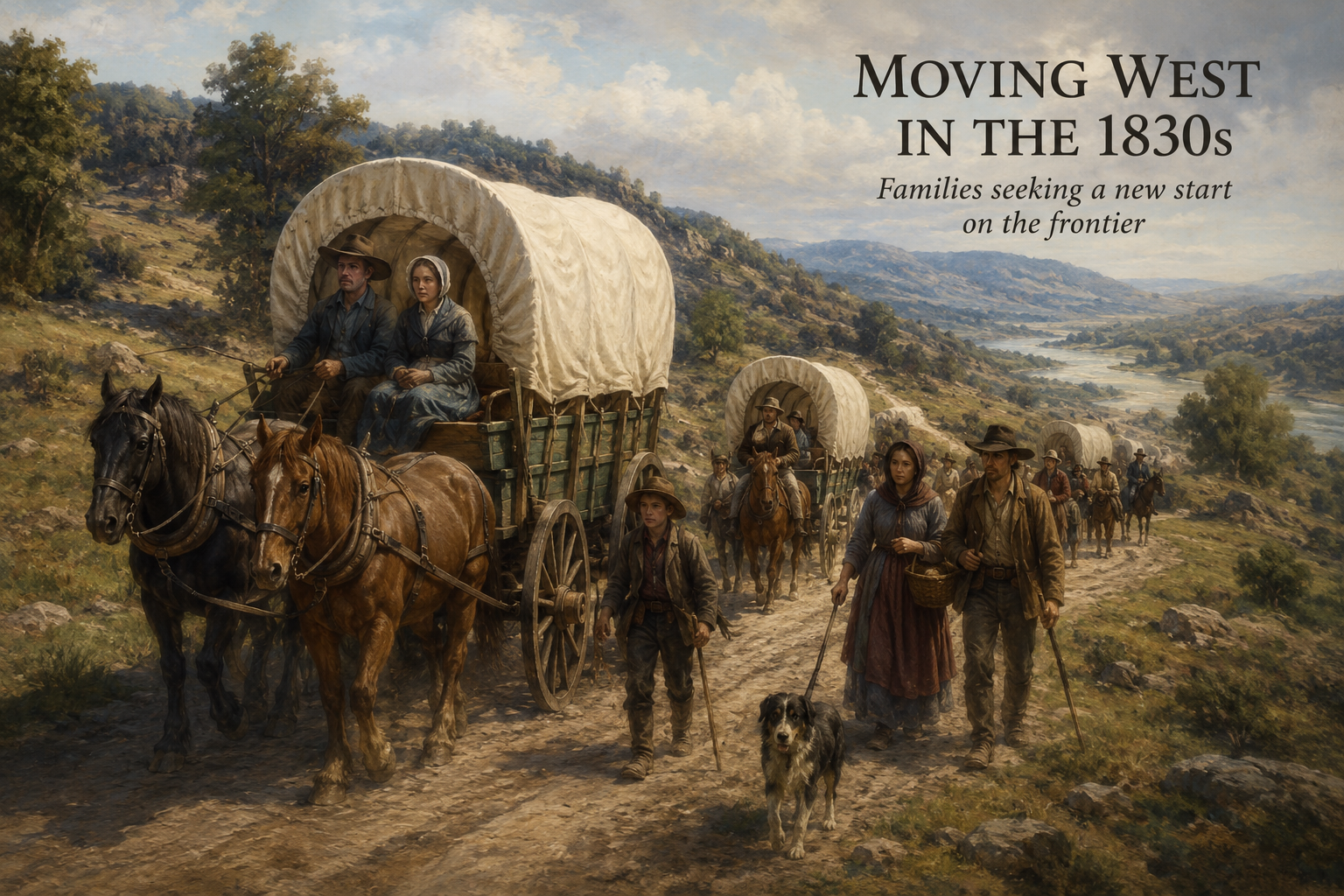
The distance from McMinn County, Tennessee, to St. Clair County, Illinois, is roughly four hundred miles. Today we think in terms of highways and hours. In 1835, families traveled by wagon, horseback, on foot, and whenever possible by river. A practical route might combine overland travel with steamboats or flatboats descending the Tennessee River to the Ohio, then the Mississippi before crossing into Illinois. Wagons carrying household goods and livestock could travel separately while part of the family continued by water.
It would not have been an easy journey.
Children tired easily, livestock required constant care, and bad weather could stop a wagon train for days. Families carried not only their possessions but their hopes for a new beginning.
Yet this was hardly unusual.
Throughout the 1830s, thousands of Americans left the older settlements of Tennessee, Kentucky, and Virginia in search of land farther west. Many paused for the winter in the vicinity of St. Louis before continuing into the newly opening lands of southwest Missouri. Rivers served as the great highways of the frontier, and communities near St. Louis became natural staging areas for migrants waiting for favorable weather before making the final leg of their journey.
Suddenly, Michael Fender's recollection made sense.
He remembered the family leaving Tennessee in the fall, spending the winter in Illinois near St. Louis, and arriving in what became Polk County on May 10, 1836. Far from sounding improbable, that sequence is exactly what one might expect of a frontier family traveling with wagons and livestock. It was a journey of not more than eight weeks, in all likelihood less.
The more I examined the migration itself, the more plausible the 1835 date became.
That discovery raised another question.
Who were all these people moving west together in 1835 and 1836?
We often think of the Cherokee only in connection with the Trail of Tears of 1838 and 1839. But thousands had already migrated west voluntarily before the forced removal. Some traveled as extended families. Others moved with neighbors or relatives whose lives crossed cultural boundaries. Alexander Brown's family included both Cherokee and white connections, making me wonder whether his journey west may have been part of a broader migration already underway rather than the later military removal remembered in our history books.
History rarely provides absolute certainty. Instead, it offers pieces that must be assembled with care.
The evidence does support one conclusion.
The government's decision depended upon a chronology that deserves another careful look. If the handwritten date has indeed been misread, then Alexander Brown's story deserves to be reconsidered alongside the historical evidence rather than dismissed because of a summary prepared more than a century ago.
One handwritten date did not prove Sawney Brown was Cherokee. It changed the questions historians should ask.
Sometimes the work of history is not to provide final answers, but to recognize when an old answer deserves another look.
In following Sawney Brown's trail, I found myself drawn into a much larger story. His story led me to a broad migration of families leaving eastern Tennessee for the lands opening in southern Illinois and southwest Missouri during the 1830s. Some were white. Some were Cherokee. Some belonged to both worlds. Their paths often crossed in ways the official records only hint at.
That larger migration now deserves a closer look. By following the roads, rivers, and settlements these families shared, we may better understand not only Alexander Brown's story, but the lives of hundreds of ordinary people whose experiences have largely disappeared from history.
By following those shared roads and rivers, we may discover that the larger story was never about one family alone, but about an overlooked migration that helped shape the American frontier.
Threads to Follow
Did your family arrive by the same road?
Thousands of families left Tennessee, Kentucky, Virginia, and the Carolinas during the 1830s. Can you trace the route your own ancestors followed west? Who traveled with them?Who traveled together?
We often think of pioneer families as moving alone. What evidence can you find that neighbors, relatives, or entire communities migrated together? What advantages would that have offered?What can one handwritten record change?
Look for an original document in your own family's history—a deed, pension file, census page, or court record. Does it tell a different story than the published summary or family tradition?What happened before the Trail of Tears?
Much attention is given to the forced removal of 1838–39. What can you learn about the voluntary Cherokee migrations that took place in the years before? How did those movements intersect with westward migration by white settlers?What stories remain hidden along familiar roads?
The routes from eastern Tennessee through southern Illinois and into southwest Missouri carried thousands of ordinary people whose stories have never been written. Is there a family, settlement, church, ferry, or crossroads along those routes that deserves to be remembered?
Author
Name: Sam Redding
Place of Residence: Towanda, McLean County, Illinois
Primary Sources: Research by a descendant; government records; histories of Cherokee and western migration
Subject
Title: Sawney Brown, Cherokee or Not
Subtitle: How One Handwritten Date Cast New Light on an Old Legend
Name of Subject at Birth: Alexander Brown
Birth Date: 1763
Birthplace: Virginia or Georgia
Name of Subject at Death: Alexander Brown
Death Date: 1838
Place of Death: Polk County, Missouri
Spouse(s): Violet Elizabeth Barton
Other Key Locations: Georgia, Tennessee, Illinois
Most admirable qualities: Determination; Resilience; Devotion to Family