
Story 21: The Wild Man and the Crockers
Awakening the Faith in the Great American Revival
By Sam Redding
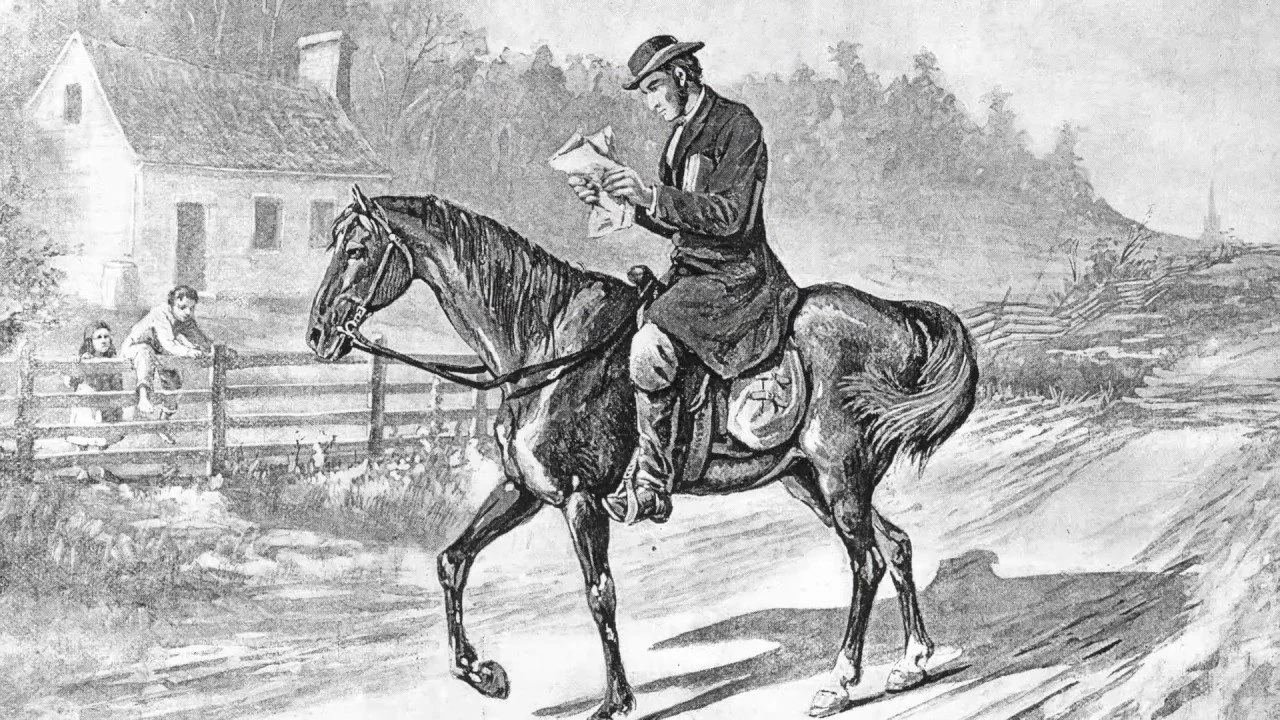
Image of a Methodist circuit rider in the nineteenth century.
This Star Hitchers story tells of two approaches to serving Christians in the American frontier during what became known as the Second Great Awakening. The author draws from two lines of family history for examples. Submit your story at StarHitchers.com
The Story
Through the dense Tennessee forest, one might have glimpsed a young man slumped over his plodding horse. He waved a Bible in the air. His other hand trembled on the saddle horn. He uttered an indistinct cry and then settled back as the horse walked on.
His behavior was disquieting, even pitiable. It was difficult to imagine that only a few years earlier he had been heir to his father's plantation in North Carolina. There he had embraced Methodism and believed himself called to the ministry.
Then something went terribly wrong.
In 1798, John Adam Granade moved west with his sister Elizabeth and her husband. They settled near Goose Creek in Sumner County, Tennessee. There J. B. McFerrin encountered him and later described a young man in the depths of spiritual despair.
Granade, McFerrin wrote, was “the most pitiable human being upon whom I ever rested my eyes.” His agony was so intense that he scarcely ate enough to sustain himself. He was not, McFerrin believed, deranged. He was desperate about his soul.
Then Granade attended a Presbyterian camp meeting at Desha's Creek.
Something happened there. He was moved powerfully enough to reclaim his Methodist calling. On October 1, 1801, John Adam Granade was admitted to the Western Conference at Ebenezer, Tennessee. During the next several years, he rode circuits through the vast country of Tennessee, Virginia, and Kentucky.
The Methodist circuit rider was one of the remarkable figures of the American frontier. Settlers were scattered across immense distances. There was rarely a church building in every community and seldom a resident minister. The circuit rider went to them, traveling from settlement to settlement, preaching wherever people gathered and returning as often as his circuit allowed.
Granade threw himself into the work.
Methodist histories credited him with abundant conversions, and McFerrin called him “one of the most extraordinary preachers of his day.” He also became known as the “Wild Man of Goose Creek.”
McFerrin remembered him as “the poet of the backwoods settlement, and a preacher of strange power, though called by many ‘the wild man.’”
The name apparently fit. Granade's preaching was accompanied by extraordinary physical agitation. He waved his arms and moved his body with an intensity that unsettled some who watched him. Yet there was no doubting the effect he had upon his listeners.
He rode, preached, and somehow, amid this frantic life, wrote hymns.
Eventually, he exhausted himself.
McFerrin recalled seeing Granade after he had returned to middle Tennessee “completely broken down.” His voice had become so weak that he could speak only in a low tone. At a camp meeting, McFerrin heard him deliver what he called a sermon “in a feeble way, as to manner,” but whose substance was “a stream of divinity.”
Something else had changed. Granade's wild physical movements were gone. His hands and feet were motionless. His sermon was, McFerrin wrote, “unattended by the slightest bodily agitation.”
The young preacher had spent himself.
Granade left the ministry and turned to the practice of medicine. He married Polly Wynne in 1805, and their son, John Adam Granade, Jr., was born the following year. John Adam Granade, Sr., died in December 1807. He was thirty-five years old.
Five months after his death, Polly gave birth to another son, Hervey Wynne Granade. Hervey would eventually marry Susan Green Loyd, the subject of another Star Hitchers story and my own great-great-grandmother.
Granade also left behind his hymns. In 1804 he published Pilgrim's Songster, a collection associated with the shape-note singing tradition. His songs became part of the musical world of the camp meetings that swept Kentucky and Tennessee.
It is remarkable to think of him writing them somewhere between settlements, while riding through the forests of the Upper South and preaching to scattered congregations. One hymn spoke of the “Sweet rivers of redeeming love.”
Perhaps, after all his struggles, he found some measure of that peace himself.
Granade's short life was part of a much larger eruption of religious energy at the beginning of the nineteenth century. Across the Upper South and the expanding frontier, camp meetings drew enormous crowds. Old denominations changed, and new ones grew rapidly.
Among the greatest beneficiaries were the Methodists and Baptists.
But they did not approach the frontier in quite the same way.
Planting Churches
The Granades belong to my mother's family. The Crockers belong to my father's.
Their stories offer two different views of religious life on the early American frontier. John Adam Granade rode hundreds of miles to reach scattered people. The Crockers, though they too moved west, built their ministries within communities.
They were farmer-preachers.
That was a familiar figure in the Baptist world of the backcountry South. A settlement might choose one of its own men to serve as minister. During the week he farmed. On Sunday he preached. He belonged to the community because he lived and worked in it.
And when the community moved west, sometimes the preacher moved with it.
That pattern can be seen in two generations of the Crocker family.
Jacob Crocker, Sr.
The family tradition began with Jacob Crocker, Sr., born about 1730 to a line of colonial Virginians. He served in the Revolutionary War with the 14th Virginia Regiment and became a Free Will Baptist.
After the war, he settled in Franklin County, North Carolina, and became a minister while continuing to earn his living as a farmer.
A footnote in George Washington Paschal's History of North Carolina Baptists reports that Jacob lived about five miles north of Louisburg and built a church near his home known as Crocker's Meeting House. He also participated in the organization of Wake Union Baptist Church.
More important to the Crocker family story, two of his sons followed him into the ministry.
Jacob Crocker, Sr., died in Franklin County in 1792, leaving his wife Mary and a large family. But the work continued. His sons preached and organized churches, even as they began to move west.
Jacob Crocker, Jr.
Jacob Crocker, Jr., born about 1772, entered the ministry in 1792. The first record of his ministry places him at Roger's Cross Roads Baptist Church in Wake County, where he served as a licentiate. He later became pastor of Sandy Creek Baptist Church.
Then the frontier pulled him south and west.
Jacob moved to the border country of North and South Carolina. At State Line Baptist Church, he was ordained and established himself as a farmer, eventually acquiring land there. But farming was only part of his life. He also served Baptist congregations, including El Bethel and Skull Shoals.
In 1824, the Crockers moved again, this time to Alabama.
Families from the Carolinas and Virginia were moving into Alabama, Mississippi, and the lands beyond. The Crockers were part of that migration. In Pickens County, Jacob established and became the first pastor of South Carolina Baptist Church, its name reflecting the number of former South Carolinians living in the area.
In 1829, he reorganized Big Creek Baptist Church near Yorkville, now Aliceville.
Then the frontier moved again. After the cession of Choctaw land in 1830, settlers continued west into Mississippi. Jacob Crocker followed and died in Lowndes County in 1833.
John Adam Granade had ridden to scattered settlements. Jacob Crocker, Jr., moved with the settlements themselves.
Thomas Crocker
Another of Jacob Crocker, Sr.'s sons carried the family tradition in North Carolina.
Thomas Crocker was born in 1786. Unlike his brother Jacob, Thomas remained in the old Carolina country. He became a Baptist minister and, in 1835, was called as the first pastor of Rolesville Baptist Church in Wake County.
A later North Carolina Baptist Almanac remembered him as an “eloquent, faithful and successful preacher of the gospel.” For more than thirty years, the account said, Thomas preached in Wake, Franklin, Warren, and Granville counties. “Hundreds of persons” were brought to Christ by his labors.
Thomas died on December 8, 1848, at the age of sixty-two.
Three Crockers—a father and two sons—spent much of their lives preaching, farming, organizing churches, and serving communities in the Carolinas and the expanding South.
Ways of Serving Souls
John Adam Granade and the Crockers were part of the same great religious transformation, but they represented different approaches to the frontier.
Granade was an itinerant. He moved across immense distances, preaching to families and settlements scattered through the wilderness. His ministry was intense, brief, and explosive. Along the way, he wrote hymns that outlived him.
The Crockers worked more slowly. They farmed, preached, organized congregations, and built churches. When their people moved west, they sometimes moved with them.
The distinction should not be pressed too far. Methodist and Baptist ministers did not live in entirely separate worlds, and both denominations used a variety of methods. Still, the contrast is useful.
The Methodists excelled at reaching people across great distances. Baptist congregations established local communities that could remain after an individual preacher was gone.
One carried religion across the frontier. The other helped root it there.
Both methods worked.
Perhaps the method itself was less important than the preacher.
An Uncomfortable Question
There is another question I find difficult to avoid when studying these distant relatives.
Where did they stand in relation to slavery?
The question produces different answers.
John Adam Granade had been heir to a North Carolina plantation whose labor was performed by enslaved people, though I have found no indication that Granade himself became a slaveholder.
Jacob Crocker, Sr., and Jacob Crocker, Jr., appear in the records principally as ministers and farmers. The evidence I have found portrays them as working farmers rather than plantation owners.
Thomas Crocker presents a different picture.
In the 1830 census for Franklin County, North Carolina, his household included eight free white persons and five enslaved people. In 1840, the last census before his death, his household included ten free white persons and one enslaved person.
The preacher who had spent decades bringing people to Christ was also a slaveholder.
The religious awakening that transformed the South reached both slaveholders and enslaved people. Methodist and Baptist ministers preached to both, and large numbers of African Americans embraced Christianity.
But the churches themselves were deeply entangled with slavery. In time, that entanglement contributed to bitter divisions, and both the Baptists and Methodists split over slavery in the decades before the Civil War.
The story of the Great Awakening and the religious frontier is therefore not simply a story of revival.
It contains faith and exhaustion, camp meetings and church building, conversion and migration, devotion and contradiction.
John Adam Granade rode through the forests waving his Bible, preaching with a power so intense that people called him the Wild Man of Goose Creek.
The Crockers farmed and preached. They organized churches and moved west with the people around them.
They served in different ways, but all were caught up in one of the great transformations of American religious life—and all, in their own ways, helped shape the world their descendants inherited.
Threads to Follow
Why did the Methodist circuit rider become such an effective figure on the American frontier?
How did Baptist and Methodist churches differ in the ways they expanded?
Why did so many families from the Carolinas move into Alabama and Mississippi during this period?
How did some ministers who preached Christian teachings justify slavery?
What was the impact of Christian ministers in the movement to abolish slavery?
What parts of American religious life can still be traced to the revivals and frontier churches of the early nineteenth century?
Sources
John B. McFerrin, History of Methodism in Tennessee, vol 1
John Adam Granade in hymntime.com
North American Baptist Almanac
Thomas Norman Crocker's Home Page, Genealogy.com, “Descendants of Anthony Crocker, Generation No. 4.”
Various books by Dr. Stephen Bradley containing extracts of early North Carolina records and other North Carolina source books.
The Union County, South Carolina, Heritage Book.
George Washington Paschal, History of North Carolina Baptists.
John Randolph Logan, Sketches, Historical and Biographical, of the Broad River and King's Mountain Baptist Associations.
Hosea Holcombe, A History of the Rise and Progress of the Baptists in Alabama.
Notes assembled by Paul M. Crocker, 2016.
John Adam Granade, Pilgrim's Song
Author
Name: Sam Redding
Place of Residence: Towanda, McLean County, Illinois
Primary Sources: Family histories and sources cited below
Subject
Title: The Wild Man and the Crockers
Subtitle: Awakening the Faith in the Great American Revival
Name of Subject at Birth: John Adam Granade, Jacob Crocker, Sr., Jacob Crocker, Jr., Thomas Crocker
Birth Date: Granade-1775, Jacob, Sr.-1730, Jacob, Jr.-1772, Thomas-1786
Birthplace: Jacob, Sr.-Virginia; others North Carolina
Name of Subject at Death: No change
Death Date: Granade-1807, Jacob, Sr.-1791, Jacob, Jr.-1833, Thomas-1848
Place of Death: Granade-Tennessee, Jacob, Sr.-North Carolina, Jacob, Jr.-Mississippi, Thomas-North Carolina
Spouse(s): Granade-Polly Wynne, Jacob, Sr.-Mary, Jacob, Jr.-Patience Higdon, Thomas-Mary Collins
Other Key Locations: None
Most admirable qualities: Determination; Resilience; Faith